Meal prep
Mediterranean Meal Prep, the Italian Way
How Italian kitchens actually cook ahead — components instead of five identical containers, the dishes that improve on day two, and how long each one really keeps.
The standard meal-prep picture is five identical containers in a row, photographed from above: chicken, broccoli, rice, chicken, broccoli, rice. It works for about nine days. By the second Wednesday the chicken is dry, the broccoli has gone to that particular olive colour, and you are ordering something.
Italian kitchens cook ahead more than American ones do, and almost none of it looks like that. What gets made on Sunday is not Thursday's dinner — it is the beginning of Thursday's dinner. The difference sounds like semantics and is not: it changes what you cook, how long it keeps, and whether you still want to eat it on day four.
Cook components, not meals
Four things are worth making in quantity on a weekend. None of them is a dish.
A pot of beans or lentils. Dried beans cooked in water with a bay leaf, a clove of garlic and nothing else, drained and kept in their own liquid. This is the single highest-leverage thing in the list: it becomes a soup, a salad, a side with olive oil and lemon, the body of a pasta, or — stewed fifteen minutes with garlic, sage and a spoonful of tomato — the bed under a sliced steak, which is the trick that lets a quarter-pound of beef feed a person properly. The beans are the part you prep; the steak takes eight minutes on the night. Our lentil soup is this idea taken to its conclusion — 447 calories, 22 g of protein and 12 g of fiber a bowl — and it keeps five days and freezes for three months without changing texture, because there is no pasta, rice or dairy in it to break down.
A tray of roasted vegetables. Whatever is cheap, cut large, tossed in oil and salt, roasted at 425°F (220°C) until the edges catch. Fennel, peppers, zucchini, squash, cauliflower, red onion. Cold they go into a grain salad; warm they go under a piece of fish; blitzed with a ladle of pasta water they are a sauce.
A soffritto. Onion, carrot and celery diced fine and stewed slowly in olive oil until sweet and collapsed — twenty-five minutes of doing almost nothing. Refrigerated it keeps a week, and frozen in an ice-cube tray it keeps three months. Every soup, stew and ragù on this site starts with it, and having it already made is the difference between a thirty-minute dinner and a seventy-minute one.
A tomato sauce. Canned tomatoes, garlic, olive oil, basil, forty minutes. It is the base of a pasta, of a parmigiana, of poached eggs, and of the braise in a tray of meatballs.
Notice what all four have in common: they are unfinished. Nothing is dressed, nothing has fresh herbs in it, nothing has been combined with something it will damage. That is why they keep.
The dishes that are actually better on day two
This is the part worth knowing, because it is not a general rule about Italian food — it is a specific, short list, and on it the whole week can be built.
| Dish | Why it improves | How long |
|---|---|---|
| Ribollita | The name is the instruction: ri-bollita, reboiled. The bread keeps breaking down into the broth and the whole thing goes from soup to something you eat with a fork | 4 days, better for the first two |
| Caponata | The vinegar keeps softening the eggplant and the agrodolce keeps merging | 5 days, better for the first three |
| Parmigiana | The layers set overnight, which is why a slice holds its shape on day two and collapses on day one | 4 days |
| Meatballs in sauce | The bread inside the meatball goes on absorbing sauce, so they sit in it rather than on it | 4 days |
| Minestrone, lentil soup, bean soups | The soffritto keeps dissolving into the broth | 5 days |
| Cabbage rolls | The half-cooked rice inside keeps drinking the tomato | 4 days |
| Frittata | It doesn't improve, but it is designed to be eaten cold, which is nearly as useful | 4 days |
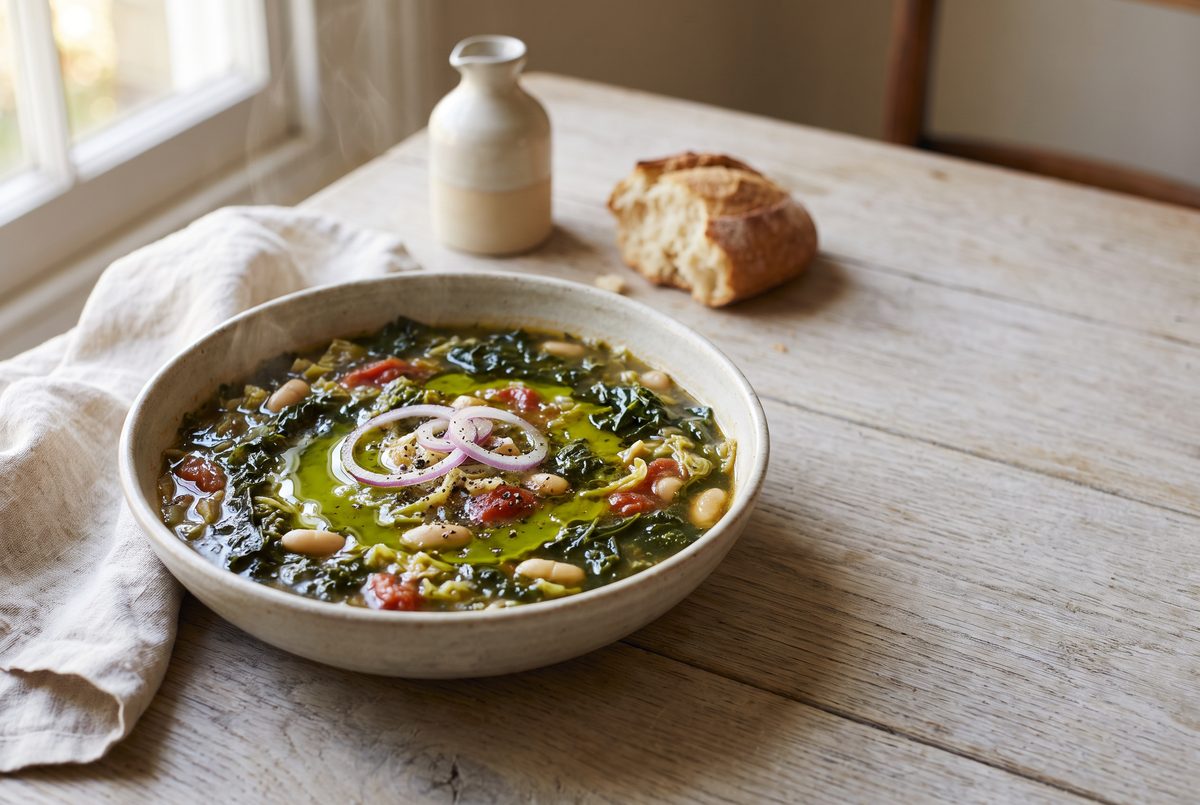
The pattern underneath the table is worth naming: these dishes all contain something absorbent sitting in something liquid — bread in broth, breadcrumb in sauce, rice in tomato, eggplant in vinegar. Time is an ingredient in them. The dishes that fail in the fridge are the ones where time is the enemy.
The ones never to prep
Equally short, and worth being strict about.
- Clam pasta and most seafood pasta. The pasta goes on absorbing until it is dry and clam meat reheated turns rubbery with no middle ground. Our spaghetti alle vongole page says so plainly — eat the leftovers cold the next day, almost as a seafood pasta salad, and never microwave them.
- Cacio e pepe, carbonara, anything emulsified. The sauce is pecorino and starch water held in suspension. It breaks on cooling and does not come back. What you can prepare weeks ahead is the shopping: a wedge of Pecorino Romano wrapped in parchment and then loosely in foil keeps two to three months in the fridge, and whole peppercorns hold their oils for about a year, so the only thing left to do on the night is boil pasta for 25 minutes.
- Risotto. Reheated risotto is a different dish — the starch retrogrades and broth never brings it back. Make it into arancini, or do what the recipe page suggests and press the cold risotto into a thin disk to fry crisp on both sides: risotto al salto is a second dinner, not a reheated first one.
- Anything crisp. A crust that took twenty minutes to build is gone in four hours in a sealed box.
There is one honourable exception to the seafood rule, and it is the reason this guide exists in the same week as the recipe: pasta con le sarde is traditionally eaten warm or at room temperature, and in Palermo the leftovers are eaten cold from the fridge the next day without apology. The sardines are already cooked and already preserved; the saffron and fennel read more clearly cool than hot. It keeps three days, and the toasted breadcrumbs go in a separate jar on the counter — refrigerate them and they are soft in an hour.
How long things really keep
The USDA's Food Safety and Inspection Service gives one number for cooked leftovers: 3 to 4 days at 40°F (4°C) or below. Our recipe pages sometimes say five, and the difference is worth explaining rather than hiding. Acid and salt both slow spoilage, so a minestrone, a lentil soup or a caponata genuinely holds longer than a tray of roast chicken. But the USDA number is the one that is always safe, it does not require you to judge anything, and if you are pregnant, elderly, immunocompromised or cooking for someone who is, use it: four days, then freeze.
Two things matter more than the number:
Cool it fast. The FDA Food Code asks commercial kitchens to take hot food from 135°F down to 70°F within two hours, and down to 41°F within six hours total. At home the practical version is: get it out of the deep pot. A gallon of soup left in its own pot on the stove is still warm at midnight. Divide it into shallow containers, leave them uncovered until they stop steaming, then lid and refrigerate within two hours of cooking.
Reheat properly. To steaming hot throughout — the USDA says 165°F (74°C) — not to lukewarm. Soups and stews go back on the stove over medium-low with a splash of water, because they all thicken in the fridge. The microwave is fine for a single portion of most things and wrong for three: bread soups (it heats unevenly and leaves cold pockets), baked eggplant (it turns to paste), and anything with egg.
The protein problem nobody mentions
Here is the failure mode of every meal-prep system, including this one. Vegetables and grains keep beautifully. Meat and fish keep less well and are more expensive. So the fridge quietly fills up with carbohydrate, the week's protein drifts down, and you end up hungrier than you were before you got organized.
Leidy and colleagues (2015, American Journal of Clinical Nutrition) summarize the case for protein in weight management: it is the macronutrient with the strongest effect on satiety and the one that best protects lean mass in a deficit, and the benefit comes from spreading it across meals rather than loading it all at dinner. Something in the region of 25–30 g per meal is the usual target.
Fix it at the component stage, not the plate stage. In practice that means one of these in the fridge every week:
- A pot of lentils or chickpeas — our lentil soup is 22 g a serving
- A tray of meatballs in sauce — 47 g a serving, and they freeze in their sauce almost perfectly
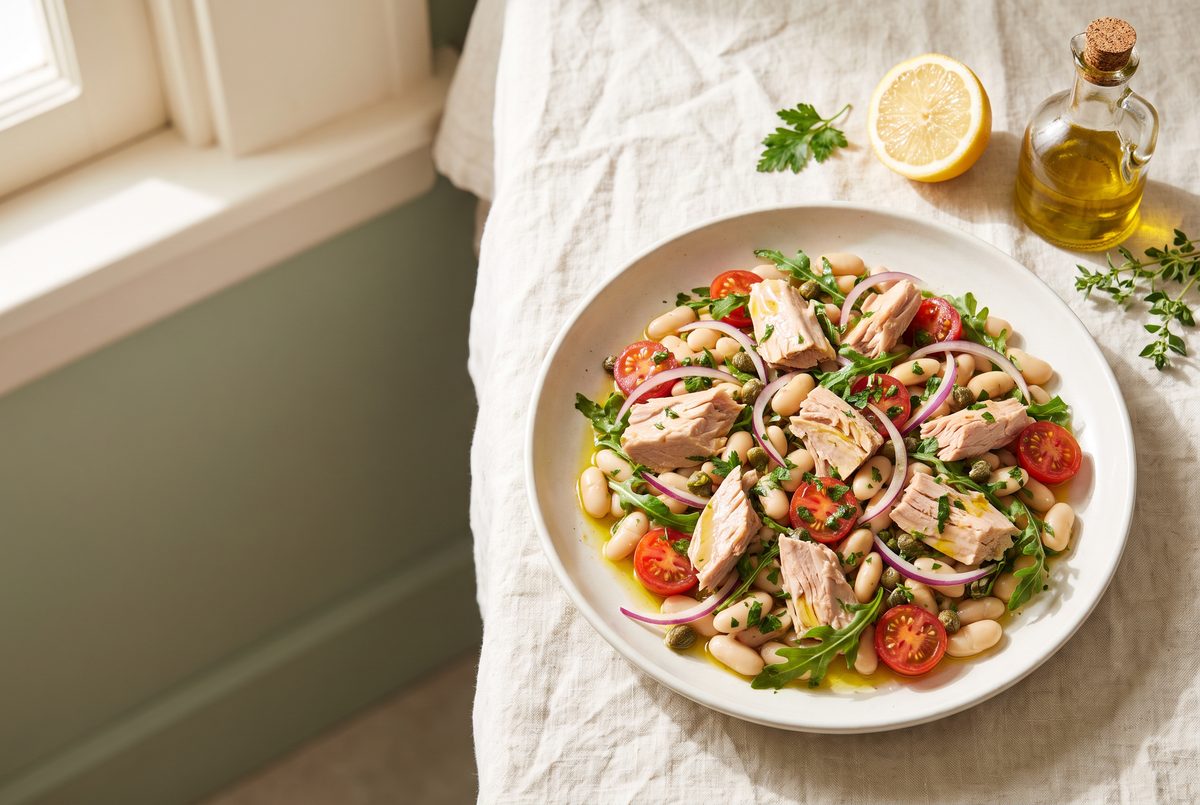
- Two cans of tuna and a can of cannellini — the Tuscan tuna and white bean salad is 40 g a serving and takes ten minutes with no cooking at all
- A roast chicken, or the cacciatore at 40 g a serving, which actually improves for four days
A real week, from ninety minutes on Sunday
Not five containers. Four bases and two finished dishes, which between them cover five dinners and three lunches.
What you make: a double batch of soffritto; a pot of lentils; a tray of roasted fennel, peppers and red onion; a tomato sauce; one caponata; one frittata.
- Monday — lentil soup, built in fifteen minutes from the lentils and half the soffritto. 447 calories, 22 g protein.
- Tuesday — pasta with the tomato sauce and a fried egg on top; the roasted vegetables alongside.
- Wednesday — frittata, cold, with caponata and bread. 390 calories a wedge, 24 g protein, and no cooking.
- Thursday — chicken thighs browned and finished in the rest of the tomato sauce with olives and capers: a cacciatore, 391 calories and 40 g of protein, twenty-five minutes because the sauce exists.
- Friday — a grain salad: farro, the last of the roasted vegetables, the last of the lentils, lemon and oil. Or, if the fish counter is good, pasta con le sarde, which is a forty-five-minute dish built almost entirely from tins.
Lunches: caponata on bread, leftover frittata, leftover lentil soup. The caponata is better on Wednesday than it was on Sunday.
Nothing in that week is eaten twice in the same form, and the total hands-on time after Sunday is about two hours for eight meals.
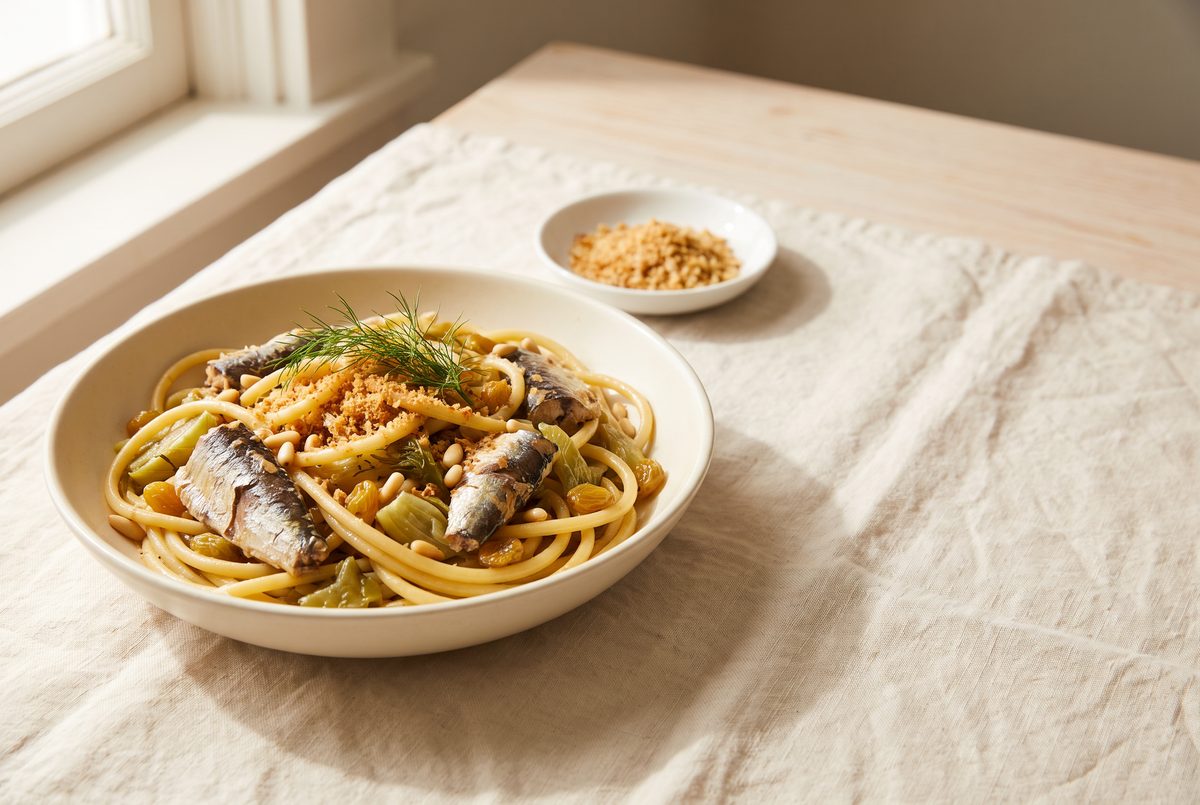
Pasta con le Sarde: Sicilian Bucatini with Sardines and Fennel
Pasta con le sarde is the signature pasta of Palermo: bucatini with sardines, fennel, saffron, raisins and pine nuts…
- 45 min
- 499 kcal
- 23 g protein
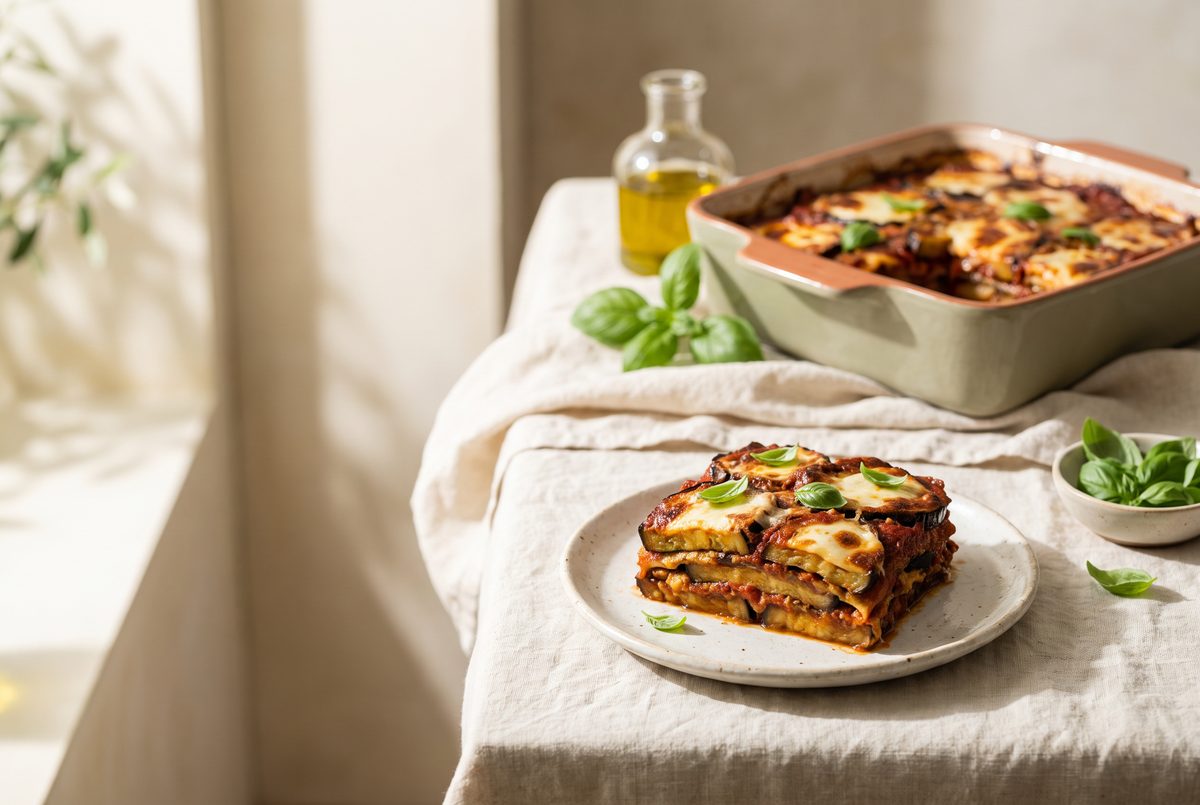
Baked Eggplant Parmesan, Roasted Not Fried
Eggplant parmesan becomes a weeknight dinner instead of a project when you roast the slices on sheet pans rather than…
- 1 hr 20 min
- 403 kcal
- 23 g protein
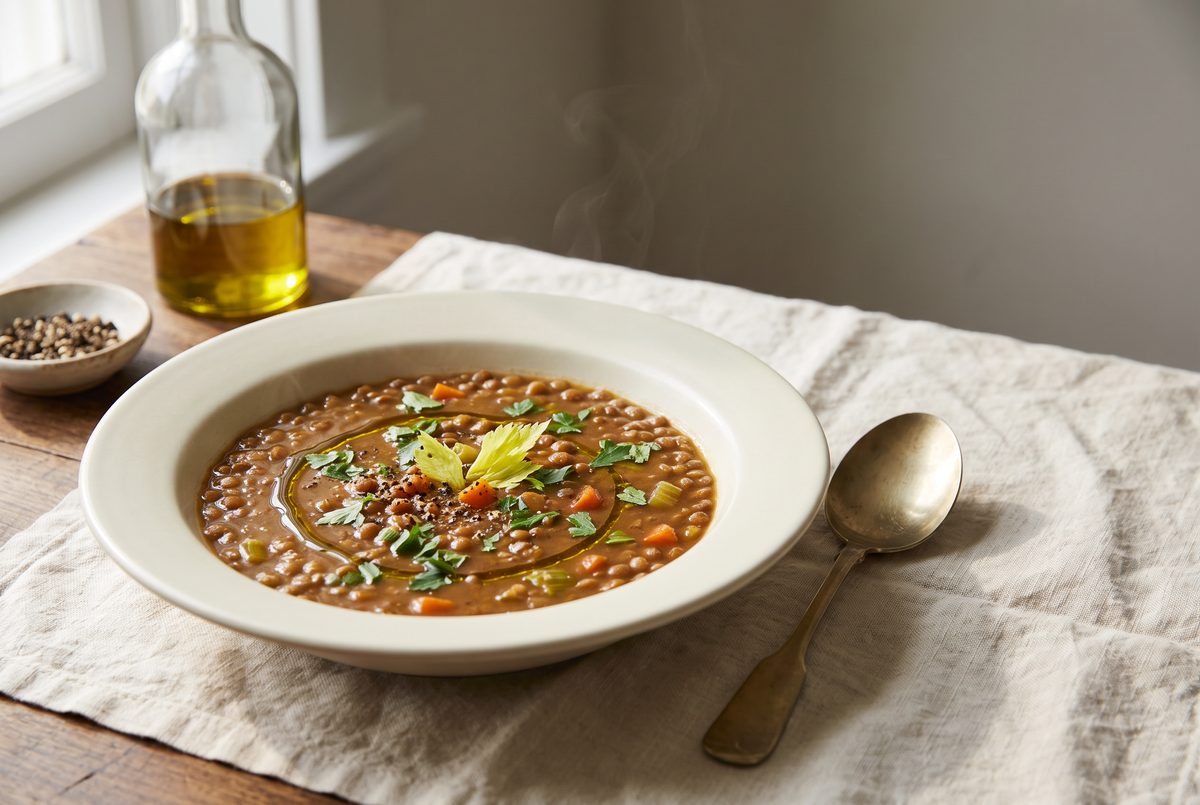
Italian Lentil Soup with Rosemary and Tomato
Italian lentil soup is a one-pot Umbrian supper: brown lentils simmered with a slow soffritto, tomato and rosemary…
- 1 hr 10 min
- 447 kcal
- 22 g protein
Where to start
If you have never done this, do not do all of it. Make the soffritto and one pot of legumes next Sunday and see what Tuesday feels like — that is the piece that pays for itself immediately, and it costs about forty minutes of mostly waiting.
Then pick one dish from the day-two table and make it deliberately on a Sunday for a Wednesday. The caponata is the easiest to be convinced by, because the improvement is so obvious: 249 calories a portion, it holds five days, and it is better on the third than it was on the first. After that the habit builds itself. Our weight-loss recipes and the healthy & green collection are where most of the batch-friendly dishes live, and the guide on eating Italian and losing weight covers the numbers this one assumes.
This guide is general information, not medical advice. Food safety guidance here follows USDA FSIS and the FDA Food Code; if you are pregnant, immunocompromised or cooking for someone who is, use the stricter limits. See our nutrition disclaimer.
Sources: USDA Food Safety and Inspection Service, Leftovers and Food Safety (3–4 day refrigerator limit; reheat to 165°F); U.S. Food and Drug Administration, Food Code 2022 (two-stage cooling: 135°F to 70°F within 2 hours, to 41°F within 6 hours total); Leidy H. J. et al., American Journal of Clinical Nutrition 2015 (protein, satiety and weight management); Rolls B. J., Physiology & Behavior 2009 (dietary energy density and energy intake).
Frequently asked questions
What is Mediterranean meal prep?
Cooking components ahead rather than assembling finished portions: a pot of beans or lentils, a tray of roasted vegetables, a soffritto base, a tomato sauce, a batch of grains. During the week those get combined into different dishes in ten or fifteen minutes. It is how Italian and Greek home kitchens have always worked, and it is more sustainable than the five-identical-containers model because nothing tastes the same twice.
How long does Mediterranean meal prep last in the fridge?
The USDA's general guidance for cooked leftovers is 3 to 4 days at or below 40°F (4°C). Acidic dishes do better: a minestrone or a lentil soup holds 5 days, and caponata holds 5 and improves for the first three because the vinegar keeps working. Dressed salads and anything with fish are the short end — 3 days. Cooked grains and beans stored plain keep 4 days and freeze well.
Is Mediterranean meal prep good for weight loss?
It helps for a practical reason rather than a metabolic one: the decision about what to eat is made on Sunday, when you are not hungry, instead of at 7pm on Wednesday when you are. The Mediterranean pattern itself is low in energy density — a lot of food weight per calorie — which is the mechanism Rolls (2009) describes for eating less without eating less food. Keep protein at 25–30 g a meal and the portions look after themselves.
Can you freeze Italian food?
Soups, stews, ragù, meatballs in sauce and baked pasta dishes all freeze for about 3 months with almost no loss. Three things do not: anything with raw dressed greens, anything whose texture is the point (risotto, fried food, crisp crusts), and dishes with a lot of cooked egg, which goes watery. Soup with pasta already in it is the common mistake — freeze the soup and boil the pasta fresh.
How do I keep prepped pasta from going mushy?
Undercook it by two minutes, drain it, toss it with a teaspoon of olive oil, and store it separately from its sauce. Pasta left sitting in sauce keeps absorbing liquid until it is swollen and soft. The exception is baked pasta, which is supposed to absorb — parmigiana and pasta 'ncasciata are better the next day for exactly the reason loose pasta is worse.
Is it safe to reheat rice and pasta?
Yes, if they were cooled fast and kept cold. The risk is Bacillus cereus, a spore-forming bacterium that survives boiling and multiplies in starch left at room temperature; the spores produce a toxin that reheating does not destroy. Spread cooked rice or pasta out to cool, refrigerate within two hours, use it within four days, and reheat it to steaming hot throughout.