Artichoke Frittata with Pecorino and Lemon
The Roman habit of turning a pound and a half of artichoke hearts into dinner for four.
Artichoke frittata is the Roman way of making a pound and a half of artichoke hearts into dinner: the hearts are browned hard in olive oil, then set with ten eggs, Pecorino Romano and lemon zest and finished in the oven. One wedge is about 390 calories with 24 g of protein and 7.3 g of fiber, and the whole thing takes 45 minutes.
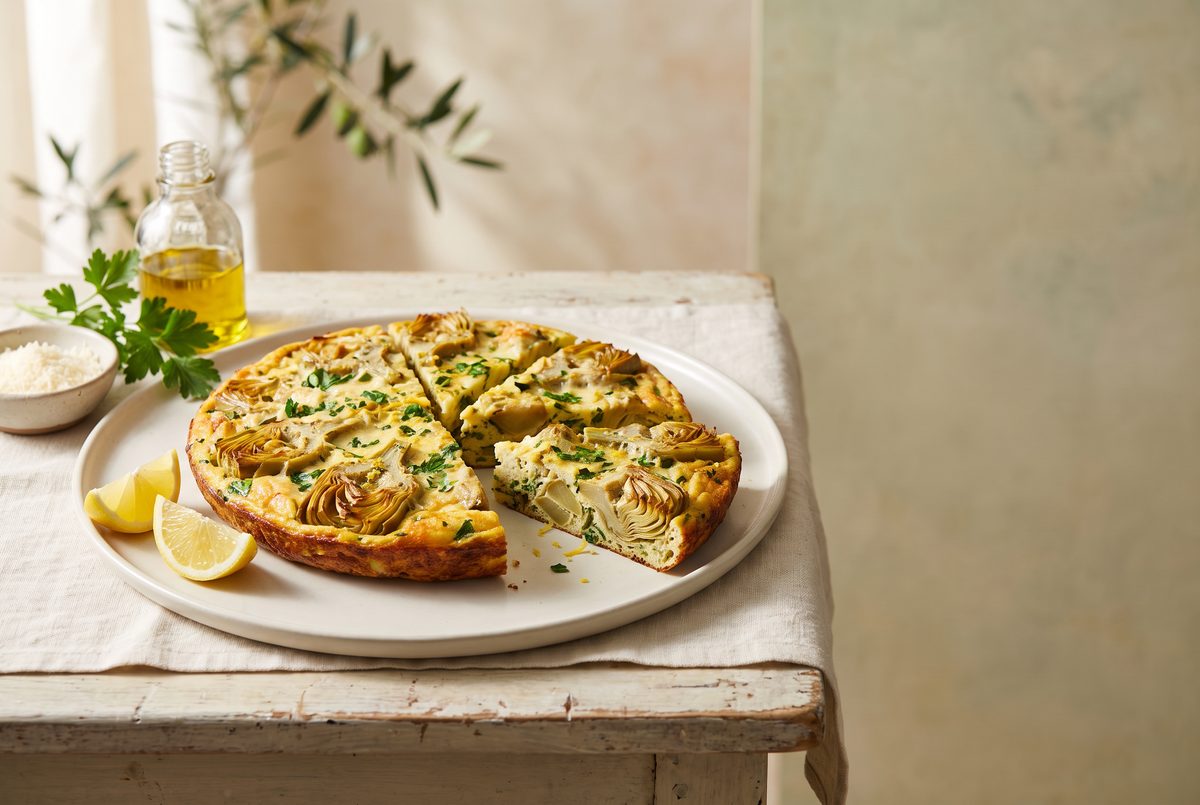
A frittata in Italy is dinner, or the thing you wrap in paper and eat cold on a train. It is almost never breakfast, and it is almost always the second life of something already cooked: the artichokes trimmed for carciofi alla romana that nobody got around to eating, the greens left over from Sunday. Roman frittata di carciofi belongs to that habit. The eggs are the cheap binder. The artichokes are the point.
This version starts from frozen artichoke hearts, which is the honest American shortcut — trimming fresh globe artichokes takes the better part of an hour and half of each one goes in the bin. What frozen hearts ask in return is patience at the start. They come out of the bag holding water, and water is what turns a frittata grey and weeping at the edge of the plate. So you dry them on a towel and then brown them hard in olive oil until the cut faces go the color of toast. That browning is the entire flavor of the dish; skip it and you have scrambled eggs with vegetables in them.
If you do want to work from fresh, California's second artichoke crop comes in through October and November — the variations below say how.
Why this recipe works for weight loss
A 390-calorie dinner that holds until morning has to do two things at once: give you enough protein to stop the hunger signal and enough bulk to fill the plate. Eggs handle the first. A pound and a half of artichokes handles the second.
Protein: 24 g per serving, most of it from the eggs — a whole egg is 12.6 g of protein per 100 g, so ten large eggs split four ways is 15.7 g before the cheese is counted. Protein is the macronutrient that best protects lean mass and appetite control in a calorie deficit (Leidy et al., 2015), and in a 8-week trial an egg-based breakfast at matched calories produced more weight loss than a bagel-based one, which the authors attributed to how long the eggs kept people full (Vander Wal et al., 2008).
Fiber and volume: 7.3 g of fiber a serving, which is more than most egg dishes manage and more than a lot of salads. Artichokes are one of the highest-fiber vegetables you can buy: 3.9 g per 100 g in the frozen hearts, against 1.7 g for onion and 1.2 g for tomato. Because the vegetable is bulky and watery, the finished wedge is large for its calories — the energy-density lever that reliably lowers how much people eat at a meal without them being told to eat less (Rolls, 2009). Higher fiber intakes also track with lower body weight over time (Howarth et al., 2001).
Where the fat is, and why it stays: 26 g of fat per serving, 7.2 g of it saturated, from ten egg yolks and three tablespoons of olive oil. Both are load-bearing. The yolks are what make a frittata a frittata instead of a rubber disc of egg white, and the oil is what browns the artichokes. On the yolks specifically: the Dietary Guidelines for Americans 2020–2025 no longer set a numeric daily limit on dietary cholesterol, while still advising people to keep it as low as a healthy pattern allows — which, at two and a half eggs in a dinner built around a vegetable, this does.
What it is not: a low-sodium dish for anyone on a strict limit. 526 mg a serving is modest for the category — see the other weight-loss recipes — but nearly a quarter of it is the Pecorino, and cutting the cheese is the first lever if you need to.
Ingredients
one 12-inch frittata, 4 wedges
Instructions
- Dry the artichokes. Really dry. Thaw the hearts overnight in the refrigerator, or spread them on a plate and give them 4–5 minutes in the microwave at 50% power. Tip them onto a clean kitchen towel, fold the towel over and press. Then cut any heart bigger than a walnut in half lengthwise, so every piece has a flat side to sit on. Wet artichokes will not brown, and the water they hold ends up under the eggs.
- Brown them hard. Heat 2 tablespoons of the oil in a 12-inch ovenproof nonstick or well-seasoned skillet over medium-high. Add the artichokes in as close to a single layer as you can manage and leave them alone for 4 minutes, then turn them over in batches and give them another 6–8, moving them only every couple of minutes. You want the cut faces deeply golden and some of the outer leaves near-brown and crisp. This is the longest step and the one that decides how the frittata tastes.
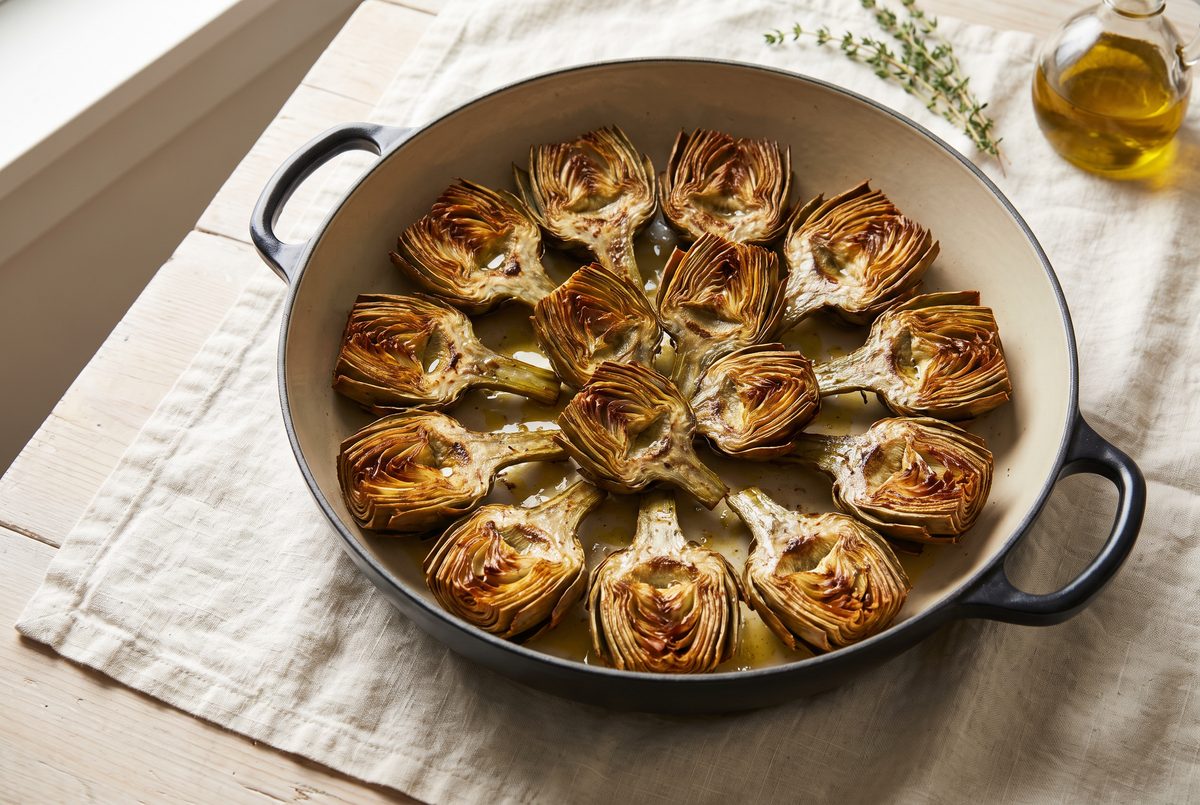
- Onion, then garlic. Push the artichokes to the side, add the last tablespoon of oil and the onion with a pinch of the salt, and cook 4 minutes until soft and translucent. Add the garlic and cook 1 minute more, just until you can smell it. Stir everything together, spread it level in the pan and turn the heat down to medium-low. Heat the oven to 375°F (190°C).
- Beat the eggs with the cheese. In a large bowl, beat the eggs with the Pecorino, parsley, lemon zest, the rest of the salt and the pepper — 30 seconds with a fork, until the color is even. Do not whisk them to a foam: air makes a frittata rise and then collapse into a crater.
- Pour, and set the bottom on the stove. Pour the eggs over the artichokes and tilt the pan so they run into every gap. Cook 5–6 minutes over medium-low, lifting the edge with a spatula once or twice to let liquid egg slide underneath. It is ready for the oven when the outer inch is opaque and the middle is still visibly loose.
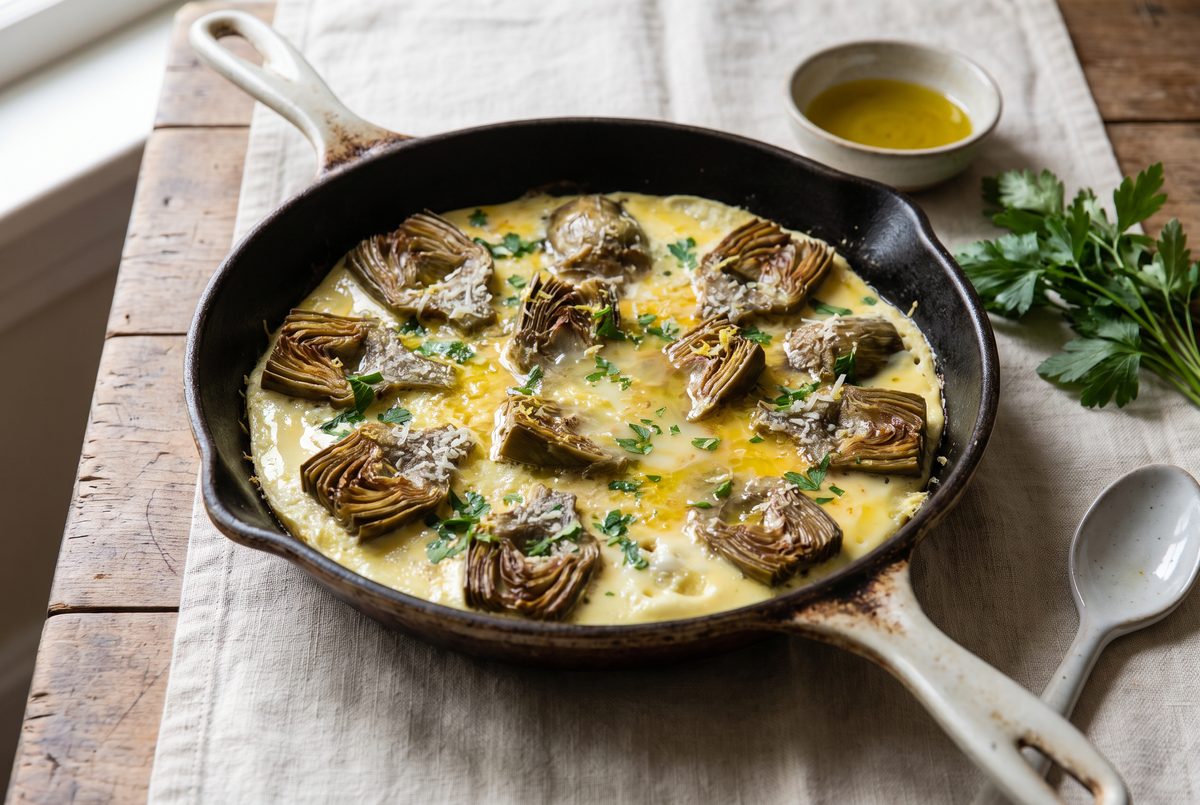
- Finish in the oven, 10–12 minutes. Slide the pan into the oven and bake until the frittata is puffed and set with the faintest tremble left at the center — 10 minutes for a 12-inch pan, 13–15 if yours is smaller and the frittata is therefore thicker. An instant-read thermometer in the middle should say 160°F (71°C), which is the USDA's number for egg dishes. Pull it a shade before it looks done; it keeps cooking in the pan.
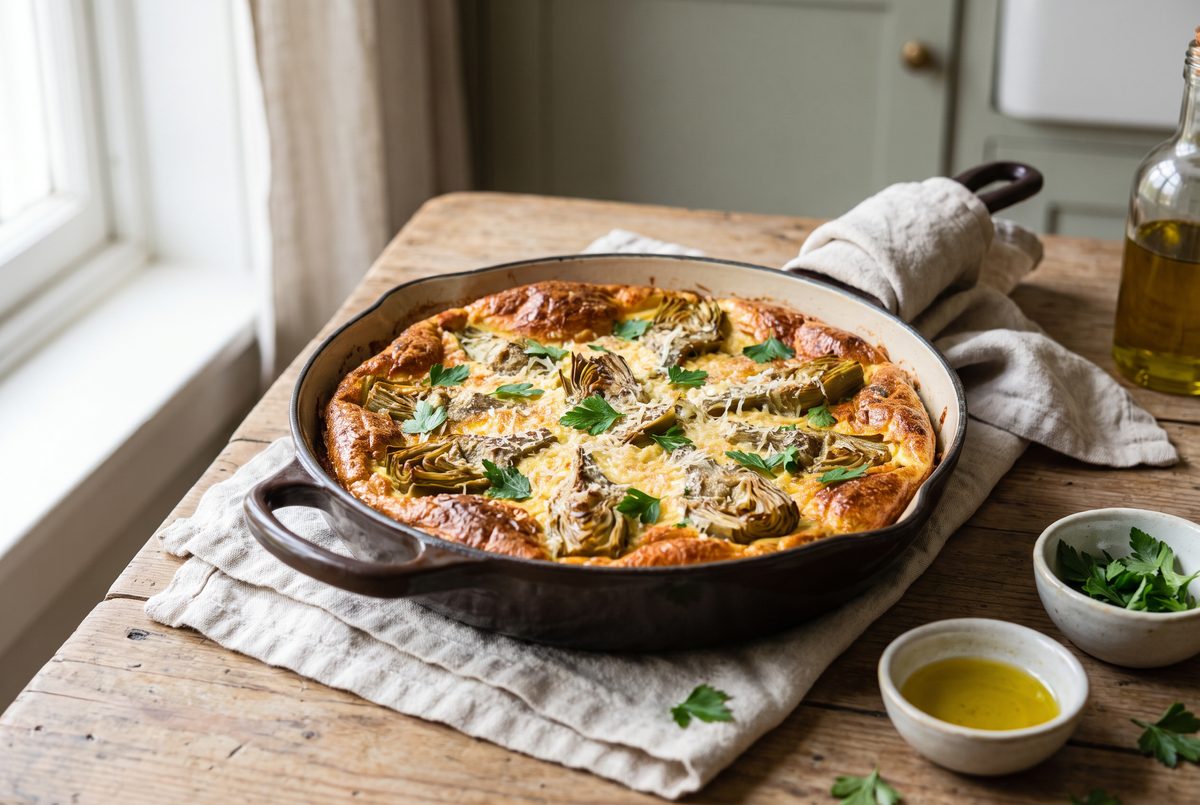
- Rest 5 minutes, then cut. Let it sit in the pan for 5 minutes — it firms up and pulls away from the sides on its own. Run a spatula around the edge, slide it onto a board, and cut into 4 wedges. Serve warm with the lemon wedges, or leave it to come to room temperature, which is how it is usually eaten in Rome.
Tips from our kitchen
- The whole recipe is step 1 and step 2. Frozen artichoke hearts are close to 90% water by weight. If you skip the towel and the browning, the eggs set around pale, squeaky vegetables and a puddle, and no amount of cheese fixes it. Budget the twelve minutes.
- Pan size changes the timing, not the recipe. A 12-inch pan gives a frittata about an inch thick that bakes in 10 minutes. A 10-inch pan gives a taller one that needs 13–15 and is more likely to be wet in the middle — check the center with a thermometer rather than the clock.
- Stop before it looks finished. An overcooked frittata weeps water onto the plate and goes spongy, and it happens in the last two minutes. The tremble at the center is the signal.
- Taste the artichokes before you salt the eggs. Pecorino Romano is about 1,200 mg of sodium per 100 g, and 1½ oz of it does most of the seasoning here. The ¼ teaspoon of added salt is deliberate — add more only after you have tasted a browned artichoke heart.
Variations
- From fresh artichokes: you need 6 large globe artichokes to end up with 1½ lb of trimmed hearts. Snap off the outer leaves, cut off the top third, pare the stem and base, halve and scrape out the fuzzy choke, slice each half into three, and hold them in water with lemon juice. Brown as written but add ¼ cup of water after the first turn and cover for 8 minutes, then uncover and let it cook dry. California's second crop runs October through November.
- Jarred or canned hearts: they work if you drain, rinse and dry them as thoroughly as the frozen ones, but they bring about seven times the sodium — 350 mg per 100 g against 47 — plus the citric-acid tang of the brine, which the eggs do not hide. Leave out the added salt entirely if you go this way.
- Mint instead of parsley: 2 tablespoons of chopped mint in place of the parsley is the Roman move, borrowed from the mentuccia in carciofi alla romana. It is a different, sharper dish and worth trying once.
- Spring version, with peas: add 1 cup (140 g) of frozen peas to the pan with the garlic. Carciofi e piselli is a real pairing and the frittata takes it well, though it pushes the calories up a little.
- For a training day: tear 3 oz (85 g) of prosciutto into the pan at the end of the browning, or serve a wedge alongside something from the muscle-gain recipes rather than on its own.
Storage & meal prep
Keeps 4 days in an airtight container in the refrigerator and is meant to be eaten cold or at room temperature — take a wedge out 20 minutes before you want it and do nothing else to it. If you insist on reheating, 10 minutes in a 300°F (150°C) oven, covered; the microwave turns the egg rubbery and drives water out of the artichokes. It does not freeze well: the whites go watery on thawing.
Nutrition per serving
| Nutrient | Amount | % DV* |
|---|---|---|
| Calories | 390 kcal | 20% |
| Total fat | 26 g | 33% |
| Saturated fat | 7.2 g | 36% |
| Carbohydrates | 18 g | 7% |
| Fiber | 7.3 g | 26% |
| Sugars | 3.4 g | — |
| Protein | 24 g | 48% |
| Sodium | 526 mg | 23% |
*Percent Daily Values are based on a 2,000-calorie diet. Values are calculated from USDA FoodData Central and manufacturer data for the ingredients as listed; they are estimates, not lab analyses. Nutrition disclaimer.
Frequently asked questions
Is frittata good for weight loss?
It depends entirely on the ratio of eggs to vegetables. A three-egg frittata with a handful of cheese is a 400-calorie dish with almost no fiber; this one is 390 calories with 24 g of protein and 7.3 g of fiber because there is more artichoke in the pan than egg. Protein and fiber together are what make a plate this size hold for hours, so load the vegetables and treat the eggs as the binder.
What is the difference between a frittata and an omelette?
An omelette is cooked fast over high heat, folded, and served the moment it leaves the pan, with the filling added at the end. A frittata is cooked slowly, unfolded, with everything mixed into the egg from the start, and it is finished flat — usually in the oven or under a broiler — then cut in wedges. The practical difference is that an omelette has to be eaten immediately and a frittata is just as good four hours later.
Can I use jarred artichoke hearts instead of frozen?
Yes, with two adjustments. Drain them, rinse them under cold water and dry them on a towel as carefully as you would the frozen ones, and leave out the added salt: jarred hearts in brine run about 350 mg of sodium per 100 g against 47 mg for frozen. Marinated artichokes in oil and vinegar are a different matter — the vinegar comes through the eggs and the frittata tastes pickled.
Can I make a frittata ahead of time?
This is the dish frittata was invented for. Make it the night before, cool it completely, and keep it whole and wrapped in the refrigerator for up to 4 days; cut wedges as you want them. Do not try to get it back to hot-out-of-the-oven — room temperature is the intended state, not a compromise.
How many eggs do you need for a frittata that serves four?
Eight to twelve, depending on how much vegetable is going in with them. Ten is right here because 1½ lb of artichoke hearts takes up most of a 12-inch pan and the eggs only have to fill the gaps; a frittata with a cup of herbs and nothing else would need twelve. If you scale down to two servings, use 5 eggs, 12 oz of artichokes and a 9- or 10-inch pan, and cut the oven time to 8 minutes. For more dinners built on this arithmetic, see the guide to eating Italian for weight loss.
Sources
- USDA FoodData Central — nutrient data for frozen artichoke hearts (FDC 168387), whole raw egg, Pecorino Romano and onion
- Leidy, H. J. et al. (2015). The role of protein in weight loss and maintenance. American Journal of Clinical Nutrition
- Vander Wal, J. S. et al. (2008). Egg breakfast enhances weight loss. International Journal of Obesity
- Rolls, B. J. (2009). The relationship between dietary energy density and energy intake. Physiology & Behavior
- Howarth, N. C., Saltzman, E., Roberts, S. B. (2001). Dietary fiber and weight regulation. Nutrition Reviews
- U.S. Departments of Agriculture and Health and Human Services (2020). Dietary Guidelines for Americans, 2020–2025, 9th edition
- USDA Food Safety and Inspection Service — safe minimum internal temperature for egg dishes
You might also like
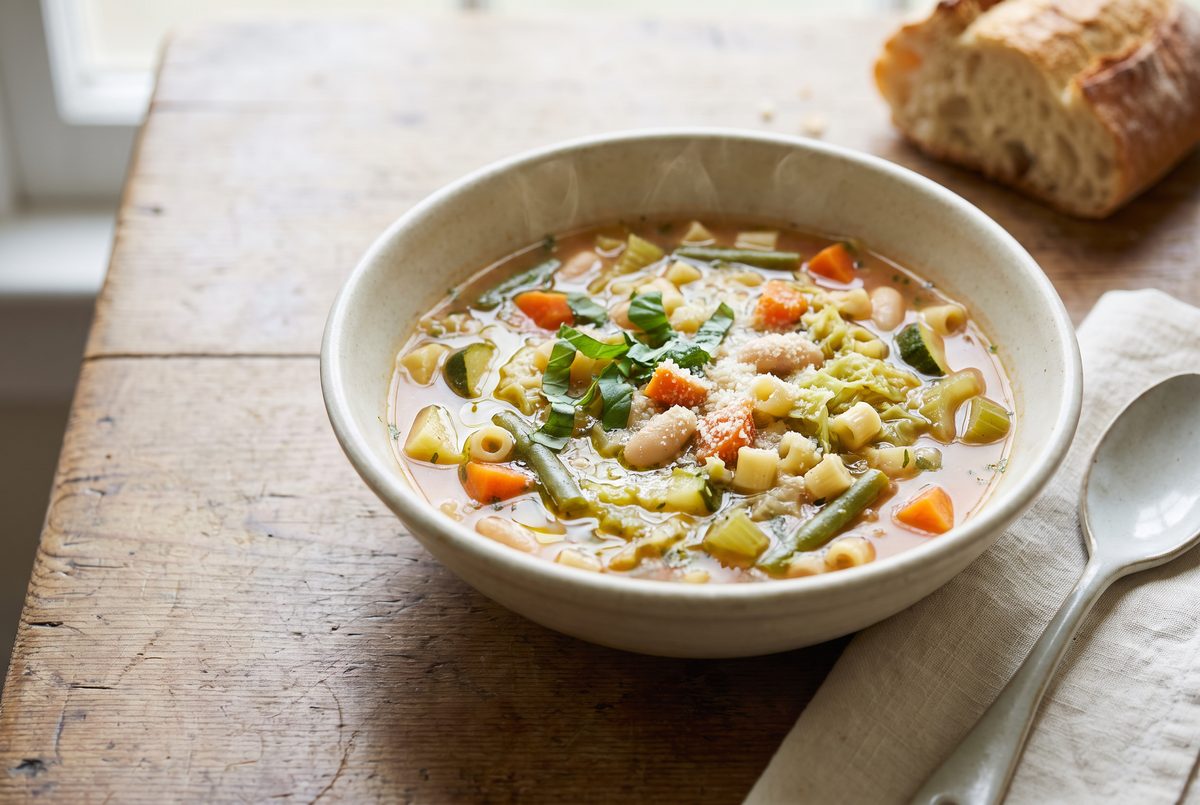
Classic Italian Minestrone Soup
Classic Italian minestrone is a thick vegetable soup with cannellini beans, seasonal vegetables and a handful of small…
- 1 hr 5 min
- 247 kcal
- 11 g protein
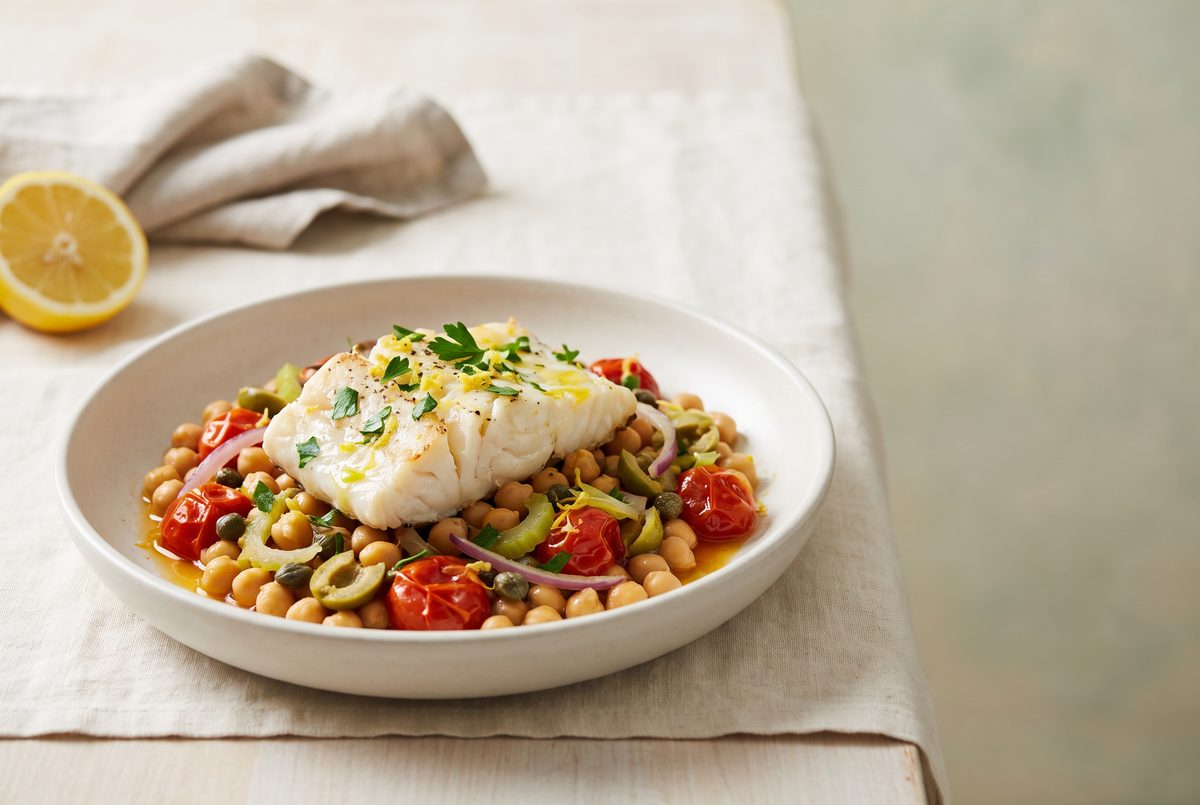
Baked Cod with Chickpeas, Tomatoes and Olives
Baked cod with chickpeas is a one-pan southern Italian dinner: cherry tomatoes, green olives and capers simmered with…
- 40 min
- 443 kcal
- 41 g protein
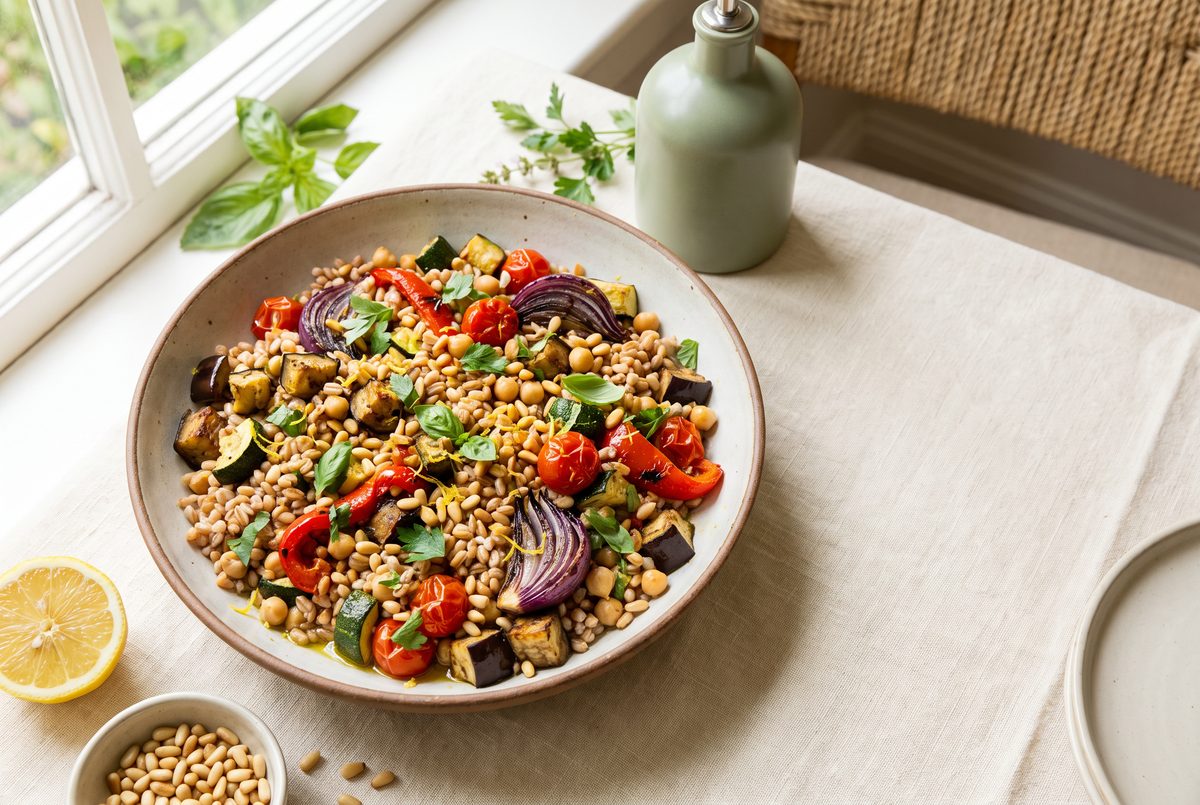
Farro Salad with Roasted Vegetables and Lemon
Farro salad with roasted vegetables tosses chewy pearled farro with oven-caramelized zucchini, eggplant, peppers, red…
- 45 min
- 481 kcal
- 14 g protein