Sicilian Caponata: Sweet-and-Sour Eggplant, Roasted Not Fried
The Sicilian way to use up the last eggplants of the season: cooked down with celery, green olives and capers in an agrodolce of vinegar and sugar, and eaten the next day.
Caponata is the Sicilian dish of eggplant, celery, green olives and capers cooked down in an agrodolce — a sweet-and-sour base of red wine vinegar and a spoonful of sugar — and it is the rare vegetable dish that is better on the second day than on the first. Roasting the eggplant instead of deep-frying it puts a serving at 249 calories with 7 g of fiber, vegan and gluten-free as written.
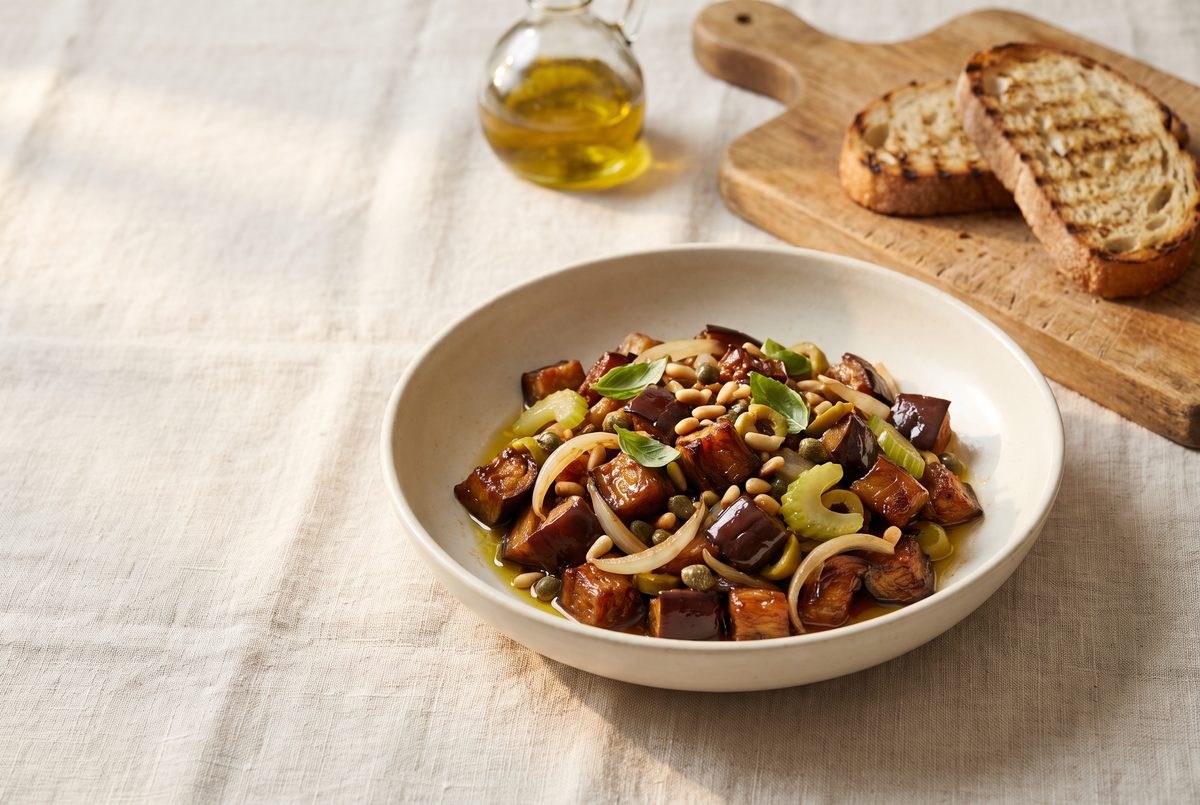
At the end of September the eggplants get cheap, and they look it: bigger than they ought to be, soft at the stem end, seedier inside than the glossy ones from July. That is not a reason to leave them at the market. Sicily has a whole register of cooking for vegetables at exactly this point in their season, and caponata is its most famous piece — a dish invented to absorb a glut, held together by vinegar and a spoonful of sugar rather than by cream, cheese or stock.
The part that decides whether it works has nothing to do with the vegetables. Agrodolce means sour-sweet, and both halves have to be cooked rather than stirred in at the end: vinegar poured into a hot pan and boiled hard for a minute loses its edge and turns round and savory, while vinegar splashed over a finished dish tastes like vinegar splashed over a finished dish. The other half of the method is waiting. Caponata is the only recipe on this site where you are asked to put the pan down, walk away until tomorrow, and eat it at room temperature — which also makes it the most useful thing to have in the fridge on a week when you are cooking once and eating four times.
Why this recipe works for healthy & green
This is a side dish, and the numbers are a side dish's numbers. 249 calories, 7 g of fiber, 3.9 g of protein. Vegetables are 84% of what goes in the pan and the dish carries a little under one calorie per gram, which is the quality that makes vegetable-heavy food filling for what it costs you: Rolls (2009, Physiology & Behavior) summarizes the work showing people eat a fairly constant weight of food and take in fewer calories when that weight is less energy-dense. Caponata is a way to put a large volume of vegetables next to a small piece of protein and have the plate feel complete.
7 g of fiber from three vegetables and a handful of raisins. Eggplant alone brings 27 g of fiber to the pan. The systematic review Reynolds and colleagues published in The Lancet in 2019 found the strongest benefit for adults eating 25–29 g of fiber a day, which is roughly double what the average American manages; one serving of this is a quarter of the way there as a side dish.
The fat is olive oil and it is the point. 17 g of fat a serving, of which 2.1 g is saturated. Guasch-Ferré and colleagues (2022, Journal of the American College of Cardiology) followed more than 90,000 US adults for 28 years and found higher olive oil intake associated with lower cardiovascular and total mortality, with the clearest signal when olive oil replaced butter, margarine or mayonnaise. Eggplant is also unusually good at drinking oil, which is exactly why the deep-fried version of this dish is so much heavier than this one.
Protein is 3.9 g, and pretending otherwise would be silly. Caponata is not a main course on its own: put it next to baked cod with chickpeas and tomatoes, spoon it over farro, or read what Italian cooking without meat actually looks like for how the rest of the plate is supposed to work. The variations below turn it into a bowl. For more cooking in this register, the healthy & green collection is where it belongs.
Sodium is the honest caveat: 461 mg a serving. Only 97 mg of that is the ¼ teaspoon of salt in the pan. The rest is the green olives (about 220 mg a serving) and the capers (about 98 mg), which are also the two ingredients doing the most for flavor — so the lever is rinsing them, not removing them.
Ingredients
About 6 cups — 6 servings as a side or antipasto, 4 as a main with bread
For roasting
The pan
Agrodolce and finish
Instructions
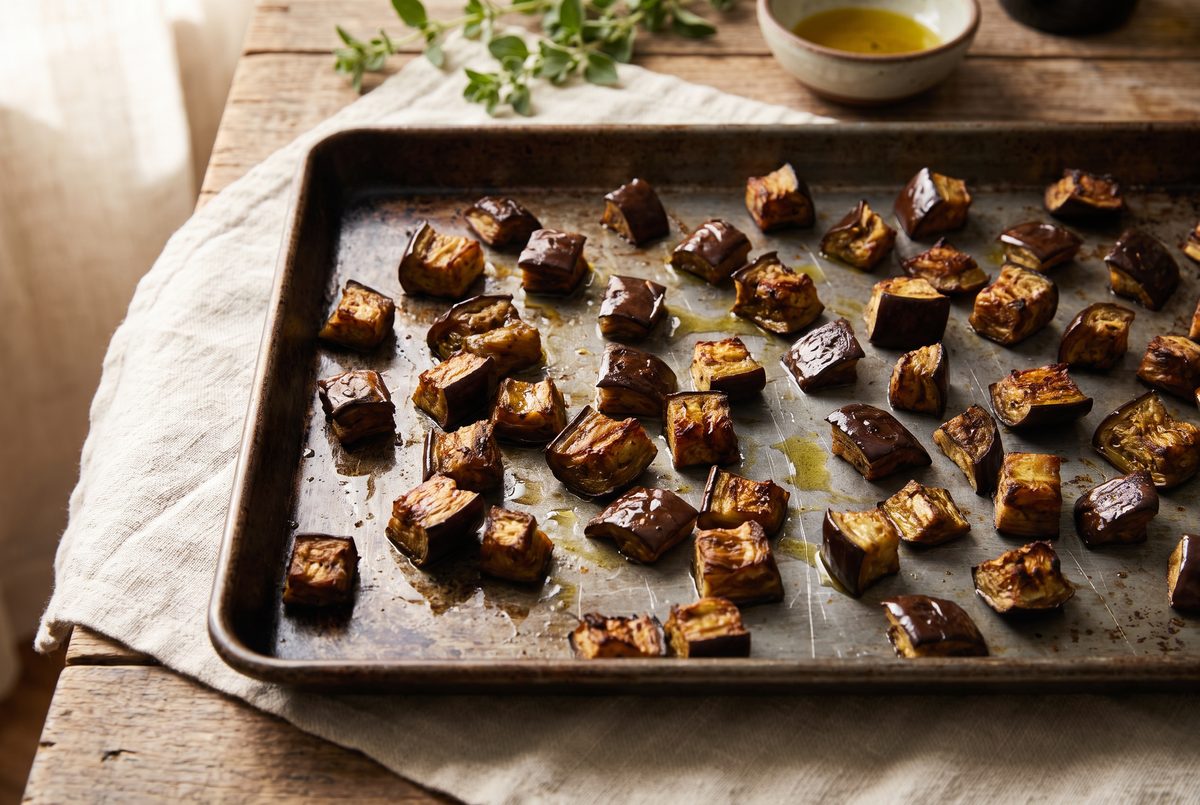
- Cube the eggplant. Don't salt it. Heat the oven to 425°F (220°C). Trim the eggplants and cut them, skin on, into cubes a full 1 inch across — bigger than feels right. Smaller pieces turn to purée in the pan later. Toss them on a large plain sheet pan with the 3 tbsp of olive oil until every cube has caught some, and spread them out so none are touching. Salting and draining eggplant is a step for frying, not for roasting: the oven drives off the water anyway.
- Roast until it is deeply browned and collapsed. Roast 30 to 35 minutes, turning the pan once halfway. You are looking past golden — the cubes should be dark at the edges, wrinkled, and soft enough that one crushes against the pan under a spoon. Undercooked eggplant stays spongy and squeaky in the finished caponata and there is no fixing it later. If your pan is crowded, use two.
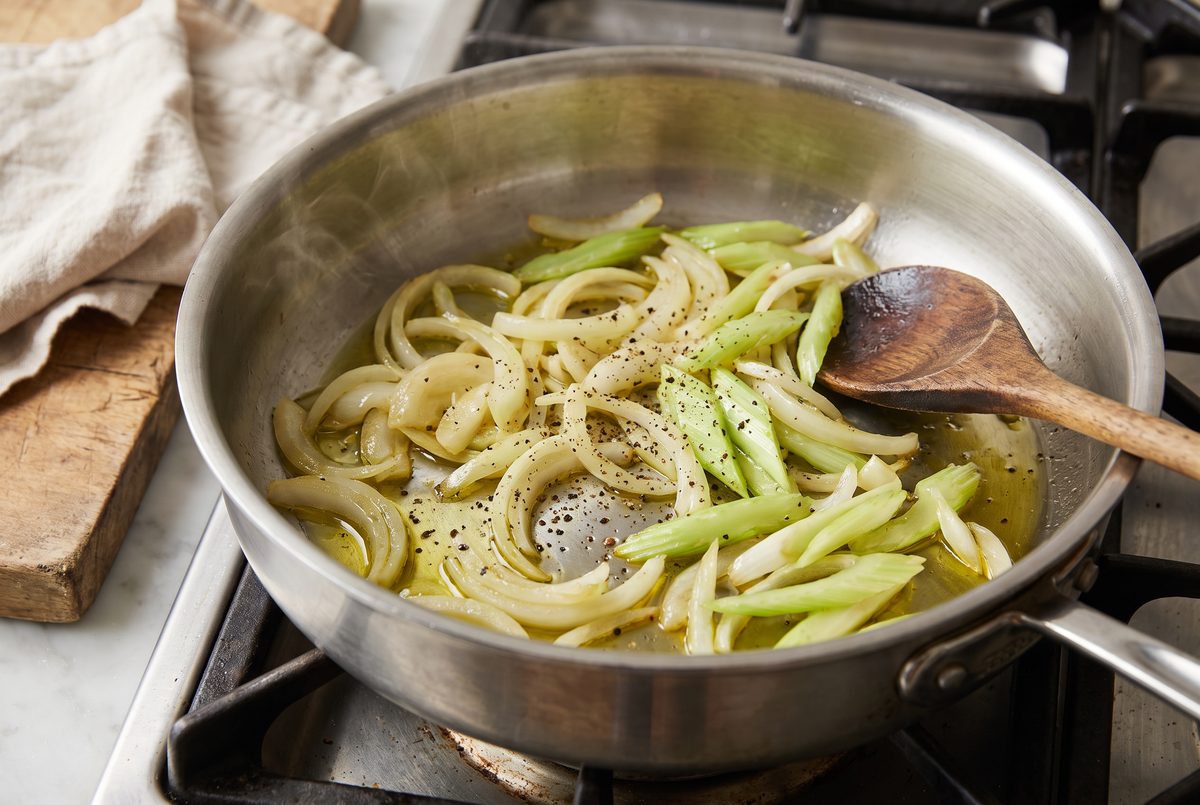
- Onion and celery, in a wide pan. While the eggplant roasts, warm the 2 tbsp of olive oil in a wide, deep pan over medium heat. Add the onion and celery with the ¼ tsp salt and cook 10 to 12 minutes, stirring occasionally. The onion should be translucent and the celery tender at the edge but still crisp in the middle — celery is the crunch in caponata and the reason the dish has any texture at all once the eggplant has gone soft.
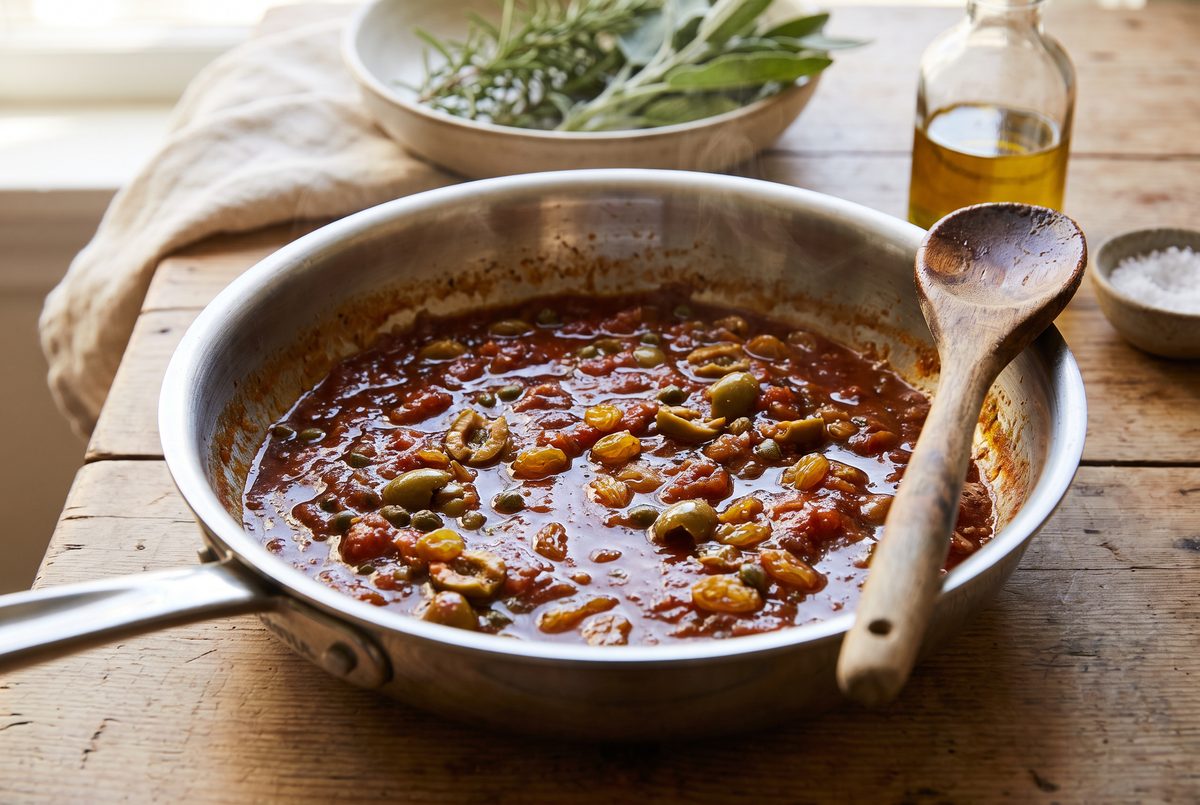
- Passata, olives, capers, raisins. Add the passata, the torn olives, the rinsed capers, the raisins and the black pepper. Bring to a simmer and cook 10 minutes, uncovered, until the tomato has darkened and thickened enough that a spoon dragged across the bottom leaves a track that stays open for a second. The raisins will plump up in the sauce.
- The agrodolce — boil it, don't stir it in. Sprinkle the sugar over the surface, pour in the vinegar, raise the heat and let it boil hard for 1 to 2 minutes without a lid. The kitchen will smell aggressively of vinegar and then stop: that is the sharpness cooking off, and it is the whole trick. Stop when the mixture is glossy and there is no thin liquid pooling at the edge of the pan.
- Fold in the eggplant off the heat. Take the pan off the burner and add the roasted eggplant, the pine nuts and the torn basil, then turn everything over gently — three or four passes with a flat spoon, no more. Anything more energetic and the eggplant breaks down into a paste. Taste now only to check it is seasoned; the real tasting happens cold.
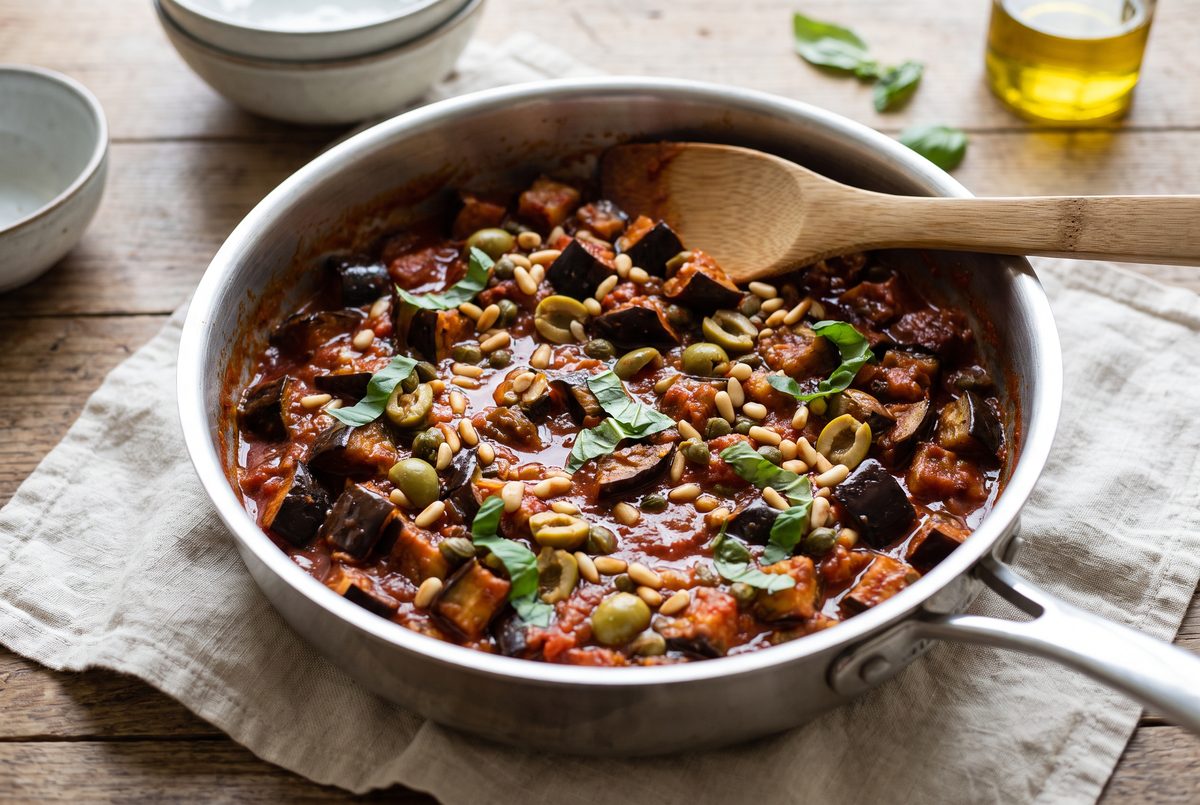
- Now wait — this is the recipe, not a suggestion. Scrape it into a shallow dish, spread it out so it cools fast, and leave it at room temperature for at least 4 hours. Better: cover and refrigerate overnight, then take it out 30 to 40 minutes before you eat so it is not fridge-cold. Taste for salt and for vinegar at that point and not before — both read completely differently once the dish is cool. Serve with a few fresh basil leaves torn over the top.
Tips from our kitchen
- Do not salt and drain the eggplant. The advice is a holdover from when eggplants were reliably bitter and from frying, where surface water means spitting oil. Modern globe eggplants are not bitter, and in a 425°F oven the water leaves on its own. Salting first only makes the cubes denser and saltier.
- One inch, skin on. The two most common failures are cubes cut too small and eggplant pulled out of the oven too early; both end in a khaki mush. The skin is what holds each piece together through the folding at the end.
- Taste it cold. Vinegar, salt and sugar all read stronger hot. A caponata that tastes perfectly balanced in the pan is usually flat the next day, and one that tastes slightly too sharp in the pan is usually right. Adjust after the rest, never before.
- Sodium: 461 mg a serving, and only 97 mg of it is added salt. Rinse the capers thoroughly — salt-packed ones soaked for 10 minutes and rinsed twice are better than brined — and give the olives a rinse too if yours came out of a very salty brine.
- It scales up without any trouble. A double batch fits in one wide pan (the eggplant needs two sheet pans) and keeps 5 days, which is the usual reason to make it at all.
Variations
- Make it a main: spoon a serving over ¾ cup of cooked farro (2 oz / 60 g dry) — about 205 calories and 7 g of protein more, and it becomes a bowl rather than a side. Our farro salad with roasted vegetables uses the same grain if you want a second use for the bag.
- On bread, the way it is actually eaten in Sicily: pile it on two ½-inch slices of grilled country bread, about 2 oz (56 g), for 150 calories and 5 g of protein more. No longer gluten-free.
- Catania style, with almonds: swap the pine nuts for the same weight of toasted sliced almonds. Nutritionally near-identical — about 5 calories less a serving — and the flavor is rounder and less resinous.
- With bell pepper: a red bell pepper, cut in strips and roasted alongside the eggplant, is standard in plenty of Sicilian households and adds sweetness for about 6 calories a serving. Skip the sugar if you use it.
- Leaner: drop the roasting oil to 2 tbsp. You save about 20 calories a serving and the eggplant browns less evenly, which matters more than it sounds like it should.
Storage & meal prep
Caponata is built around keeping. It holds 5 days covered in the fridge and genuinely improves for the first two or three — the vinegar keeps softening and the flavors keep merging — so making it on Sunday for the week is the intended use rather than a compromise. Always serve it at room temperature: take the container out 30 to 40 minutes ahead, because cold blunts the agrodolce completely. It freezes for 3 months but the celery comes back limp, so freeze it only if you are going to eat it on bread. Add fresh basil at the moment you serve, never before storing — it blackens in the vinegar overnight.
Nutrition per serving
| Nutrient | Amount | % DV* |
|---|---|---|
| Calories | 249 kcal | 12% |
| Total fat | 17 g | 22% |
| Saturated fat | 2.1 g | 11% |
| Carbohydrates | 24 g | 9% |
| Fiber | 7.4 g | 26% |
| Sugars | 14 g | — |
| Protein | 3.9 g | 8% |
| Sodium | 461 mg | 20% |
*Percent Daily Values are based on a 2,000-calorie diet. Values are calculated from USDA FoodData Central and manufacturer data for the ingredients as listed; they are estimates, not lab analyses. Nutrition disclaimer.
Frequently asked questions
What is caponata?
A Sicilian dish of eggplant cooked with celery, onion, tomato, green olives and capers in an agrodolce — a sweet-and-sour base of vinegar and sugar. It is served as an antipasto or a side, at room temperature, and it is one of the few Italian dishes that is expected to be made a day ahead. Versions differ by town: Palermo adds raisins and pine nuts, Catania uses bell pepper, and almost everywhere argues about whether tomato belongs at all.
Is caponata healthy?
A serving is 249 calories with 7 g of fiber, 24 g of carbohydrate and 17 g of fat that is almost entirely olive oil, and it is vegan and gluten-free as written. Vegetables are 84% of the weight of the pan. The two things to know: protein is only 3.9 g, so it is a side rather than a meal, and sodium is 461 mg a serving because of the olives and capers.
Do you eat caponata hot or cold?
Room temperature, and it is not a matter of taste — the dish is finished by cooling. Hot from the pan the vinegar dominates and the parts taste separate; after four hours, and better after a night in the fridge, the agrodolce settles into the eggplant. Take it out of the refrigerator 30 to 40 minutes before serving, because fridge-cold flattens it as badly as hot does.
Can I make caponata without frying the eggplant?
Yes, and this recipe does. Roasting 2 lb of cubed eggplant at 425°F with 3 tablespoons of olive oil browns and collapses it the way deep-frying does, for a fraction of the fat — eggplant absorbs an enormous amount of oil in a fryer. The difference you can taste is a slightly drier, more concentrated eggplant, which most people prefer in a dish that sits overnight anyway.
How long does caponata last in the fridge?
Five days in a covered container, and it is better on day two and day three than on day one. The vinegar and salt do real preserving work here. It also freezes for up to 3 months, though the celery loses its crunch on thawing, so freeze it only if you plan to eat it spread on bread.
Do I need to salt the eggplant first?
No. Salting to draw out bitterness made sense with older varieties; commercial globe eggplant today is not bitter. Salting also draws out water, which matters if you are frying and spattering, but a 425°F oven removes that water for you. Skipping it saves half an hour and gives you a less salty finished dish.
Sources
- USDA FoodData Central — eggplant (raw), celery (raw), onion (raw), green olives (canned), capers (canned), raisins, pine nuts, olive oil, red wine vinegar
- Reynolds, A. et al. (2019). Carbohydrate quality and human health: a series of systematic reviews and meta-analyses. The Lancet
- Guasch-Ferré, M. et al. (2022). Consumption of Olive Oil and Risk of Total and Cause-Specific Mortality Among U.S. Adults. Journal of the American College of Cardiology
- Rolls, B.J. (2009). The relationship between dietary energy density and energy intake. Physiology & Behavior
You might also like
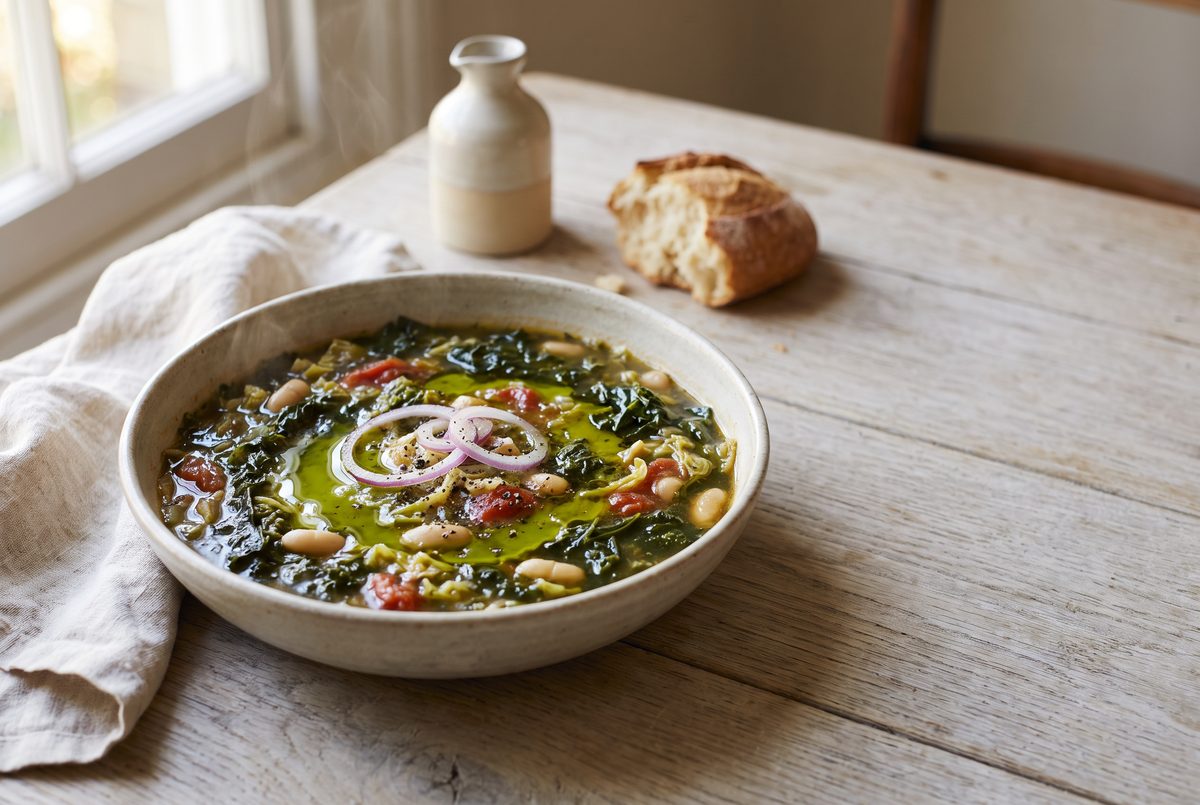
Ribollita: The Tuscan Kale, Bean and Bread Soup
Ribollita is the Tuscan soup that starts as a pot of cannellini beans and black kale and only becomes itself the next…
- 2 hr
- 418 kcal
- 15 g protein
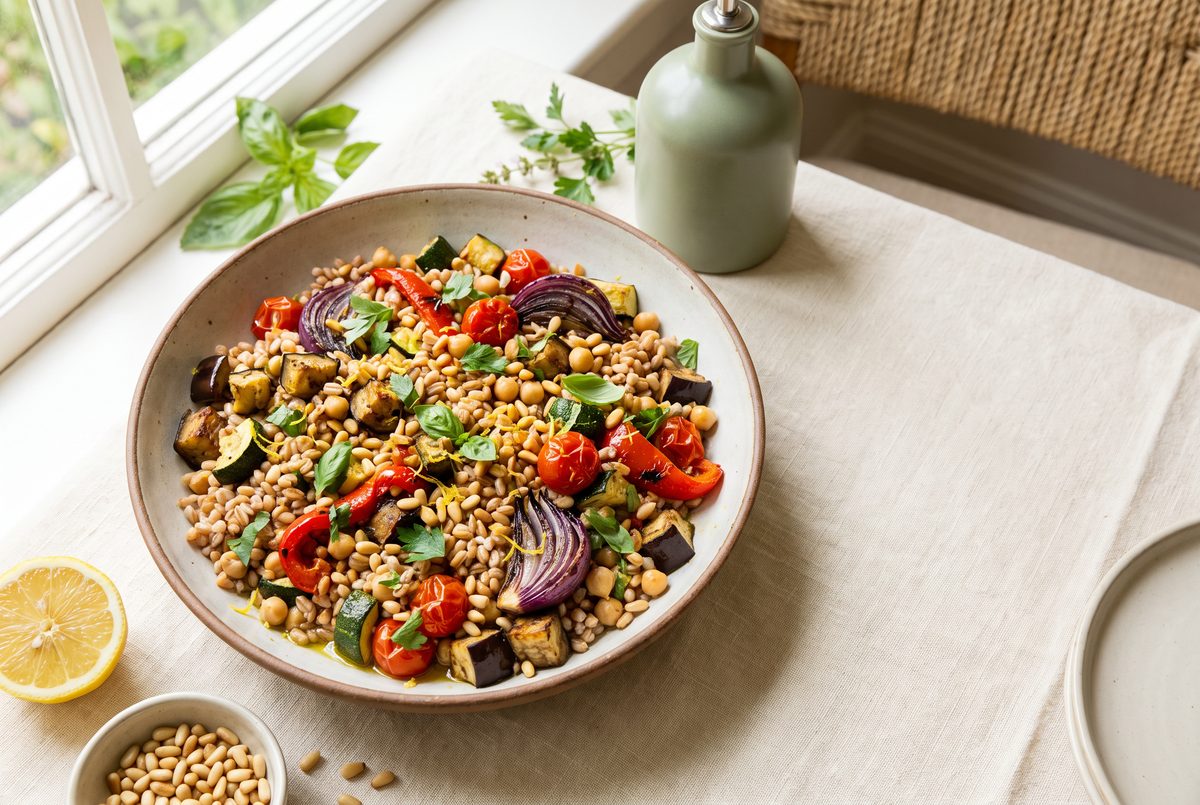
Farro Salad with Roasted Vegetables and Lemon
Farro salad with roasted vegetables tosses chewy pearled farro with oven-caramelized zucchini, eggplant, peppers, red…
- 45 min
- 481 kcal
- 14 g protein
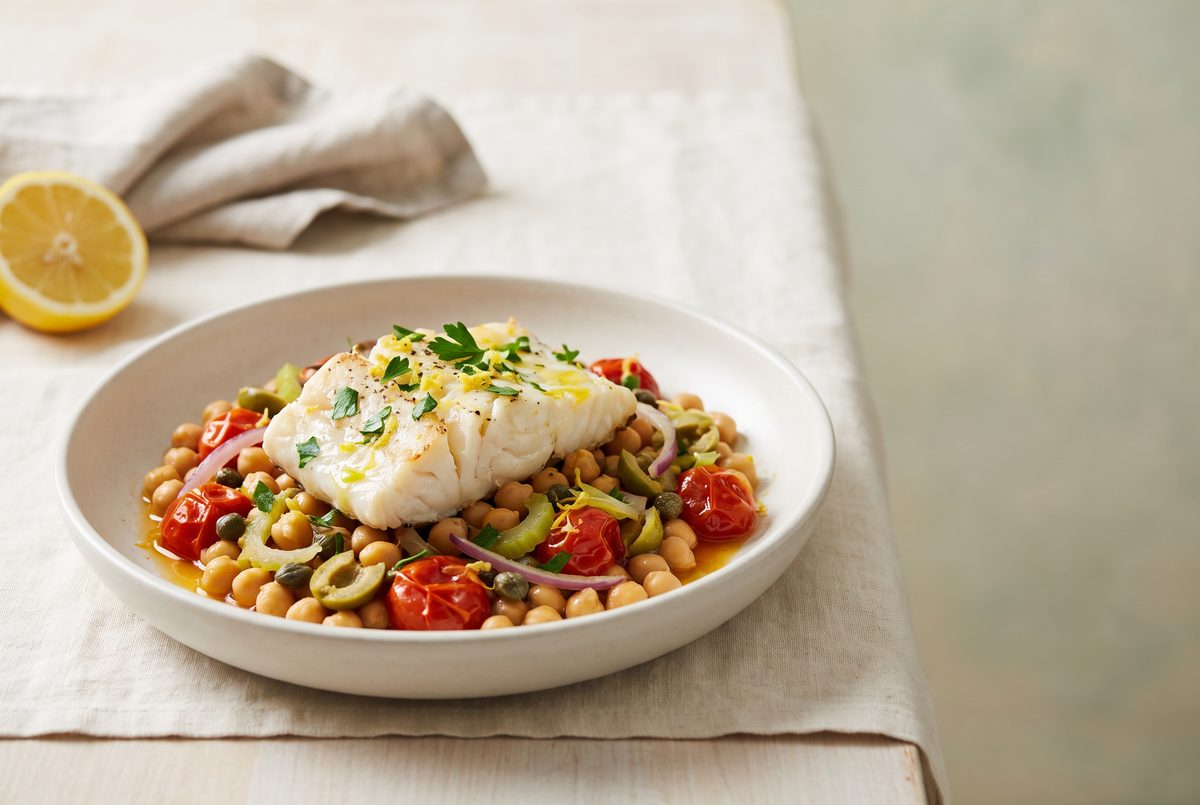
Baked Cod with Chickpeas, Tomatoes and Olives
Baked cod with chickpeas is a one-pan southern Italian dinner: cherry tomatoes, green olives and capers simmered with…
- 40 min
- 443 kcal
- 41 g protein