Italian Cabbage Rolls: Rice, Beans and Ricotta in Savoy Leaves
Involtini di verza, the way they are made from Lombardy up into the Alps: twelve blanched savoy leaves rolled around rice, borlotti beans and ricotta, then baked in tomato with sage until the sauce goes thick.
Involtini di verza are the northern Italian cabbage roll: savoy leaves blanched until pliable, wrapped around a filling of half-cooked rice, borlotti beans, ricotta and Parmigiano, and baked in tomato passata with sage. Three rolls are a 488-calorie vegetarian main with 23 g of protein and 11 g of fiber, and they are better reheated the next day.
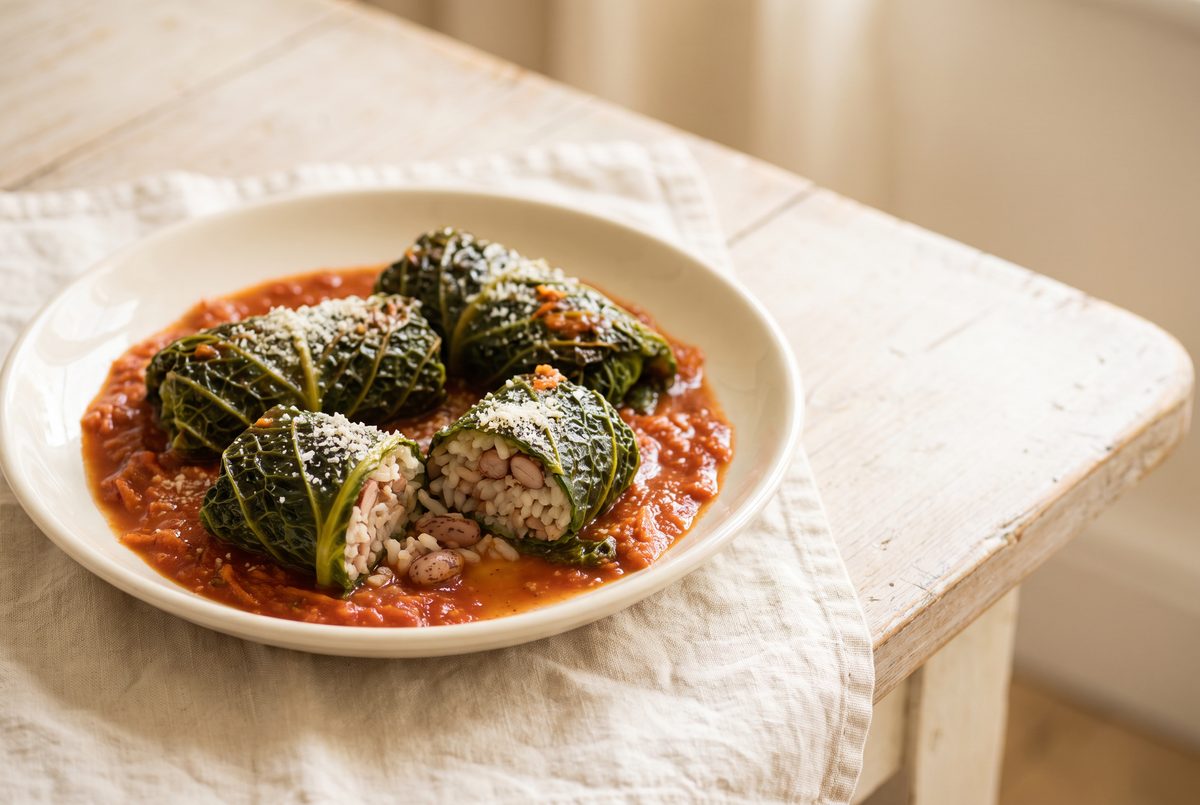
The leaf is the reason for the recipe. Pull an outer leaf off a head of savoy cabbage and look at it: deeply crinkled, almost quilted, with a pale rib running up the middle thick as a celery stalk. Drop it in boiling water for three minutes and it turns dark green and goes slack, and — this is the part that matters — it bends in half without splitting. Do the same with a leaf of ordinary smooth green cabbage and it cracks along the fold about half the time. Northern Italy, from the Lombard plain up through Trentino where verza grows all winter, built a whole category of dish on that one physical property, and involtini di verza is the most useful piece of it.
Americans know cabbage rolls, but usually the other ones — the Polish and Hungarian version, beef and rice inside, sour cream and paprika or dill on top. The Italian ones go a different direction entirely: into a dish with tomato passata and a few sage leaves, covered, into the oven, and they come out with the sauce reduced and caught in the crinkles of the leaf. There is no dairy on top. Two warnings before you start, both learned the dull way. Season the filling harder than seems sensible — cabbage is bland and watery and it dilutes whatever it is wrapped around, so a filling that tastes correct in the bowl tastes of nothing in the finished roll. And the rolling takes fifteen minutes, which no amount of practice shortens much. This is a Sunday-afternoon dish that reheats into three weeknight dinners, not a thirty-minute one.
Why this recipe works for healthy & green
488 calories for 479 g of food, which is the whole trick of cooking this way. A serving is three rolls plus the sauce they baked in, and it runs at a hair over 1 calorie per gram — the cabbage is 140 g of that per serving and brings 38 calories. Rolls (2009, Physiology & Behavior) summarizes the work behind why that matters: people tend to eat a fairly constant weight of food, so lowering the energy density of a dish lowers the calories eaten without anyone eating less. A plate of these is physically a lot of dinner.
23 g of protein without meat, spread across four ingredients rather than leaning on one. The 91 g in the dish comes mostly from six places — ricotta 23 g, borlotti beans 19 g, Parmigiano 16 g, the cabbage 11 g, rice 8 g and one egg 6 g — with the last 8 g scattered across the tomato and the vegetables. The old advice was that plant proteins must be combined at each meal — rice short on lysine, beans short on methionine — and Mariotti and Gardner (2019, Nutrients) is worth reading on why that framing has softened: what matters is total daily protein and variety across the day, not arithmetic at every sitting. This meal happens to do both anyway, which is less a design achievement than what Italian peasant cooking has always looked like.
11 g of fiber a serving, and it is the two cheapest ingredients doing it. The leaves contribute 17 g of fiber to the dish and the can of borlotti another 16 g — 33 of the 45 g total. The systematic review Reynolds and colleagues published in The Lancet in 2019 found the clearest benefit for adults eating 25–29 g of fiber a day, against a US average closer to half that; one serving here is more than a third of the way to the bottom of that range. If you want more cooking in this register, the healthy & green collection is where this belongs.
Two honest caveats, both from the cheese. Saturated fat is 6.3 g a serving, and 4.3 g of that is the ricotta and the Parmigiano together — the variations below include a version with half the Parmigiano that takes it to 5.4 g. Sodium is 772 mg, which is on the high side for this site: only 240 mg of it is added salt, the rest being Parmigiano (180 mg), the canned beans (180 mg) and the ricotta (62 mg). Rinsing the beans in a colander instead of just draining them cuts a useful amount that the table above cannot credit, since USDA values for canned legumes are measured drained and not rinsed. For a version with no dairy at all, our guide to vegan Italian food covers what to use instead of ricotta in a stuffing like this one.
Ingredients
12 rolls in a 9x13-inch dish — 4 main-course servings of 3 rolls
The leaves
The filling
The braise
Instructions
- Take the leaves off the head without tearing them. Cut a deep cone out of the base of the cabbage with a paring knife to free the ribs where they attach. Then peel the leaves off one at a time from the outside, bending each one back from the core rather than pulling it straight off. You want 12 leaves big enough to roll — roughly the outer two thirds of a large head. Keep going past twelve if any tear; two spares cost nothing. Save the dense pale heart, which is a different vegetable for cooking purposes and is better off in soup.
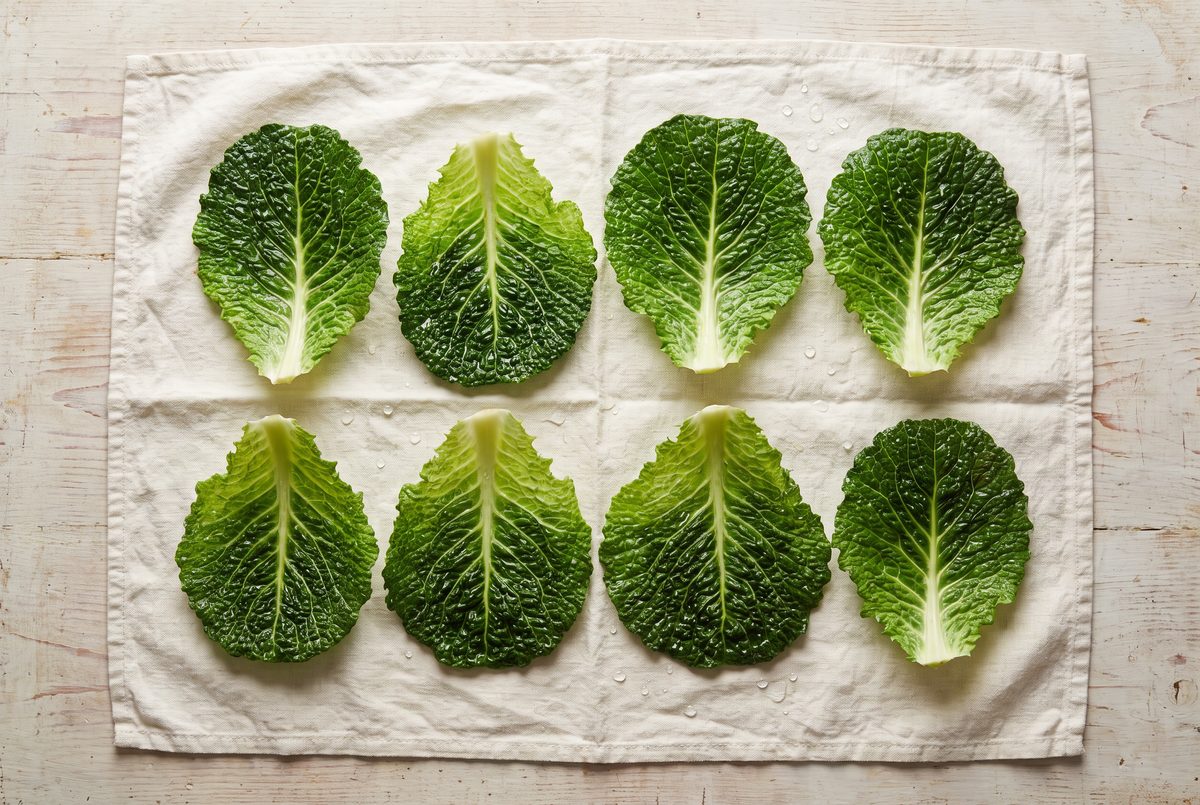
- Blanch three minutes, then cold water. Bring a large pot of unsalted water to a boil (salted water here would end up in the finished sodium figure for no flavor return) and drop in 4 leaves at a time. 3 minutes — they go from gray-green to dark green and from stiff to limp. Lift them out with tongs into a bowl of cold water, then lay them flat on a towel. Now pare the thick rib: lay the leaf rib-side up and run a knife almost parallel to the board to shave the rib down flush, without cutting it out. Cutting it out leaves a hole and the roll comes apart.
- Half-cook the rice. Ten minutes, timed. Boil the rice in plenty of unsalted water for exactly 10 minutes, then drain it and spread it on a plate to stop the cooking. Bite a grain: soft outside, still chalky in the center. That is correct. The rice has another 50 minutes in the oven, where it will absorb tomato and swell inside the roll — which is where the flavor comes from. Rice cooked through at this stage turns to paste and makes the filling heavy.
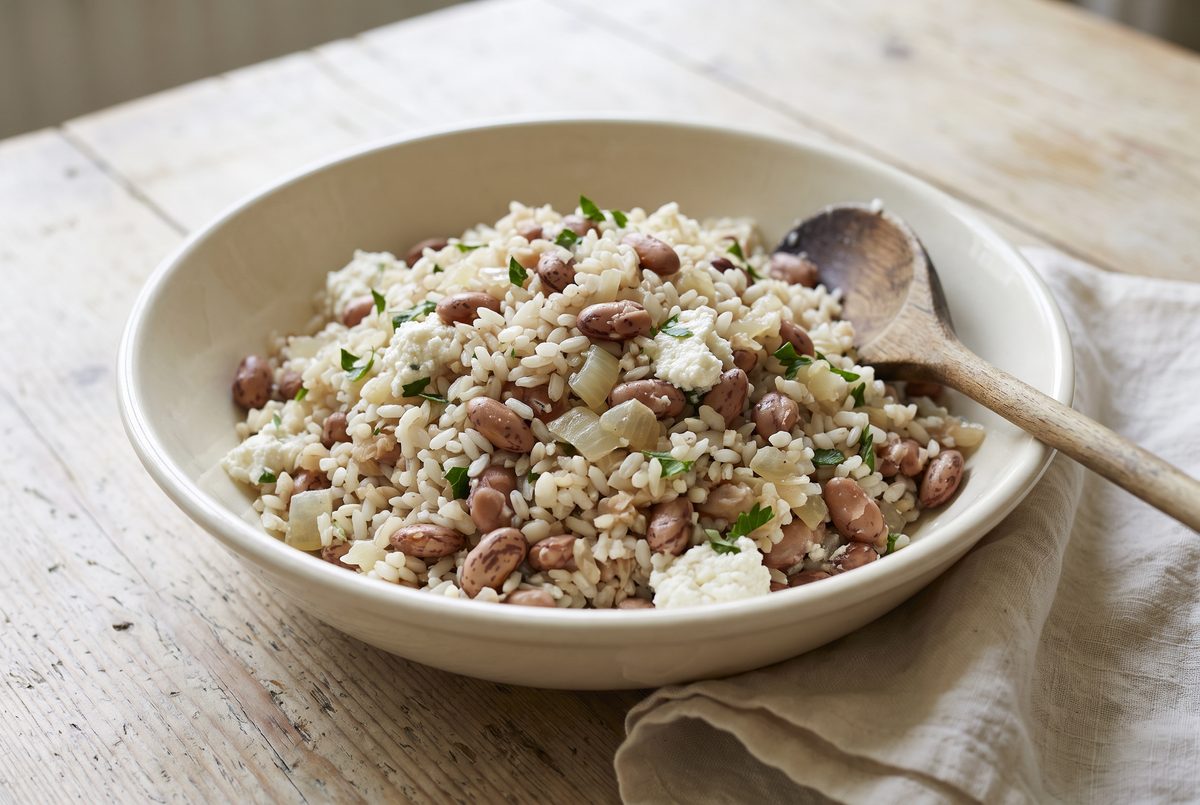
- Soffritto, then mash half the beans. Warm the 2 tbsp olive oil in a skillet over medium heat, add the onion and cook 8 minutes until soft and translucent but not colored, then the garlic for 1 minute more. Scrape it into a large bowl. Add the drained, rinsed borlotti and crush about half of them against the side of the bowl with a fork, leaving the rest whole. The mashed half binds the filling; the whole half gives you something to bite.
- Mix the filling and taste it before the egg. To the same bowl add the half-cooked rice, the ricotta, the Parmigiano, parsley, nutmeg, the ⅓ tsp salt and the pepper. Fold until evenly combined. Taste it now, before the egg goes in, and be aggressive: it should taste slightly over-seasoned on a spoon, because 140 g of blanched cabbage per serving will mute it. Then stir in the beaten egg, which is what holds a roll together when you cut into it.
- Roll twelve. Lay a leaf rib-side up with the stem end toward you. Put a scant ¼ cup (about 60 g) of filling in a log across the leaf, an inch up from the stem end. Fold the stem end over the filling, fold both sides in like an envelope, then roll it up away from you and set it seam side down. Snug, not tight — the rice still has to expand. Repeat eleven times. If a leaf is small, overlap two; if one tore, patch it with a spare.
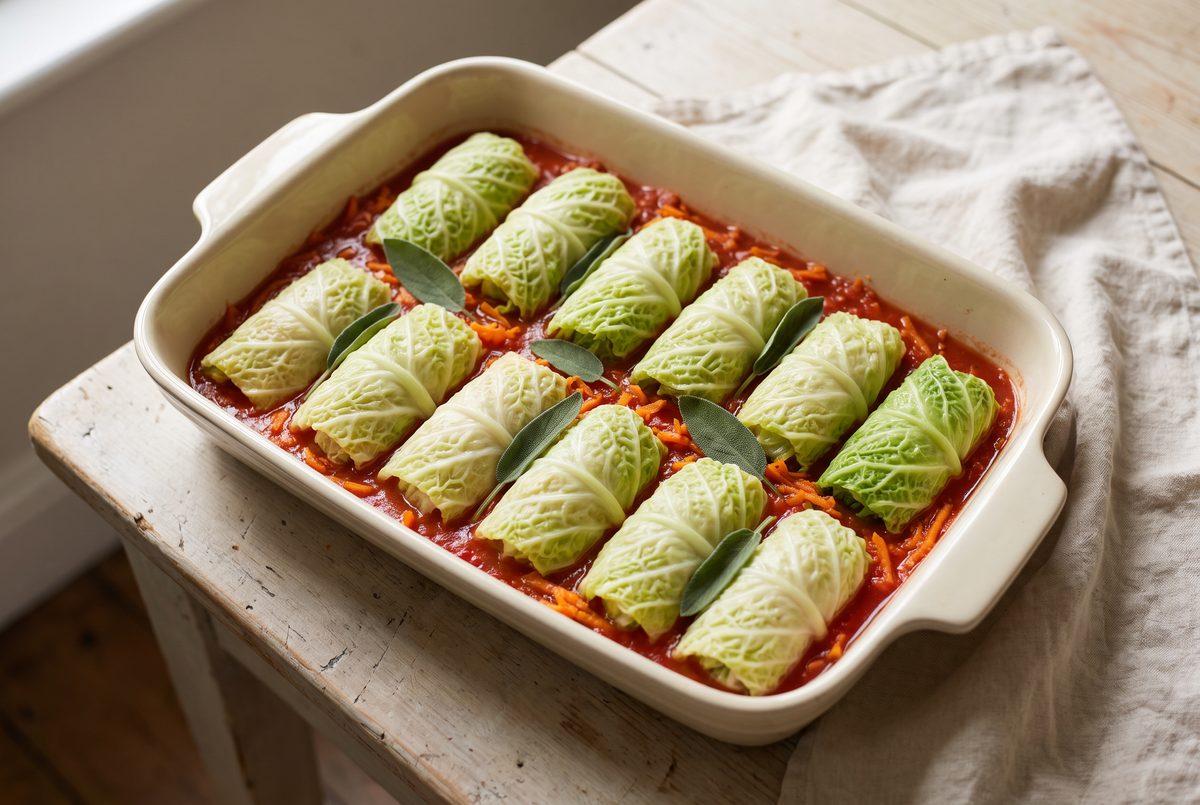
- Pack them in, sauce them, cover, 35 minutes. Heat the oven to 375°F (190°C). In a 9x13-inch ceramic or glass dish, stir together the passata, broth, 1 tbsp olive oil, the grated carrot and the ⅛ tsp salt, and spread it out. Nestle the rolls seam side down in a single layer — they should touch, which keeps them from unrolling — and tuck the sage leaves between them. Spoon a little sauce over the tops so nothing bakes dry. Cover tightly with foil and bake 35 minutes.
- Uncover for 15, then let them sit. Take the foil off and bake another 15 minutes, until the sauce around the edges has darkened and thickened and the tops of the rolls have a few bronzed spots. Total oven time 50 minutes. Then leave the dish alone for 10 minutes before serving: straight out of the oven the rolls are slack and they tear when you lift them, and ten minutes of resting is the difference between serving three neat rolls and serving a scoop. Grate a little more Parmigiano over the top at the table if you like.
Tips from our kitchen
- Savoy, not green cabbage, and not napa. Smooth green cabbage leaves are brittle and split on the fold; napa is too thin and watery and the rolls collapse. If savoy is all your store has in a small head, buy two and use the outer leaves of both — the heart of each goes into minestrone or a ribollita, where savoy cabbage is a traditional ingredient anyway.
- Shave the rib, do not cut it out. This is the single most common failure. A V-cut through the rib leaves a gap in the middle of the leaf, exactly where the filling sits, and the roll opens in the oven. Hold the knife almost flat and take the rib down to the thickness of the rest of the leaf.
- Taste the filling before the egg goes in, and season it past the point that feels right. Everything about a stuffed cabbage leaf conspires to dull the seasoning: the blanching water, the leaf's own water, the neutral rice. The traditional correction in the north is more cheese; the cheaper one is more pepper and nutmeg.
- Sodium is 772 mg a serving and the beans are a lever. Only 240 mg is added salt. Tip the can into a colander and rinse under cold running water for 15 seconds — USDA figures for canned legumes are measured drained but not rinsed, so the table above cannot credit it, but the reduction is real. Using the lower-Parmigiano version in the variations takes the total to 692 mg.
- It is better on day two, so make twelve even if you are two people. The rice keeps absorbing sauce in the fridge and the leaves firm up, which makes them easier to lift out whole than they were on the night.
Variations
- Vegan, with mushrooms instead of the dairy: drop the ricotta, Parmigiano and egg; add 1½ cups (150 g) of chopped cremini cooked down with the onion until dry, a further ½ can (120 g) of borlotti, and ⅓ cup (40 g) of whole-wheat breadcrumbs plus an extra tablespoon of oil to bind. That gives 466 calories, 16 g of protein, 14 g of fiber and 2.1 g of saturated fat — more fiber, noticeably less protein, and no longer gluten-free. The mashed beans and breadcrumbs do the egg's job well enough.
- Farro instead of rice: swap the Arborio for the same 120 g of pearled farro, boiled 12 minutes instead of 10. 482 calories, 25 g of protein, 13 g of fiber — better on both counts and a chewier filling, but no longer gluten-free. It is a good way to finish the bag from our farro salad with roasted vegetables.
- Half the Parmigiano: 25 g instead of 45 g brings a serving to 468 calories, 21 g of protein, 5.4 g of saturated fat and 692 mg of sodium. Worth it if sodium is the number you are watching; you lose some of the savory backbone, so add a little more nutmeg and pepper to compensate.
- With more mushroom, keeping the cheese: 7 oz (200 g) of cremini sautéed dry and added to the filling as it is gives 499 calories and 24 g of protein with 11.5 g of fiber. This is the version to make in November when the cabbage is the only other thing worth buying.
- On a note about the cheese: Parmigiano Reggiano is made with animal rennet, so strict vegetarians should use a rennet-free hard grating cheese — the weight and the numbers are close enough that the table above still holds.
Storage & meal prep
These are built for the week. Covered in the fridge they keep 4 days and genuinely improve for the first two, because the rice goes on drinking the sauce and the leaves tighten up. Reheat in a covered dish at 325°F (160°C) for 20 to 25 minutes, with a splash of water or broth added to the sauce, which will have thickened; the microwave works for a single serving at half power but the leaf goes rubbery at full. They freeze 3 months, and freeze better baked than assembled raw — raw blanched leaves weep on thawing and the rolls lose their shape. Freeze them in their sauce, thaw overnight in the fridge, then reheat as above. To get ahead without freezing, assemble the whole dish, sauce and all, cover and refrigerate up to 24 hours, then bake straight from cold adding 10 minutes to the covered stage.
Nutrition per serving
| Nutrient | Amount | % DV* |
|---|---|---|
| Calories | 488 kcal | 24% |
| Total fat | 19 g | 24% |
| Saturated fat | 6.3 g | 32% |
| Carbohydrates | 59 g | 21% |
| Fiber | 11 g | 39% |
| Sugars | 9.4 g | — |
| Protein | 23 g | 46% |
| Sodium | 772 mg | 34% |
*Percent Daily Values are based on a 2,000-calorie diet. Values are calculated from USDA FoodData Central and manufacturer data for the ingredients as listed; they are estimates, not lab analyses. Nutrition disclaimer.
Frequently asked questions
What are involtini di verza?
Italian cabbage rolls: blanched savoy cabbage leaves (verza) wrapped around a stuffing and baked, usually in tomato. They are northern — Lombardy, Veneto, Trentino — and in most households the filling is whatever needs using, from leftover risotto to sausage meat to bread and cheese. This version uses half-cooked rice, borlotti beans, ricotta and Parmigiano, which makes it a vegetarian main at 488 calories and 23 g of protein for three rolls.
Are cabbage rolls healthy?
This version is: 488 calories a serving with 23 g of protein, 11 g of fiber and 19 g of fat, mostly olive oil and cheese. The dish weighs 479 g a serving, so it is a large plate of food for the calories. The two numbers to watch are saturated fat at 6.3 g, almost all from the ricotta and Parmigiano, and sodium at 772 mg — reducible to 692 mg by halving the Parmigiano, and further by rinsing the canned beans.
Can I make cabbage rolls ahead of time?
Yes, and two ways. Assemble the whole dish with its sauce, cover and refrigerate up to 24 hours, then bake from cold with 10 extra minutes under the foil. Or bake them completely and reheat: they keep 4 days in the fridge and are better on day two than on day one, because the rice keeps absorbing the tomato. Reheat covered at 325°F for 20 to 25 minutes with a splash of broth stirred into the sauce.
Do you have to boil cabbage leaves before rolling them?
Yes. Three minutes in boiling water is what turns a stiff leaf into one that folds without cracking, and it also starts cooking the leaf, which would otherwise still be tough after 50 minutes in the oven. The freezer method works too if you plan far enough ahead: freeze the whole head solid, thaw it overnight, and the leaves come off limp and pliable with no pot at all. Microwaving the leaves in a covered dish with a little water for 3 to 4 minutes is the third option.
How much protein is in vegetarian cabbage rolls?
23 g a serving of three rolls here, which is a real amount for a meatless main. It comes from four places rather than one: ricotta contributes 23 g to the dish, the can of borlotti 19 g, Parmigiano 16 g and the cabbage leaves themselves 11 g, out of 91 g total. Swapping the rice for pearled farro raises the serving to 25 g; the dairy-free version in the variations drops it to 16 g.
Why is my cabbage roll falling apart?
Almost always the rib. If you cut a V out of the thick pale rib instead of shaving it flat, the leaf has a hole exactly where the filling sits and it opens up in the oven. The other two causes are rolling too tight — the rice expands as it absorbs sauce and splits a tight roll — and leaving out the egg, which is the only thing binding a filling of rice and beans. Packing the rolls so they touch each other in the dish also physically holds them closed.
Sources
- USDA FoodData Central — savoy cabbage (raw), rice (short-grain, dry), cranberry/borlotti beans (canned, drained), ricotta (part-skim), Parmigiano Reggiano, egg (whole), onion, carrot, tomato passata, olive oil
- Reynolds, A. et al. (2019). Carbohydrate quality and human health: a series of systematic reviews and meta-analyses. The Lancet
- Mariotti, F. & Gardner, C.D. (2019). Dietary Protein and Amino Acids in Vegetarian Diets — A Review. Nutrients
- Rolls, B.J. (2009). The relationship between dietary energy density and energy intake. Physiology & Behavior
You might also like
Creamy Mushroom Polenta (Polenta ai Funghi)
Polenta ai funghi is soft stone-ground cornmeal under a ragù of 1½ pounds of mushrooms, browned in two batches with…
- 1 hr
- 453 kcal
- 13 g protein
Sicilian Caponata: Sweet-and-Sour Eggplant, Roasted Not Fried
Caponata is the Sicilian dish of eggplant, celery, green olives and capers cooked down in an agrodolce — a…
- 1 hr 10 min
- 249 kcal
- 3 g protein
Ribollita: The Tuscan Kale, Bean and Bread Soup
Ribollita is the Tuscan soup that starts as a pot of cannellini beans and black kale and only becomes itself the next…
- 2 hr
- 418 kcal
- 15 g protein