Ribollita: The Tuscan Kale, Bean and Bread Soup
The soup that isn't finished on the day you make it: beans and black kale, thickened with yesterday's bread and cooked a second time.
Ribollita is the Tuscan soup that starts as a pot of cannellini beans and black kale and only becomes itself the next day, when it is reboiled with day-old bread until a spoon will stand up in it. One bowl is 418 calories with 14 g of fiber and 15 g of protein, vegan as written, and it is built on vegetables that cost a few dollars.
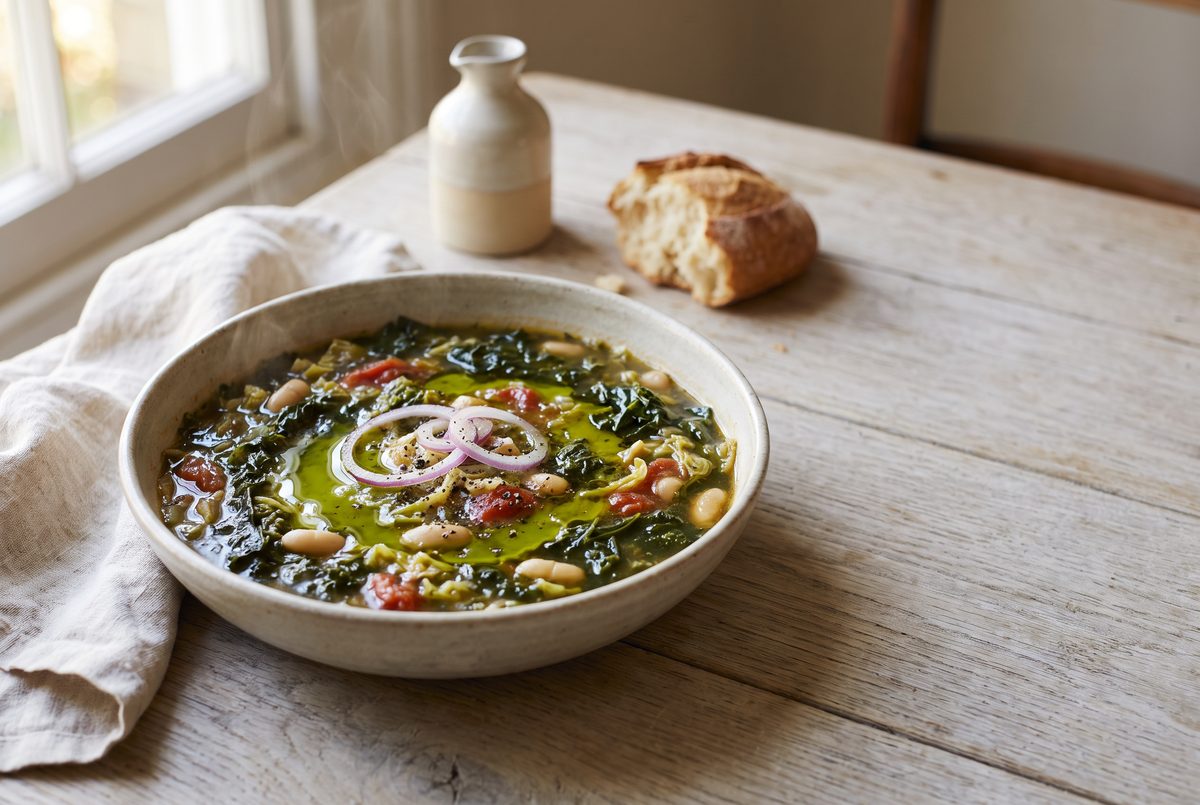
Tuscan bread has no salt in it. Nobody agrees on why — a medieval salt tax, a blockade by Pisa, or simply that a saltless loaf keeps longer and doesn't argue with prosciutto and pecorino — but the consequence in the kitchen is not in dispute. Pane sciocco goes stale fast and it goes stale hard, and a whole branch of Tuscan cooking exists to use it up. Panzanella soaks it in summer tomatoes. Pappa al pomodoro melts it down. Ribollita, the cold-weather one, boils it into a pot of beans and black kale until the bread stops being bread.
The name is also the method. Ribollita means reboiled, and it refers to a second cooking: today you make minestra di pane, a soup of beans and greens with bread stirred through it, and tomorrow you put it back on the heat and it turns denser, darker and considerably better. Skip that and you have a good vegetable soup. Do it, and you get something you eat with a fork, with raw olive oil poured over at the table and a few slivers of raw red onion. The waiting is the recipe, and the waiting isn't work.
Why this recipe works for healthy & green
Fiber is the headline: 14 g a bowl, roughly half the 25–30 g most adults are told to aim for and about four times what the average American actually eats. It arrives from three directions — cannellini, lacinato kale, savoy cabbage — which matters, because the systematic review Reynolds and colleagues published in The Lancet in 2019 found the dose-response for fiber and mortality holds across whole grains, legumes and vegetables alike, with the largest benefit between 25 and 29 g a day.
Beans are doing most of the work. Two cans of cannellini carry the protein, about half the fiber and the starch that thickens the pot. A meta-analysis by Afshin and colleagues (2014, American Journal of Clinical Nutrition) put four weekly servings of legumes at a meaningfully lower risk of ischemic heart disease. Four servings a week is one pot of this.
Kale and savoy cabbage are both brassicas, and regular cruciferous intake tracks with lower total and cardiovascular mortality in large cohorts (Zhang et al., 2011). The effect sizes are modest and observational. The vegetables are cheap and filling either way.
Protein comes in at 15 g, which is fine for a vegetable soup and not enough if you are eating to a protein target — see how much protein you actually need and the muscle-gain recipes if that is the goal. The variations below take this to about 21 g with a third can of beans. For more cooking in this register, the healthy & green collection is where it lives.
The olive oil is not optional. Two of the five tablespoons go in raw at the table, which is how Tuscans serve it and also the only point at which you taste the oil as oil rather than as a cooking fat.
Ingredients
6 deep bowls
Soffritto
The pot
Bread and table
Instructions
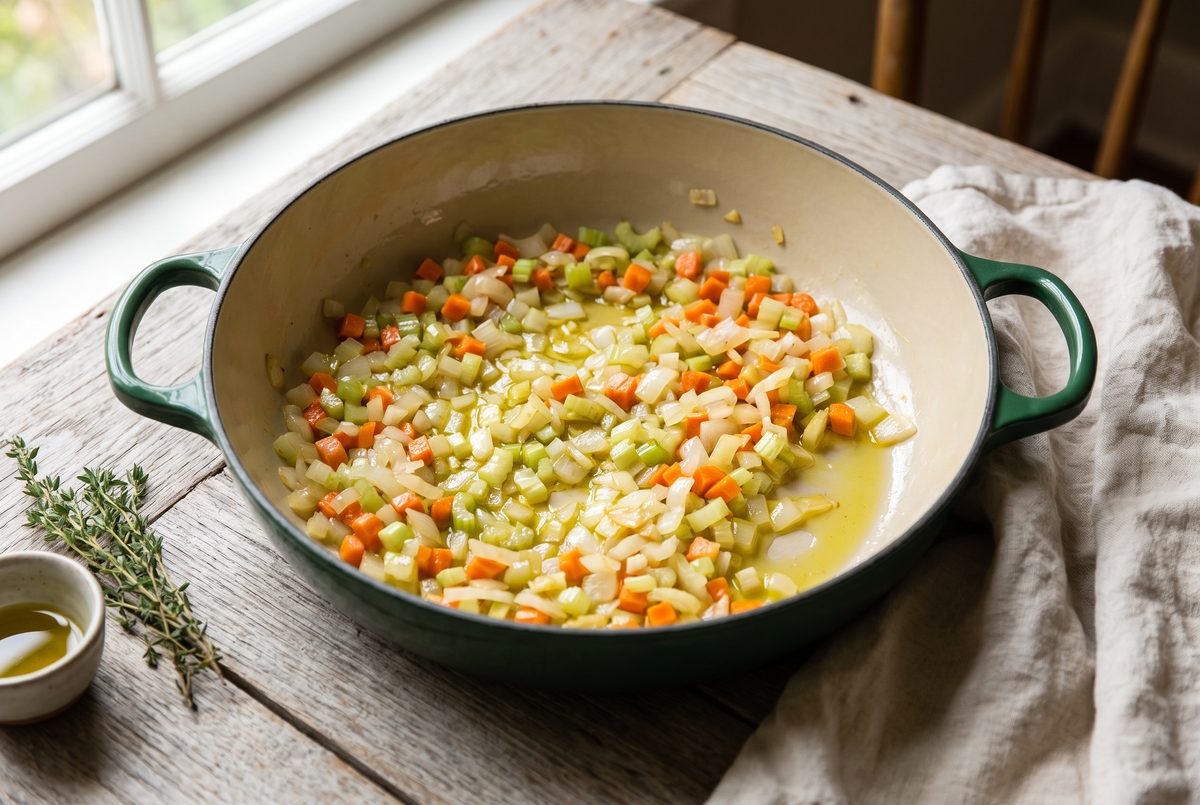
- Start the soffritto, slowly. Warm the 3 tbsp olive oil in a large heavy pot over medium-low heat. Add the onion, carrot and celery with a pinch of the salt and cook 12 to 15 minutes, stirring now and then. You want them soft, sweet and barely colored — this is the base flavor of a soup that has no stock cube, no meat and almost no herbs, so it is not the step to rush.
- Garlic, chili, tomato. Add the sliced garlic and chili flakes and cook 2 minutes more, until the garlic smells sweet and is still pale. Pour in the crushed tomatoes, raise the heat to medium and let them cook down 5 minutes, until the mixture darkens and pulls away from the bottom of the pot when you drag a spoon through it.
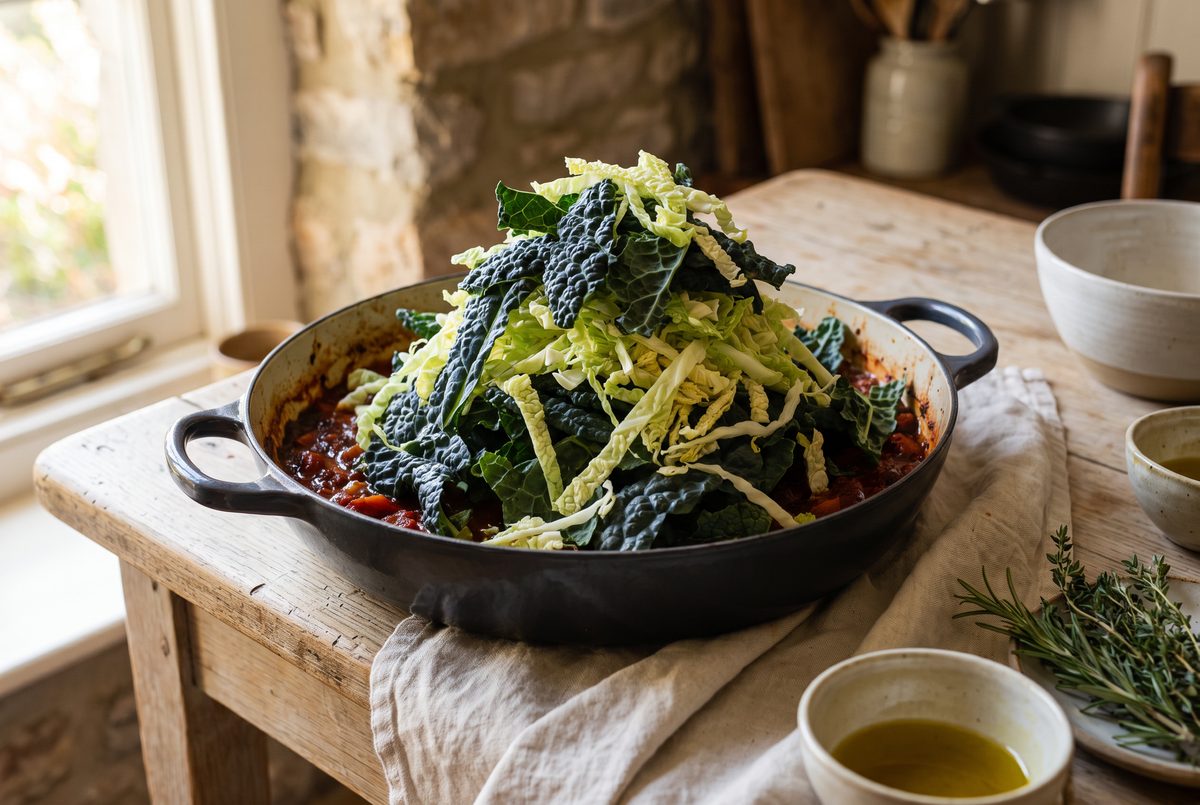
- Add the greens in stages. Strip the kale leaves off their stems and tear them into rough pieces; shred the savoy cabbage. Add them to the pot a large handful at a time — it will look like far too much for the pot and it is not. Each batch collapses in about a minute and makes room for the next. Stir in the diced potato once everything is wilted.
- Beans, half of them mashed. Put about a third of the beans in a bowl and crush them roughly with a fork, then add both the crushed and the whole beans to the pot with the broth, the water, the rest of the salt and the pepper. The mashed beans are the thickener: they dissolve into the liquid over the next hour and give the soup its body. No flour, no cream, no blender.
- Simmer 45 minutes. Bring to a boil, then drop to the lowest simmer that still moves the surface and cook 45 minutes, uncovered, stirring occasionally so nothing catches. The potato should be falling apart at the edges and the kale should be genuinely tender — not the bright, squeaky green of quickly cooked greens. Tuscan greens in this dish are cooked soft on purpose.
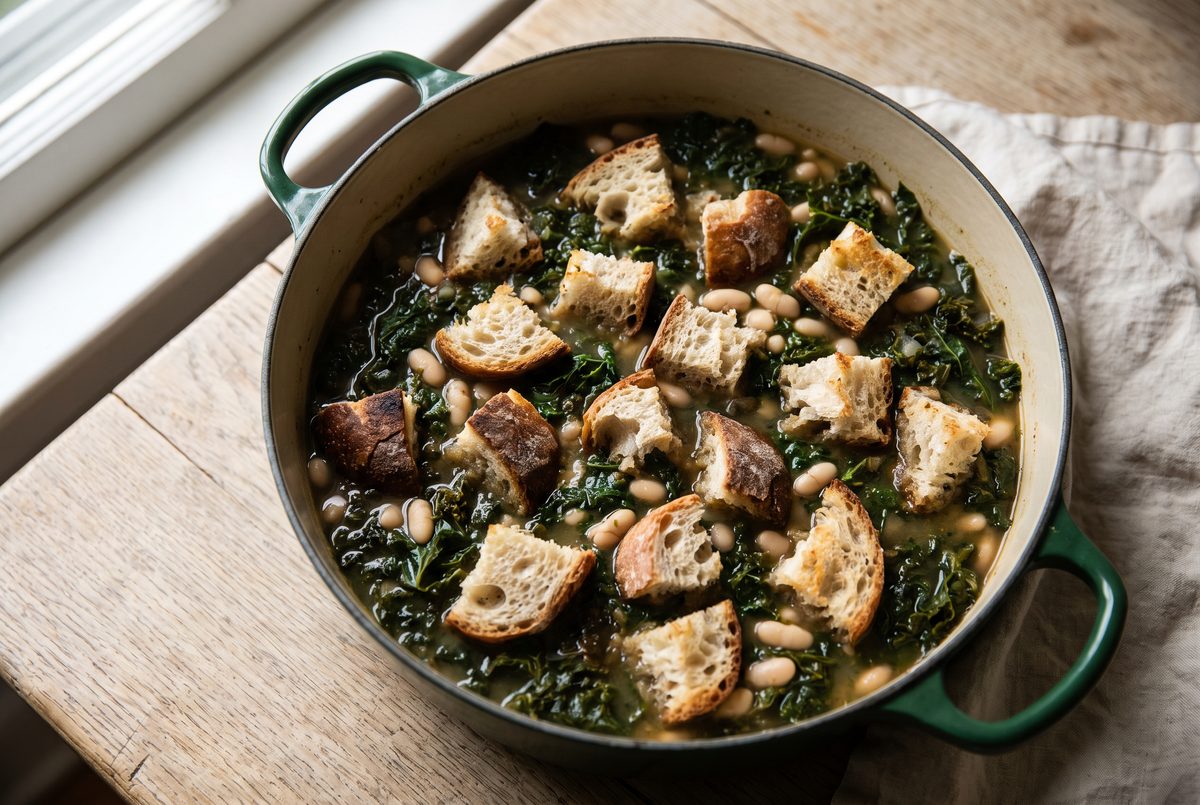
- Stir in the bread, then walk away. Tear the bread into rough 1-inch pieces, crust and all, and push them down into the soup. Simmer 5 more minutes, take the pot off the heat, and let it stand at room temperature for an hour, then refrigerate overnight. Overnight is where the bread disappears into the liquid and the flavors come together. This is not a resting time you can shorten to twenty minutes.
- The second boiling. The next day the soup will be set solid enough to hold the shape of the pot. Put it back on medium-low heat with a splash of water if it looks too stiff to stir, and cook 20 to 25 minutes, stirring more often now — it is thick and it will stick. It is ready when a spoon pushed upright into the middle stays there for a second before it leans. Taste for salt here and not before.
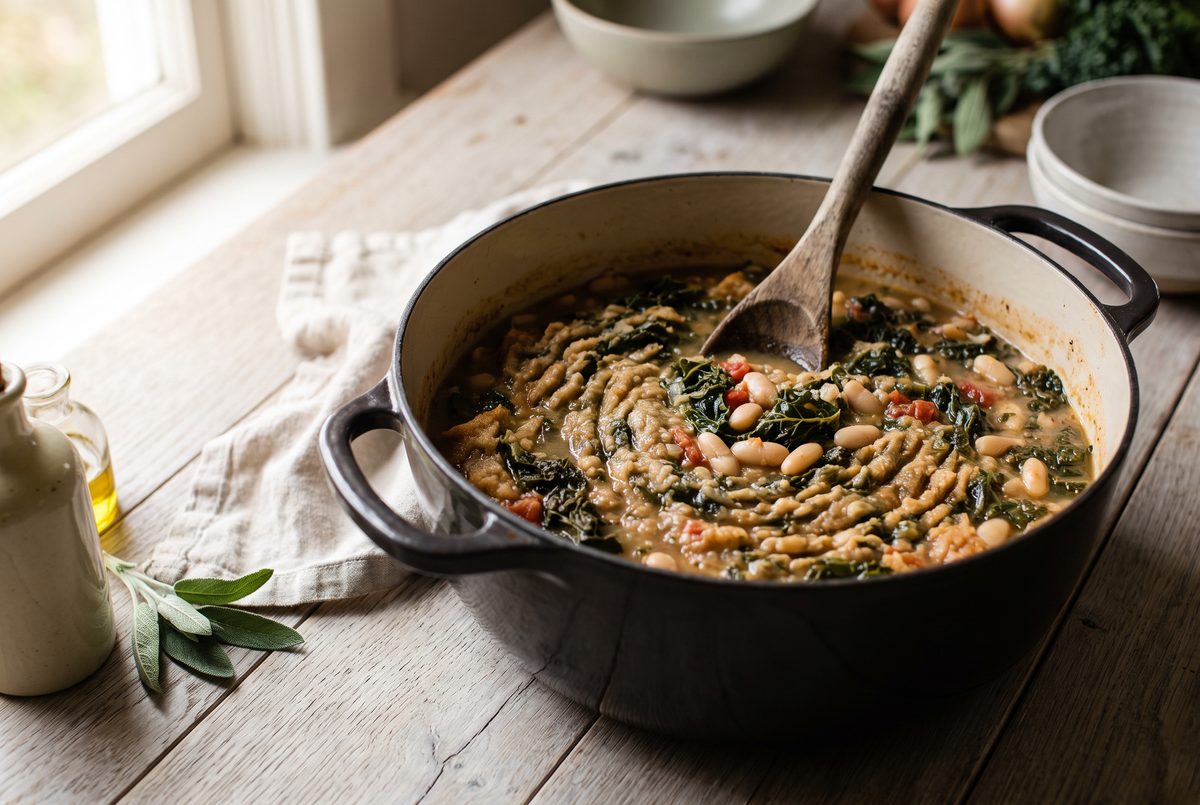
- Serve it the Tuscan way. Ladle into deep bowls, pour a good tablespoon of raw olive oil over each one — this is the moment the oil is a flavor rather than a fat — and scatter over the paper-thin red onion. A few grinds of pepper. Nothing else.
Tips from our kitchen
- Stale bread, not fresh. Fresh bread turns to paste and makes the soup gluey. If your loaf is soft, tear it up and dry it in a 300°F (150°C) oven for 15 minutes until it is hard and dry but not toasted brown.
- Sodium is 816 mg a serving, which is high in absolute terms for a vegetable soup. It is not from the ¼ tsp of salt in the pot — it comes from the canned beans, the broth and the bread, in that order. Rinsing the beans well under cold water is the single biggest lever, followed by no-salt-added cans and an unsalted loaf.
- Cavolo nero after a frost is the good stuff. Cold weather makes lacinato kale sweeter, which is why this is an October-through-March dish in Tuscany. In September the leaves are tougher: cook them the full 45 minutes and do not be tempted to cut it short.
- Do not blend it. Every year someone puts an immersion blender in this and produces a khaki purée. The texture of ribollita is deliberately uneven — dissolved bread, soft beans, whole ones, strands of kale.
Variations
- Higher protein: a third can of cannellini takes the bowl to roughly 21 g of protein and adds about 5 g of fiber, and the soup gets thicker still. It stays vegan.
- With a Parmigiano rind: drop one into the pot with the broth and fish it out before serving. No longer vegan or vegetarian in the strict sense — rennet — but it is what a Tuscan kitchen does with the rind, and it adds savory depth for very few calories.
- With pancetta: render 2 oz of diced pancetta in the pot before the soffritto and cook the vegetables in the fat. About 60 calories and 3 g of protein more per bowl, and no longer vegetarian.
- Gluten-free: leave the bread out and add a second potato plus a third can of beans. It will not be ribollita — the bread is in the name of the parent dish, minestra di pane — but it is a very good bean and kale soup.
- No savoy cabbage? Green cabbage works, and Swiss chard is the other traditional green; both go in at the same point. For another way with bitter greens and beans, our orecchiette with broccoli rabe uses the same Italian logic in half an hour.
Storage & meal prep
Ribollita is a dish designed around keeping. It holds 4 days in the fridge and genuinely improves for the first two — a third boiling is not a mistake. Reheat gently in a pot with a splash of water, never in a microwave, which heats the bread unevenly and leaves cold pockets. It freezes for 3 months, though the bread softens further: freeze in single portions, thaw overnight in the fridge, and reheat with an extra splash of water. Add the raw olive oil and red onion only at the moment you serve, never before storing.
Nutrition per serving
| Nutrient | Amount | % DV* |
|---|---|---|
| Calories | 418 kcal | 21% |
| Total fat | 14 g | 18% |
| Saturated fat | 1.9 g | 10% |
| Carbohydrates | 61 g | 22% |
| Fiber | 14 g | 50% |
| Sugars | 8.8 g | — |
| Protein | 15 g | 30% |
| Sodium | 816 mg | 35% |
*Percent Daily Values are based on a 2,000-calorie diet. Values are calculated from USDA FoodData Central and manufacturer data for the ingredients as listed; they are estimates, not lab analyses. Nutrition disclaimer.
Frequently asked questions
What is ribollita?
A thick Tuscan soup of cannellini beans, black kale and other winter vegetables, thickened with stale bread. The name means "reboiled" and refers to the method: the soup is made one day as minestra di pane and cooked a second time the next, which is what gives it a texture you eat with a fork rather than a spoon. It is peasant cooking in the literal sense — a way of using bread too stale to eat.
What is the difference between ribollita and minestrone?
Minestrone is a broth-based vegetable soup, usually with pasta or rice, eaten the day it is made — our classic minestrone is the template. Ribollita has no pasta and no rice: the starch is bread, the greens are specifically cavolo nero and cabbage, and it is reboiled the following day until it is thick. Minestrone is a soup. Ribollita is closer to a stew.
What kale do you use for ribollita?
Lacinato kale, sold in the US as Tuscan kale, dinosaur kale or cavolo nero — the dark, bumpy, strap-shaped leaves. It is the authentic green and it holds up to long cooking without turning to string. Curly kale works at a pinch but is milder and needs its thick stems stripped just as carefully.
Is ribollita healthy?
One bowl is 418 calories with 15 g of protein, 61 g of carbohydrate and 14 g of fiber — about half a day's fiber in a single dish — and the 14 g of fat is almost entirely olive oil. It is vegan as written and vegetables make up most of the weight of the pot. The number to watch is sodium at 816 mg, which comes from the canned beans, broth and bread rather than added salt.
Can I make ribollita in one day?
You can make minestra di pane in one day, and it is good. You cannot make ribollita, because the reboiling the next day is the definition of the dish. If you are short on time, the overnight rest can happen at room temperature for two hours in a cool kitchen instead, but the result is noticeably thinner and the bread will still be recognizable as bread.
Sources
- USDA FoodData Central — kale (raw), savoy cabbage (raw), cannellini beans (canned, drained), ciabatta bread, olive oil
- Reynolds, A. et al. (2019). Carbohydrate quality and human health: a series of systematic reviews and meta-analyses. The Lancet
- Afshin, A. et al. (2014). Consumption of nuts and legumes and risk of incident ischemic heart disease, stroke, and diabetes: a systematic review and meta-analysis. American Journal of Clinical Nutrition
- Zhang, X. et al. (2011). Cruciferous vegetable consumption is associated with a reduced risk of total and cardiovascular disease mortality. American Journal of Clinical Nutrition
You might also like
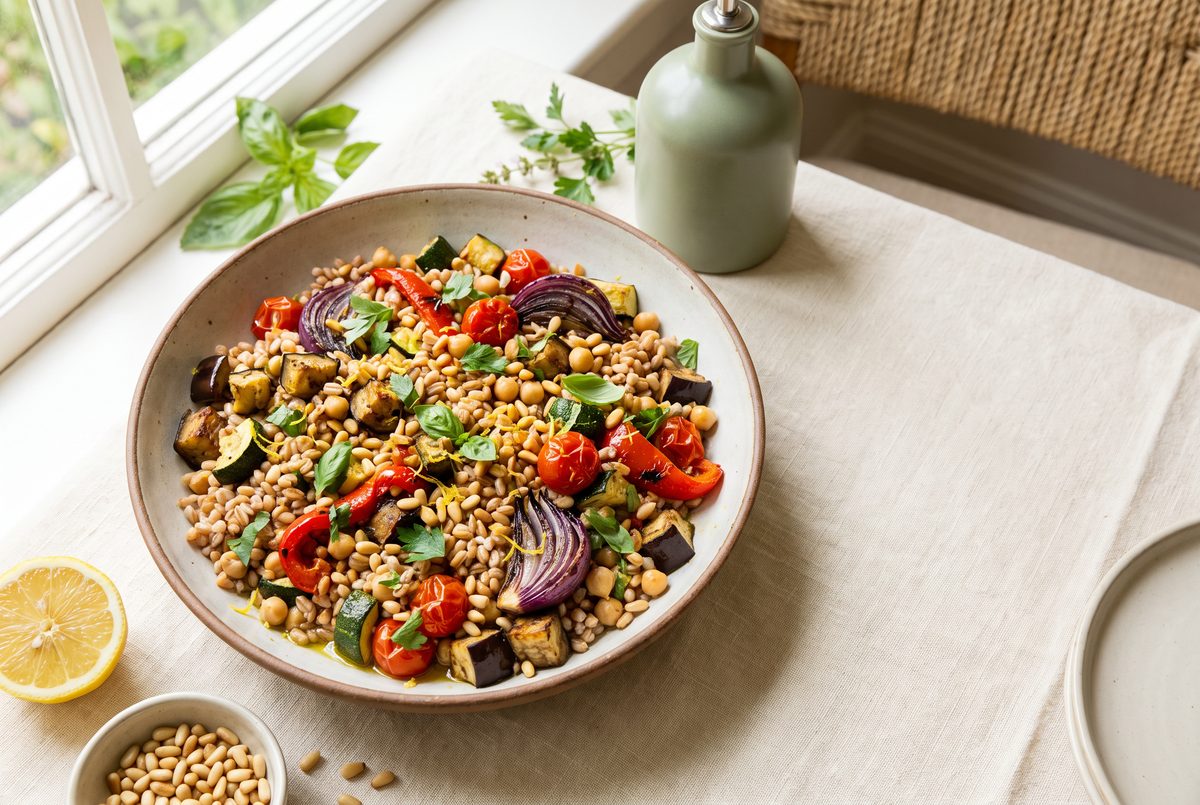
Farro Salad with Roasted Vegetables and Lemon
Farro salad with roasted vegetables tosses chewy pearled farro with oven-caramelized zucchini, eggplant, peppers, red…
- 45 min
- 481 kcal
- 14 g protein
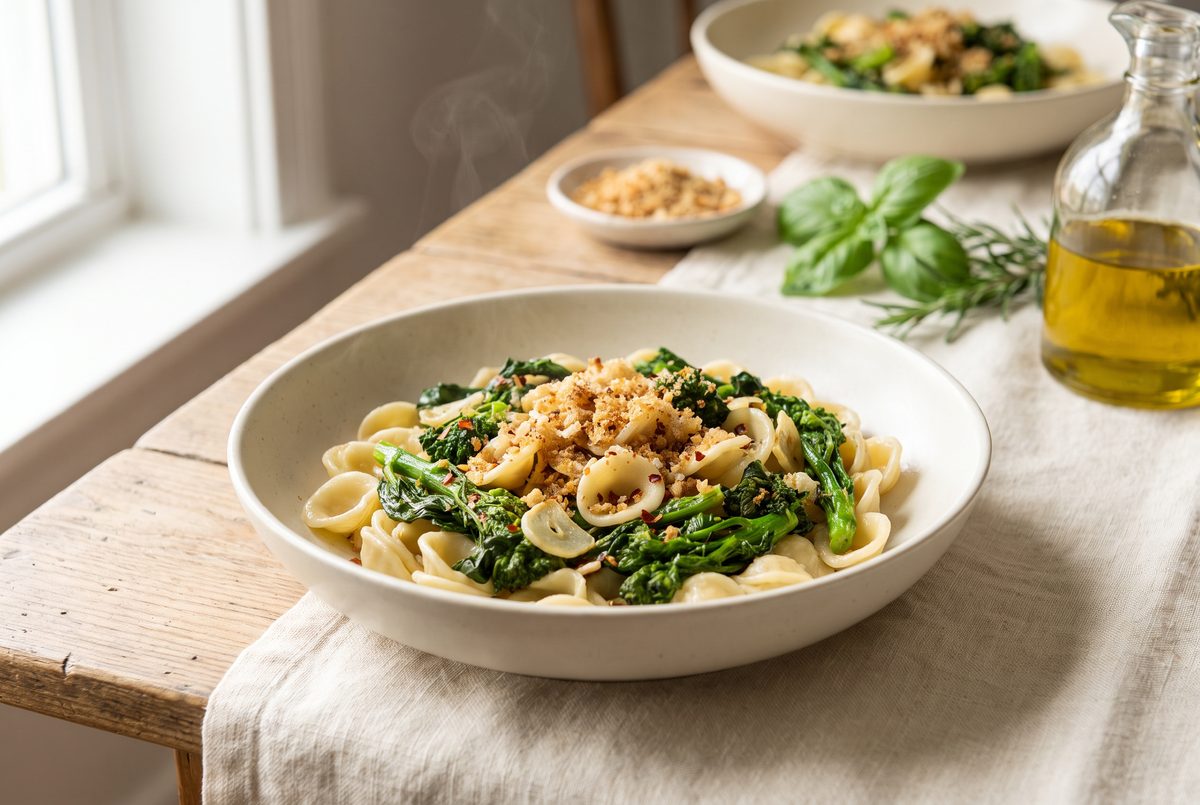
Orecchiette with Broccoli Rabe
Orecchiette with broccoli rabe is the standard plate of Puglia: a pound and a half of rapini blanched in the pasta…
- 30 min
- 456 kcal
- 16 g protein
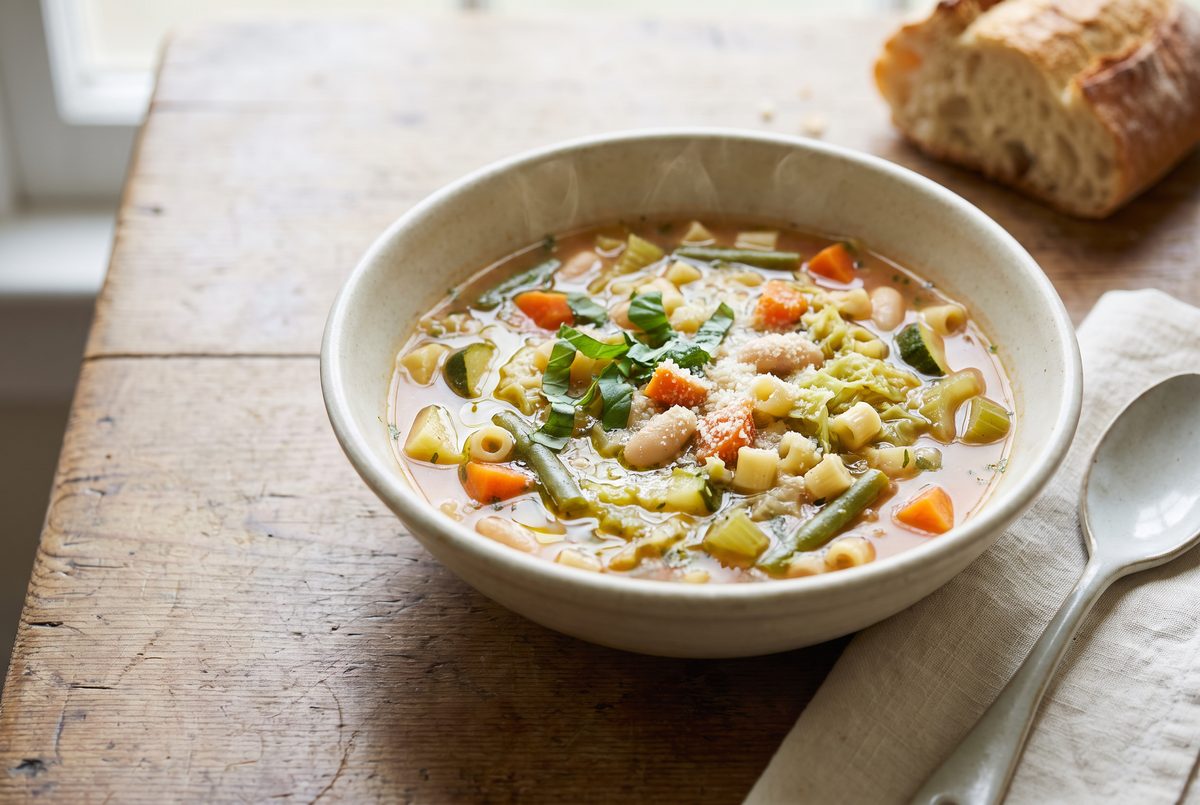
Classic Italian Minestrone Soup
Classic Italian minestrone is a thick vegetable soup with cannellini beans, seasonal vegetables and a handful of small…
- 1 hr 5 min
- 247 kcal
- 11 g protein