Sicilian Cauliflower Affogato
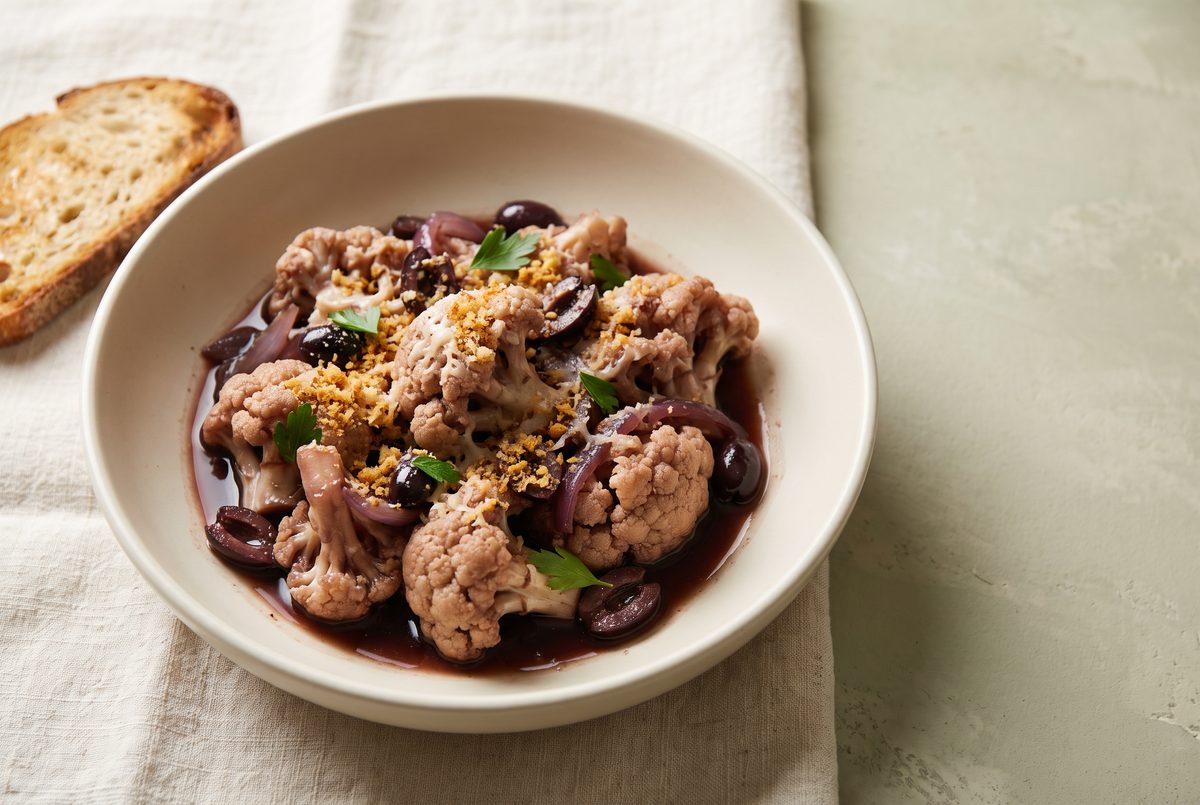
Cavolfiore affogato: a whole cauliflower layered in a pot with red onion, black olives and pecorino, drowned in red wine and left under a lid until it collapses. No oven, no stirring.
*Cavolfiore affogato* is the Palermo way with cauliflower: florets layered in a pot with red onion, black olives and pecorino, then drowned in a glass of dry red wine and cooked covered until they collapse into each other. One plate with bread is 412 calories, 9 g of fiber and 15 g of protein, and it needs 35 minutes and no oven.
Cauliflower has one problem and it is the smell. Boil it, or steam it under a lid in plain water, and the sulfur compounds come out of the florets and stay in the kitchen until the next morning. The American fix of the last ten years is a 450°F oven and a sheet pan, and it works. The Sicilian fix is older and goes the other way entirely: put the lid on, but drown the thing in red wine first.
Cavolfiore affogato — drowned cauliflower — is what gets made in Palermo when the white heads pile up at Ballarò in November. You build it cold, in layers, like a lasagna with no pasta: sliced red onion and oil on the bottom, then cauliflower, then a scatter of black olives, grated pecorino, pepper and chili, then the rest of the cauliflower and the rest of the olives and cheese on top. The wine goes over everything, the lid goes on, and for twenty-five minutes you do nothing at all. What comes out is not roasted cauliflower and not boiled cauliflower: the florets have slumped against each other, the wine has reduced to something dark and savory at the bottom, and the pecorino has melted into it.
The reason it does not smell of sulfur is the same reason it tastes of something: acid. The wine keeps the pot acidic, which slows the breakdown that produces those compounds, and the olives and cheese give the pot enough salt and fat that you are not trying to make a vegetable interesting with technique alone. It is a poor dish — cauliflower, an onion, a handful of olives, the end of a bottle — and it eats like it isn't.
Why this recipe works for healthy & green
Fiber is what this plate does best: 9 g per serving, out of 2½ lb of cauliflower split four ways and a slice of bread each. Average intake in the United States sits around 16 g a day against a 28 g daily value (Quagliani & Felt-Gunderson, 2017), so one plate closes a third of that gap. The Lancet series on carbohydrate quality found the clearest dose-response for mortality and cardiometabolic risk in the 25–29 g range of daily fiber (Reynolds et al., 2019); vegetables this bulky are the cheapest way into it, because 100 g of cauliflower is 25 calories and 2 g of fiber.
Cauliflower is Brassica oleracea, the same species as cabbage, broccoli and Brussels sprouts, and carries the glucosinolates of the family. Large prospective cohorts associate regular cruciferous intake with lower total and cardiovascular mortality (Zhang et al., 2011) — observational, with modest effect sizes, and worth no more than that. The uncontroversial part is the USDA data: a 10 oz serving of raw cauliflower covers the daily vitamin C requirement on its own.
The protein is 15 g and it is a vegetable dish being honest. Roughly 6 g comes from the cauliflower itself, 4 g from the pecorino, the rest from the bread and the breadcrumbs. That is in the normal range for this collection — our healthy & green recipes are built to be vegetable-first, with cheese seasoning the plate rather than carrying it — but it is not a high-protein dinner, and if that is what you need tonight the muscle-gain recipes start at 30 g. The variations below add a can of chickpeas, which takes the plate to 19 g.
Olive oil is 3 tablespoons and 88 of the 412 calories. Spending a fifth of a plate's calories on it is defensible: in a US cohort of over 90,000 adults followed for 28 years, the highest olive oil intake was associated with 19% lower cardiovascular mortality, with the clearest effect when it replaced butter and margarine (Guasch-Ferré et al., 2022). This is also the dish where you taste it, since the last 2 teaspoons go in raw at the end.
Sodium is the weak point and it is 730 mg per serving. The olives bring about 110 mg of that, the pecorino 150, the bread 170, and the ¼ teaspoon of added salt 145. Rinsing the olives, using unsalted bread, or simply leaving the added salt out — the pot genuinely does not need it — brings the plate under 600 mg. We would not touch the pecorino: it is the only thing in the pot that makes the wine taste like a sauce.
Ingredients
4 main plates with bread, or 8 side portions
The pot
To finish
To serve
Instructions
- Break down the whole cauliflower, core included. Pull off the outer leaves and set aside any that are tender and pale — they go in the pot. Cut the head into quarters through the stem, then cut the florets off in pieces about 1½ inches across, roughly walnut-sized. Do not throw away the core: peel the tough outside off it and slice what's left ¼ inch thick, like a stalk of broccoli. It cooks sweeter than the florets and it is a quarter of the weight you paid for. You want about 2½ lb of cut cauliflower in a bowl.
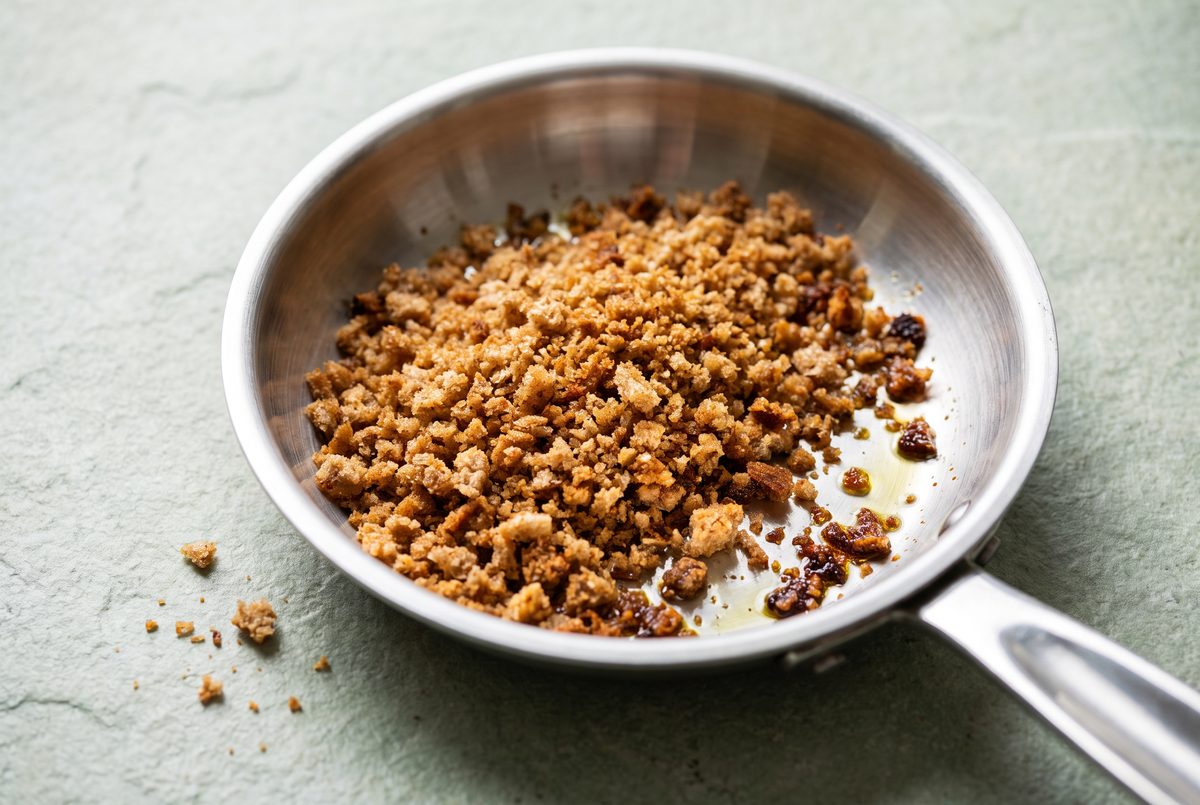
- Toast the breadcrumbs separately. Warm 1 tsp of the olive oil in a small skillet over medium heat, add the breadcrumbs and cook 3 to 4 minutes, moving them around the pan, until they are the color of a brown paper bag and smell toasted. Tip them onto a plate right away — they keep darkening in a hot pan and burnt crumbs taste of nothing but ash. This is muddica atturrata, what Sicilians put on a dish instead of more cheese, and it is the only crunch in a pot where everything else goes soft.
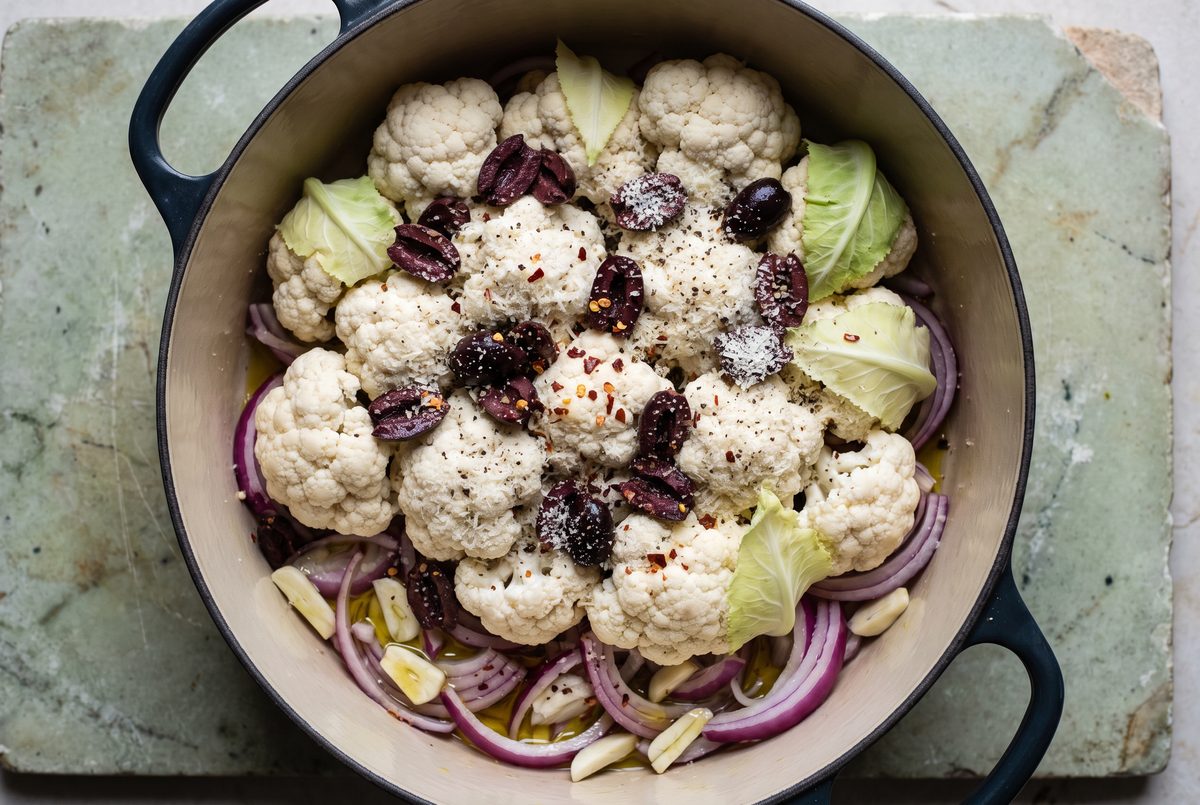
- Build the pot cold, in two layers. Take a heavy pot of at least 5 quarts with a tight lid. Pour the 2 tbsp of olive oil over the bottom and spread the sliced onion and garlic in it in an even bed. Add half the cauliflower, then scatter over half the olives, half the pecorino, the chili flakes, half the black pepper and the salt. Add the rest of the cauliflower — leaves and core slices tucked into the gaps — and finish with the remaining olives, pecorino and pepper. The pot will look alarmingly full and it will lose a third of its height in the first ten minutes.
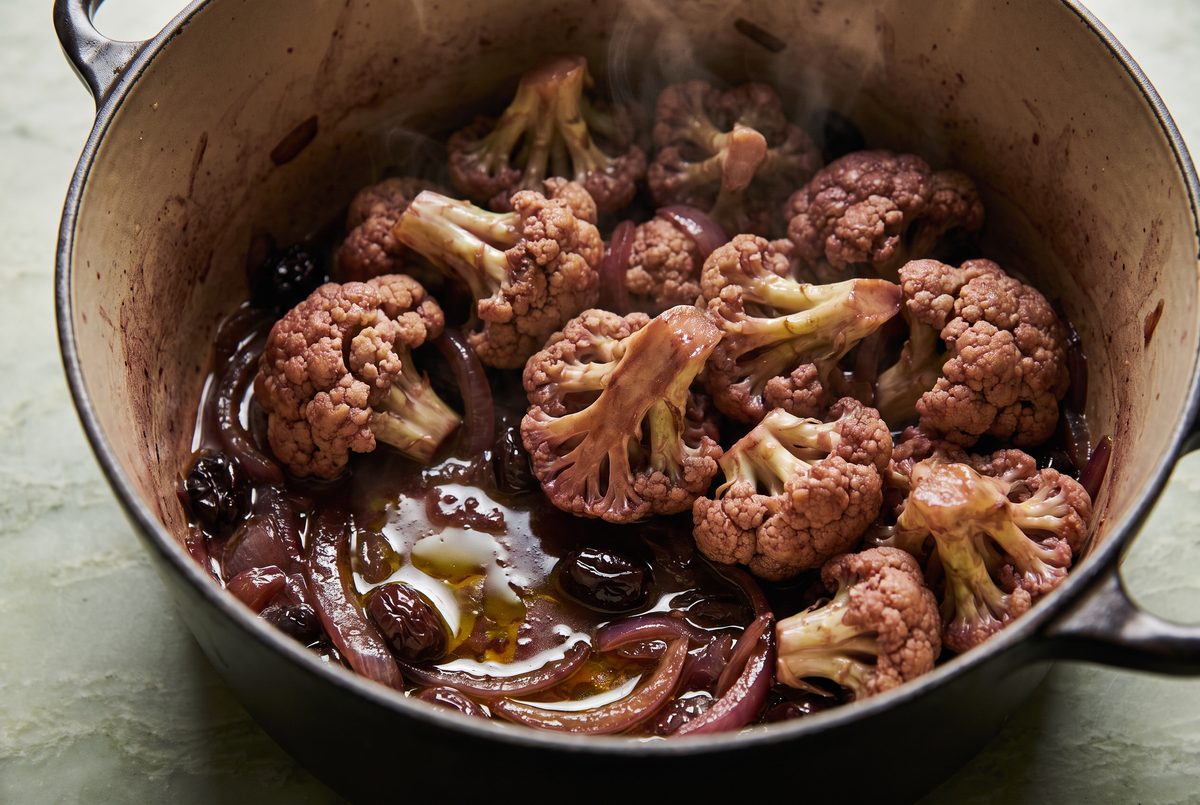
- Pour in the wine, cover, and leave it alone. Pour the wine over everything — it will only come an inch up the pot, which is correct, since the cauliflower releases plenty of its own water. Put the lid on, bring it to a simmer over medium heat (you'll hear it after 4 or 5 minutes), then turn it to low and cook 25 minutes. Do not stir and do not lift the lid before 20 minutes: every peek costs steam, and steam is what is cooking the top layer. It is done when a knife slides into a thick floret with no resistance and the cauliflower has gone from white to the color of weak tea.
- Uncover and drive off the liquid. Take the lid off, raise the heat to medium-high and let the pot bubble 4 to 6 minutes without stirring, until the liquid at the bottom is reduced to a glossy dark pool a spoon can drag through — not a broth. Then fold the pot over on itself two or three times with a wooden spoon, gently, breaking some of the softest florets on purpose: that is what makes the sauce cling. Taste it now. This is the first and only moment the pot might want salt, and nine times out of ten the olives have taken care of it.
- Finish with raw oil, parsley and the crumbs. Off the heat, pour over the remaining 2 tsp of raw olive oil and stir in the parsley. Toast the bread. Spoon the cauliflower into shallow bowls, scatter the breadcrumbs over each one at the table rather than in the pot — they go soft within a couple of minutes — and put a slice of bread in or beside each bowl. Serve it warm, not hot: this is a dish that tastes of more as it cools, which is also why it works on a buffet.
Tips from our kitchen
- A 5-quart pot is the minimum for 2½ lb of cauliflower, and a tight lid matters more than the pot. If yours sits loose, lay a sheet of parchment over the pot before the lid — the 25 minutes depend on trapped steam, not on the liquid.
- Buy the heaviest head with the leaves still on. Weight relative to size tells you the florets are dense and fresh; the leaves tell you it hasn't been trimmed to hide browning. Yellow-brown speckles on the curds are oxidation, harmless but a sign of age, and they go grey in the pot.
- Cheap red is fine, sweet red is not. A dry Nero d'Avola or a Frappato is what would be open in Sicily, but any dry red works. What ruins the pot is residual sugar: anything that tastes of jam will cook down into something cloying against the cauliflower.
- Oil-cured or brined olives, never canned. The soft black cans sold as "ripe olives" in the US are lye-cured and carry almost no flavor — they will dissolve into the pot and leave only salt. Gaeta, Itrana, or any wrinkled oil-cured Sicilian olive gives you what the dish is built on.
- If the pot looks watery at the 25-minute mark, it means the cauliflower was wet when it went in or the lid was lifted early. Don't panic and don't drain it: the uncovered stage in step 5 exists for exactly this, and two extra minutes over medium-high heat fixes it.
Variations
- With anchovy, the way most Palermo cooks make it: 4 oil-packed anchovy fillets melted into the oil and onion at the bottom of the pot before the cauliflower goes in. No longer vegetarian; it costs 8 calories and 1 g of protein per serving but pushes sodium to 877 mg, and the pot gains a savory depth you cannot get from cheese alone.
- With chickpeas, as a bigger dinner: one 15 oz can, drained and rinsed, scattered between the two layers. The plate becomes 495 calories with 19 g of protein and 13 g of fiber — a fuller dinner for 83 calories, without touching the method. Sodium goes to 880 mg, so leave the added salt out if you do this.
- Vegan: leave out the pecorino and add 2 tbsp of toasted pine nuts and a tablespoon of capers, rinsed, between the layers. The plate becomes 392 calories with 11 g of protein and 633 mg of sodium, the lowest version of this recipe; it is less rich, but the capers do the job of making the wine taste seasoned. Our guide to vegan Italian food has the same logic applied to other classics.
- As a pasta sauce, which is what the leftovers want to be: chop the cold cauliflower coarsely, warm it with a ladle of pasta water and toss with 10 oz of short pasta. It is a cousin of pasta chi vruocculi and feeds four with what two people left in the pot.
- Same pot, other November vegetables: wedges of savoy cabbage, quartered fennel or halved radicchio all take the layered-and-drowned method. Cut the covered time to 15 minutes for radicchio, which collapses fast, and to 20 for fennel.
- With a piece of fish beside it, the pot becomes a two-dish dinner: a fillet of trout baked in paper with leeks and potatoes goes into the oven for the same 25 minutes the cauliflower spends under its lid, and neither needs watching.
Storage & meal prep
Keeps 4 days in the fridge and is genuinely better on day two, once the wine and the cheese have gone through the florets. Store it without the breadcrumbs and without the raw finishing oil, and add both when you reheat. Warm it in a covered pan with a splash of water over low heat, or eat it at room temperature, which is how half of Sicily eats it. It freezes acceptably for 2 months — the texture goes softer still, so freeze it with the leftovers-as-pasta-sauce variation in mind rather than as a plate.
Nutrition per serving
| Nutrient | Amount | % DV* |
|---|---|---|
| Calories | 412 kcal | 21% |
| Total fat | 17 g | 22% |
| Saturated fat | 4 g | 20% |
| Carbohydrates | 46 g | 17% |
| Fiber | 9.1 g | 33% |
| Sugars | 9.2 g | — |
| Protein | 15 g | 30% |
| Sodium | 730 mg | 32% |
*Percent Daily Values are based on a 2,000-calorie diet. Values are calculated from USDA FoodData Central and manufacturer data for the ingredients as listed; they are estimates, not lab analyses. Nutrition disclaimer.
Frequently asked questions
Is cauliflower healthy?
It is 25 calories per 100 g with 2 g of fiber, and a 10 oz serving covers the daily value for vitamin C on its own (USDA). As a cruciferous vegetable it belongs to the group that large cohort studies link with lower total and cardiovascular mortality (Zhang et al., 2011) — observational evidence, so the honest reading is "associated with", not "causes". What is certain is the arithmetic: 2½ lb of it carries 24 g of fiber for 300 calories.
How do you cook cauliflower so it doesn't smell?
Cook it in something acidic, or cook it dry and hot. The sulfur smell comes from glucosinolate breakdown, which a long cook in plain water encourages; the ¾ cup of dry red wine in this pot keeps things acidic enough to slow it down, and the lid traps the steam instead of sending it into the kitchen. The other reliable method is the opposite extreme — a 425°F oven and a sheet pan, no liquid at all. What produces the smell is boiling it, uncovered, in salted water for twenty minutes.
What does affogato mean in cooking?
Drowned. In Italian kitchens affogato describes anything cooked submerged in liquid — eggs poached in tomato are uova affogate, and the coffee dessert is a scoop of gelato drowned in espresso. Here it is the cauliflower under three quarters of a cup of red wine plus the water it releases itself, cooked covered until it gives up. It is a method, not a brand of dish: the same word is used in Palermo for cabbage and for escarole.
Can I make this ahead?
Yes, and it is one of the few vegetable dishes that improves. Cook it through step 5, cool it and refrigerate up to 4 days; reheat covered with a splash of water, then add the raw oil, the parsley and the toasted breadcrumbs. The crumbs can be toasted three days ahead too and kept in a jar at room temperature. It also holds warm in a low oven for half an hour without turning to mush, which is unusual for cauliflower.
Can I serve cauliflower affogato as a Thanksgiving side?
That is what the 8-portion yield is for: a side portion is about 210 calories with 4 to 5 g of fiber, it can be made the day before, and it reheats in a covered pan while the oven is busy with everything else. It is also the rare holiday vegetable that isn't competing with the stuffing — no cream, no butter, no sugar — and the dark wine-stained florets look like nothing else on the table.
Do I have to use wine?
The dish is named after it, so you will be making something else — but something else that works. Use ½ cup of water with 2 tbsp of red wine vinegar and a pinch of sugar: you keep the acidity, which is what stops the sulfur note and what cuts the pecorino, and you lose the depth the wine gives as it reduces. Dealcoholized red wine is a better substitute than grape juice, which is far too sweet. Cooked uncovered for the last 5 minutes, almost all the alcohol in the original version is gone anyway.
Sources
- USDA FoodData Central — cauliflower (raw), onion, black olives, pecorino romano, whole-wheat breadcrumbs, olive oil
- Zhang, X. et al. (2011). Cruciferous vegetable consumption is associated with a reduced risk of total and cardiovascular disease mortality. American Journal of Clinical Nutrition
- Reynolds, A. et al. (2019). Carbohydrate quality and human health: a series of systematic reviews and meta-analyses. The Lancet
- Guasch-Ferré, M. et al. (2022). Consumption of olive oil and risk of total and cause-specific mortality among U.S. adults. Journal of the American College of Cardiology
- Quagliani, D. & Felt-Gunderson, P. (2017). Closing America's fiber intake gap. American Journal of Lifestyle Medicine
You might also like
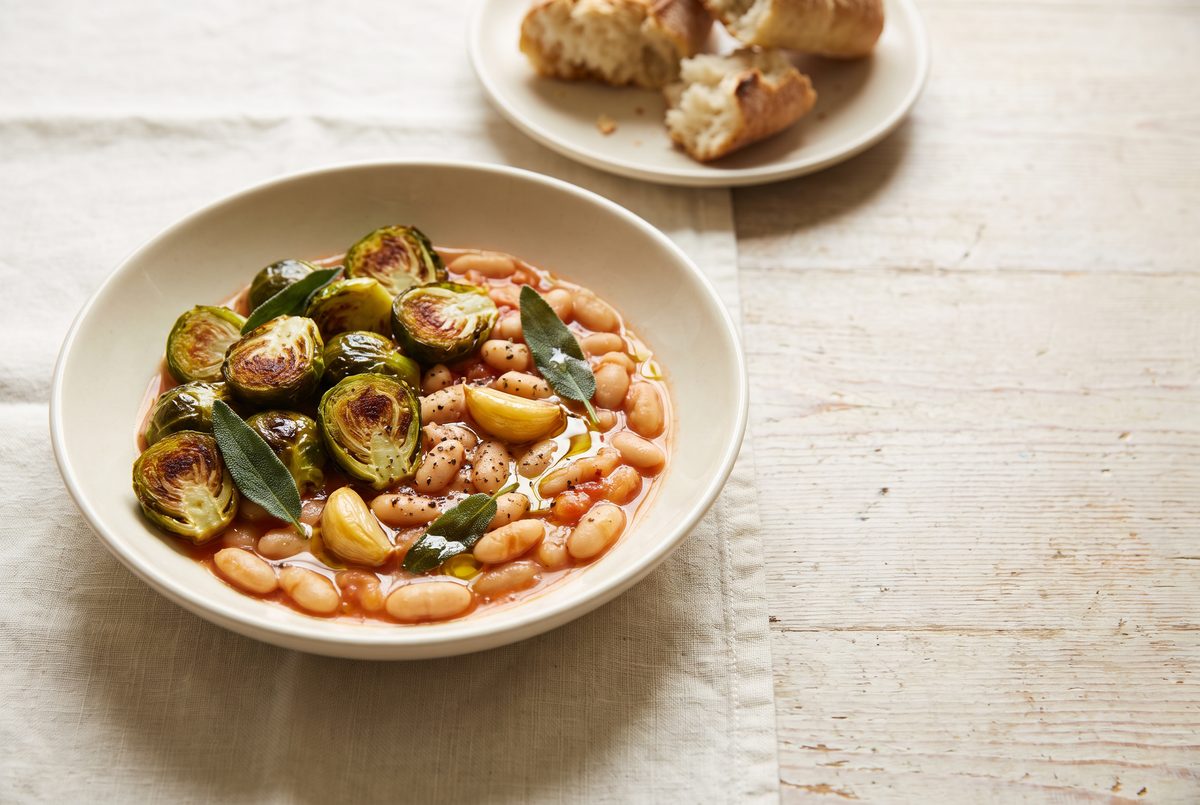
Brussels Sprouts with Tuscan White Beans
Brussels sprouts seared cut-side down until deeply browned, then finished in a pan of *fagioli all'uccelletto* — the…
- 35 min
- 383 kcal
- 18 g protein
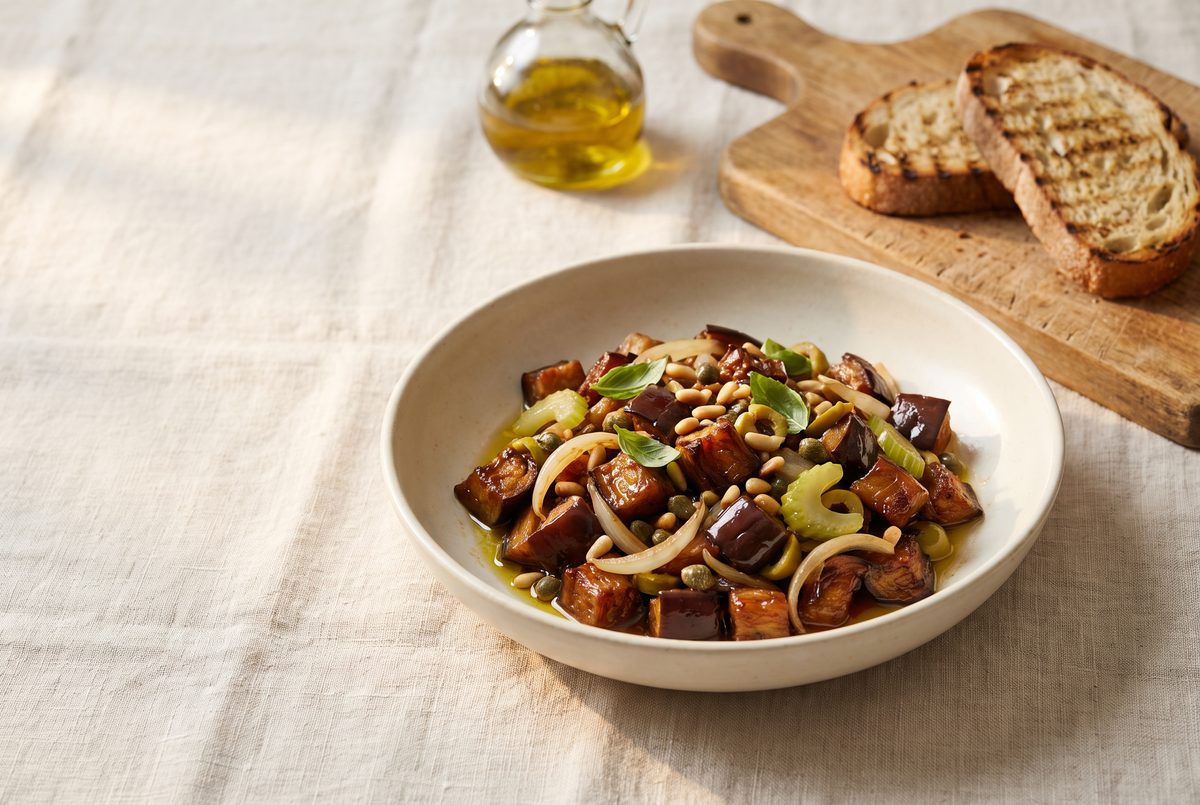
Sicilian Caponata: Roasted Sweet-and-Sour Eggplant
Caponata is the Sicilian dish of eggplant, celery, green olives and capers cooked down in an agrodolce — a…
- 1 hr 10 min
- 249 kcal
- 3 g protein
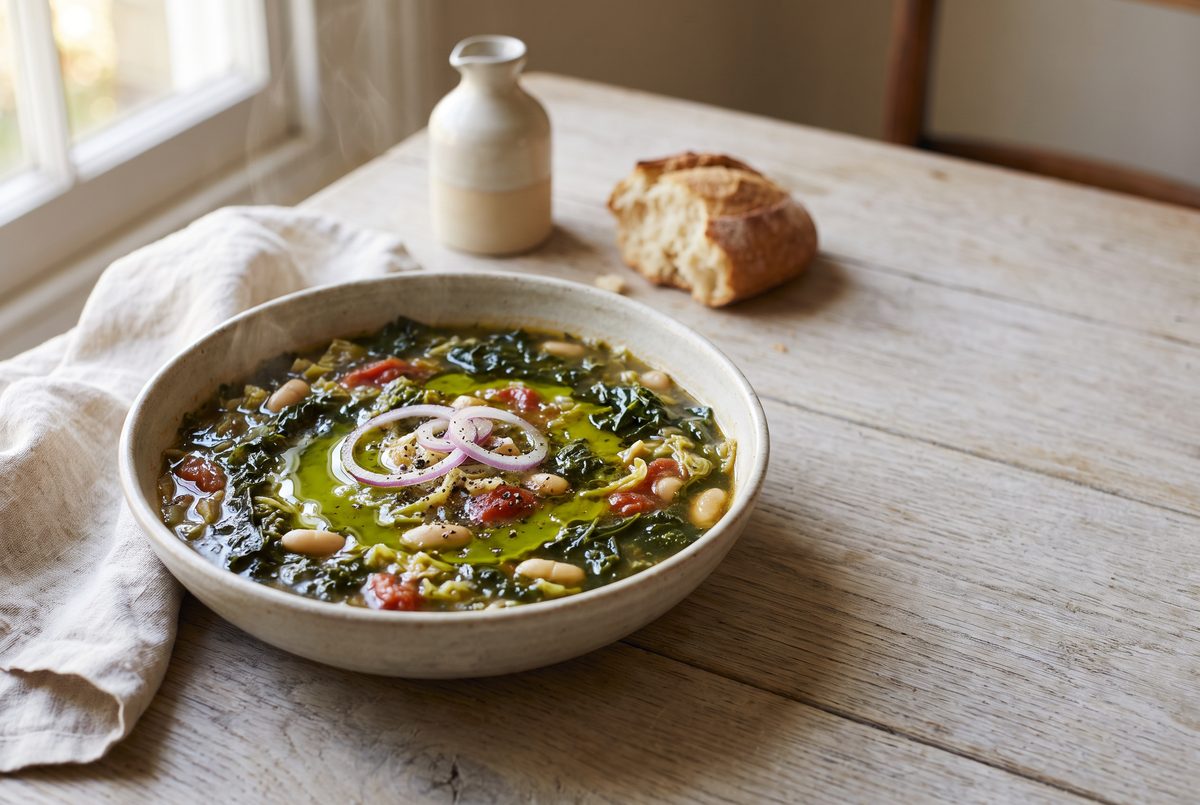
Ribollita: The Tuscan Kale, Bean and Bread Soup
Ribollita is the Tuscan soup that starts as a pot of cannellini beans and black kale and only becomes itself the next…
- 2 hr
- 418 kcal
- 15 g protein