Trout al Cartoccio, Baked in Parchment
Al cartoccio means in paper, and it is the quietest way to cook fish there is: a trout fillet on a bed of thin potatoes and leeks, lemon, capers and a splash of white wine, folded shut and left to steam in its own juices for fifteen minutes.
Al cartoccio means in paper: a trout fillet goes into a folded parchment packet on a bed of thin potatoes and leeks, with lemon, capers and a splash of white wine, and steams in its own juices for fifteen minutes. One packet is a whole dinner at 450 calories with 33 g of protein and 5.5 g of fiber, it takes 45 minutes start to finish, and the kitchen does not smell of fish afterwards.
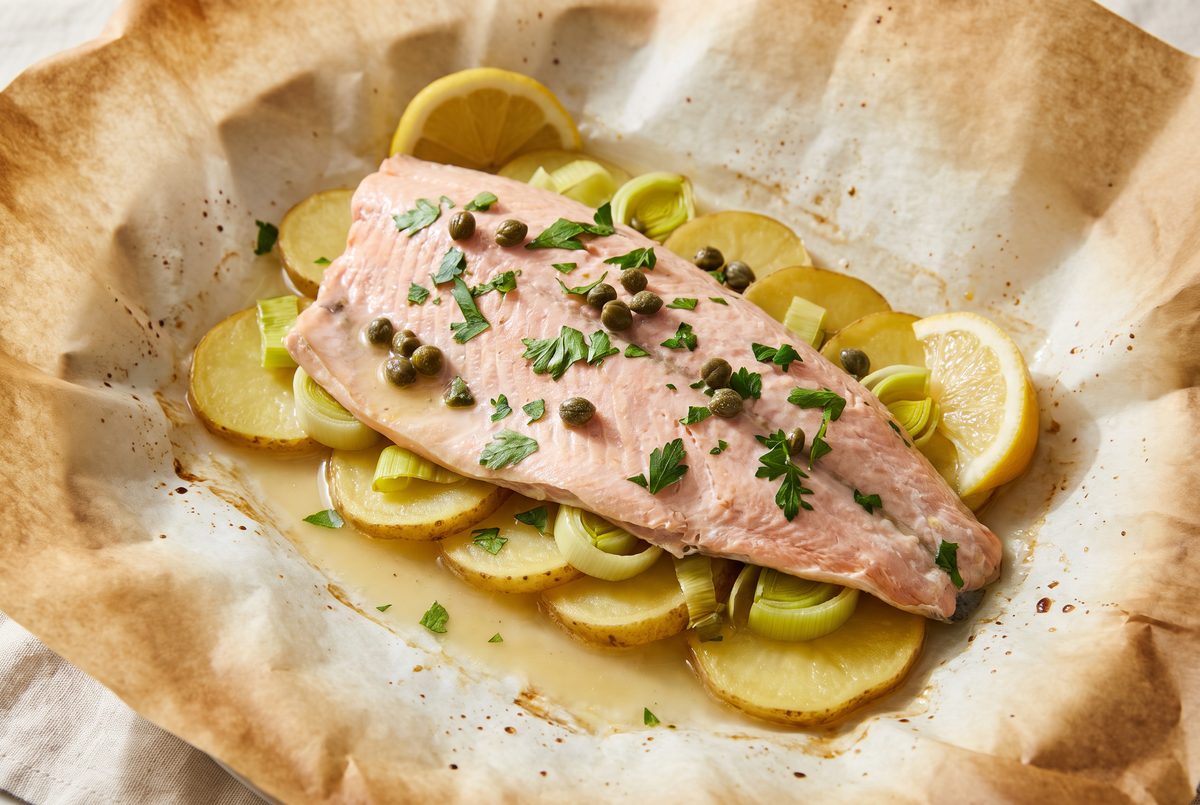
The honest reason most people I know do not cook fish at home has nothing to do with technique. It is that the apartment smells of it until Thursday. Frying drives it into the curtains, broiling drives it into the hallway, and the smell of yesterday's fish is the single best argument for ordering it in a restaurant instead. The first time I cooked trout al cartoccio I opened the oven expecting the usual and found almost nothing — the smell was all still inside four sealed paper packets, and it came out in one short, wonderful burst when I cut the first one open at the table.
Cartoccio is simply the Italian for a paper wrapper: the cone a friggitoria hands you fried anchovies in, and the folded parcel a fish goes into before it goes in the oven. Pesce al cartoccio is cooked all down the peninsula — orata, branzino, a whole fish with lemon slices in its belly — and it is not a restaurant flourish but a home method, because paper costs nothing and it is forgiving. Trout is the version from higher up. Rainbow trout is the most widely farmed fish in Italy and the country produces roughly a fifth of all the trout in the European Union, nearly all of it in the spring-fed valleys of the north (D'Agaro et al., 2022), which is also why trota turns up on menus in Trentino and Friuli where the sea is three hours away. It happens to be the same species sitting in the American fish case at $9 a pound, boned and butterflied, which makes this one of the rare Italian fish dishes you can cook here with exactly the fish they cook it with there.
What earns it a place in this collection is arithmetic rather than virtue. Trout is 141 calories per 100 g raw with 19.9 g of protein — leaner than salmon by a third, richer than cod by a good margin — and a packet built on 6 oz of potatoes and a whole leek comes to 450 calories with 33 g of protein. That is a full dinner with a starch on it, which is not something the 550-calorie ceiling usually allows, and the reason it fits is that steam needs no fat to carry heat. The same fish in a pan wants oil, and the same potatoes roasted want more; this version spends its fat budget on 2 tablespoons of good olive oil poured over four packets at the end. If the general principle interests you more than the recipe, it is the one our guide on how to eat Italian and lose weight is built around.
Why this recipe works for weight loss
Trout sits in the gap between cod and salmon, and that gap is the whole point. Per 100 g raw: cod is 82 calories with 17.8 g of protein, trout 141 with 19.9 g, salmon 208 with 20.4 g. Expressed as protein per 100 calories that is 21.7 for cod, 14.1 for trout, 9.8 for salmon. Cod wins the arithmetic outright and our baked cod with chickpeas and tomatoes is that version written out in full — but cod is a fish that needs help, and a packet is a gentle place. Trout has enough fat of its own (6.2 g per 100 g) to come out of fifteen minutes of steam tasting like something rather than like a diet. One fillet puts 27.9 g of protein on the plate, which clears on its own the 20 g floor every main in this collection is built to; protein is also the macronutrient with the best evidence behind it for holding appetite down and protecting lean mass while calories are restricted (Leidy et al., 2015).
The potatoes are in here on purpose, and the reason is satiety rather than tradition. Potatoes have a worse reputation in American kitchens than they deserve: in the classic satiety-index work, boiled potatoes scored higher than any other food tested — more than three times white bread, gram for gram of calories (Holt et al., 1995). Plain boiled potato is bulky, watery and filling, and at 77 calories per 100 g it buys a lot of volume cheaply. Six ounces a person is 131 calories, 30 g of carbohydrate and 3.7 g of fiber, and it is what makes this feel like dinner instead of a fillet on a plate. Leave the skins on — most of that fiber is in them.
Fifteen minutes of steam, and no added fat to carry the heat. The packet is a sealed steam oven: the liquid is a tablespoon of wine per person plus whatever the leeks and potatoes give up, and the trapped vapor cooks the fish from every side at once at a temperature that cannot run away from you. This matters to the numbers more than it sounds. The total fat on the plate is 16 g, of which 8.7 g is the trout's own and 6.8 g the olive oil; saturated fat is 2.9 g. Pan-searing the same fillet would add a teaspoon of oil per person before anything else happened, and roasting the potatoes properly would add a tablespoon. For comparison, our pan-seared salmon with salmoriglio is 497 calories with 32 g of fat — the same protein, twice the fat, and a sauce worth it.
Freshwater trout is on the short list of fish you can eat often. The Dietary Guidelines for Americans 2020–2025 ask adults for at least 8 oz of seafood a week and most Americans manage about half of that; one serving here is 5 oz, so two dinners covers it. Trout is in the "Best Choices" group of the FDA and EPA's Advice About Eating Fish — the lowest-mercury category, safe at two to three servings a week including in pregnancy — and the American Heart Association's seafood advisory asks for one to two fish meals a week specifically for the long-chain omega-3 fats that oily and semi-oily fish carry (Rimm et al., 2018). This site's nutrition table has no omega-3 column, so you will not find a milligram figure here: the claim is the fish, not a number we cannot calculate.
Where the 586 mg of sodium comes from, item by item. 388 mg is the 3/4 teaspoon of kosher salt, divided between four fillets and their beds. 100 mg is the capers — 2 tablespoons for the whole recipe, and they are salty enough that the dish would taste thin without them and over-salted with twice as many. 71 mg is the trout itself, and the potatoes and leeks bring 24 mg between them. Nothing here is cured, canned in brine or jarred except those capers, which is why a plate this savory lands at a quarter of the daily ceiling rather than half of it.
Ingredients
Four sealed parchment packets, each one a whole dinner on its own, 4 plates
The fish
The bed
To close the packets
Instructions
- Heat the oven and tear your paper first. 425 °F (220 °C), rack in the middle, a rimmed sheet pan ready but not greased. Tear four sheets of parchment about 15 inches (38 cm) long off the roll and fold each one in half like a book, then open it again — that crease is what you will build against, and creasing it now while your hands are dry is easier than creasing it later. Foil works too and seals more easily; parchment is better here, and the tips explain why.
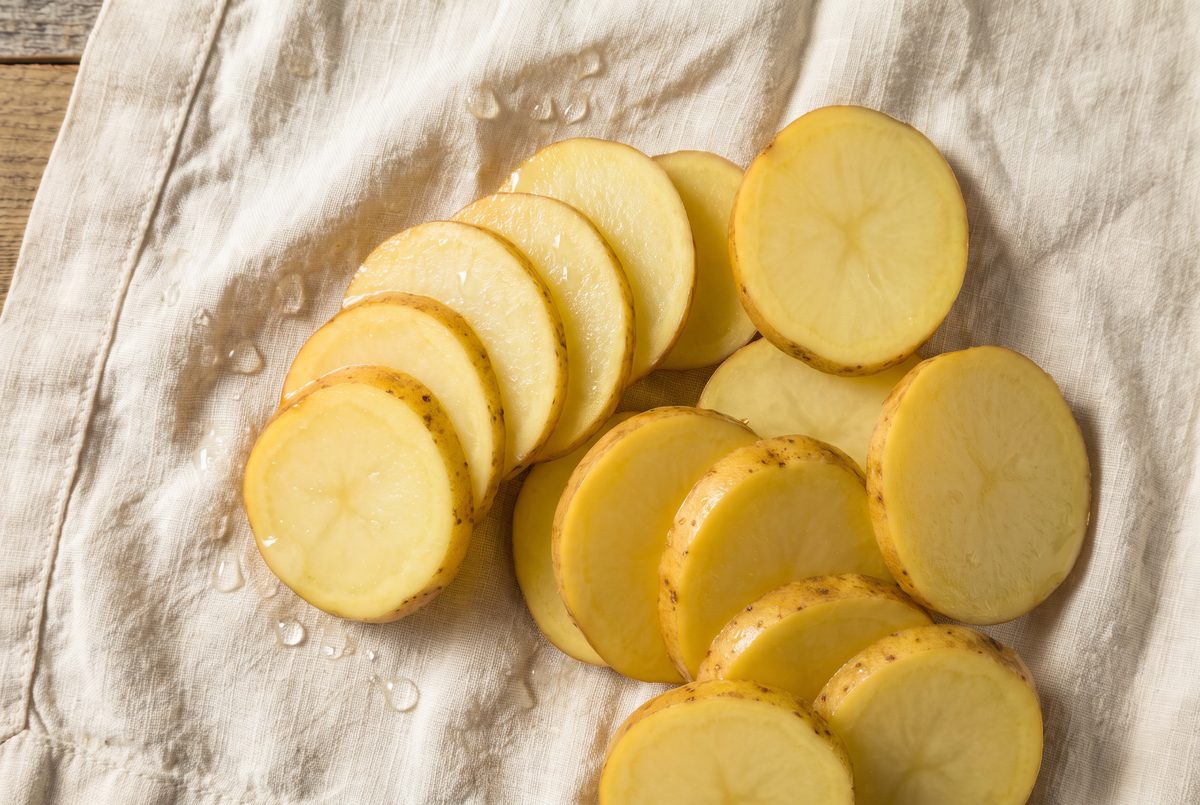
- Slice the potatoes thin, boil them 7 minutes, and dry them. Scrub the potatoes and slice them 1/8 inch (3 mm) thick, skins on — a mandoline if you have one, otherwise a sharp knife and a flat side to work from. Drop them into a pot of unsalted boiling water and cook 7 minutes from the moment the water returns to the boil. The state you want is specific: lift one out and bend it, and it should fold double without snapping, still firm in the middle. Drain them, spread them in a single layer on a clean towel and leave them there while you do the leeks — a wet slice turns the inside of the packet into soup. The water stays unsalted on purpose: potato slices this thin take up salt fast, and the 3/4 teaspoon in this recipe is already accounted for.
- Wash the leeks the only way that works. Halve the leeks lengthwise, cut them into 1/4-inch half-moons, and drop the lot into a bowl of cold water. Swish, wait a minute, then lift the leeks out with your fingers spread and leave the water behind: the grit sinks, and a leek tipped into a colander gets its grit back on the way through. Shake them dry. Add the sliced garlic and about half the parsley.
- Build each packet: potatoes, leeks, fish, in that order. On one half of each sheet, just off the crease, lay a quarter of the potato slices in a tight overlapping circle about the size of your palm — they are the fish's insulation from the hot pan as much as they are dinner. Scatter a quarter of the leeks and garlic over them, season with a pinch of the salt, and set a trout fillet skin-side down on top. Season the fish with the rest of the salt, the pepper and the lemon zest, then over each packet go 1 1/2 teaspoons of olive oil, 1 tablespoon of wine, 1 1/2 teaspoons of lemon juice and a quarter of the capers. Keep it compact: a flat, wide pile cooks faster than a tall one and fits the paper better.
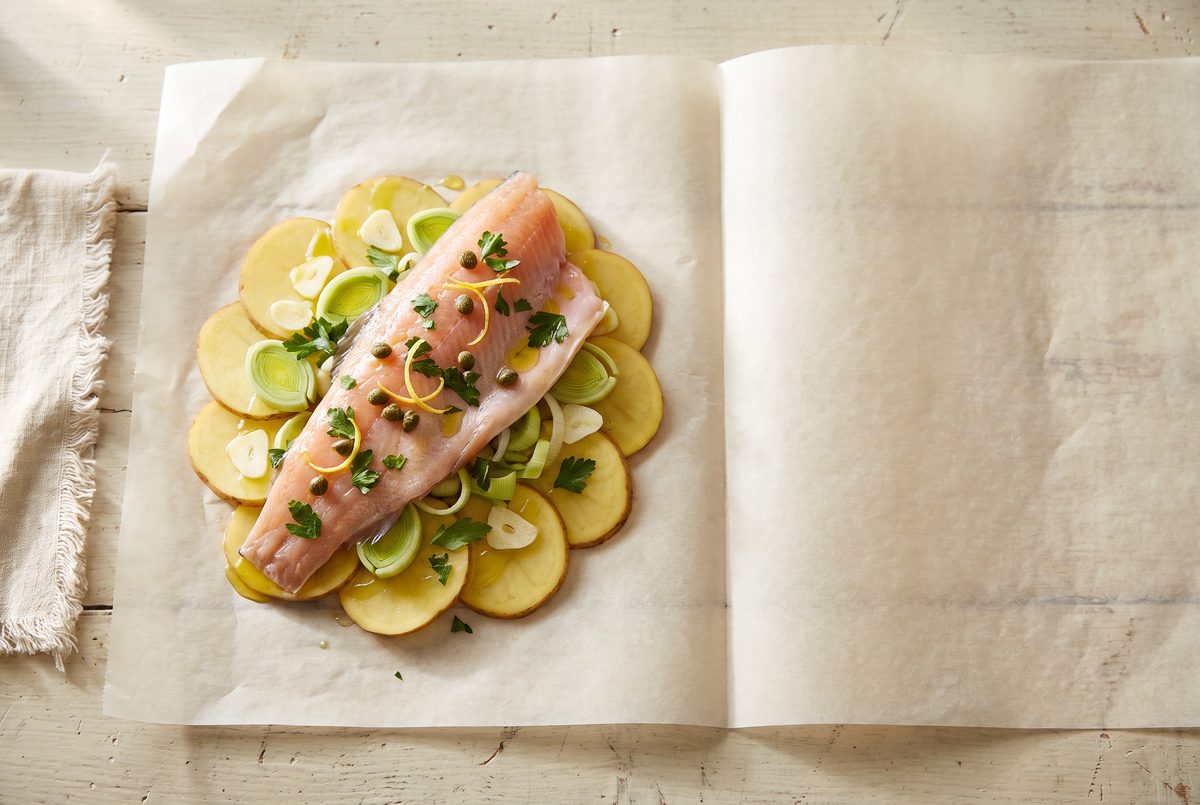
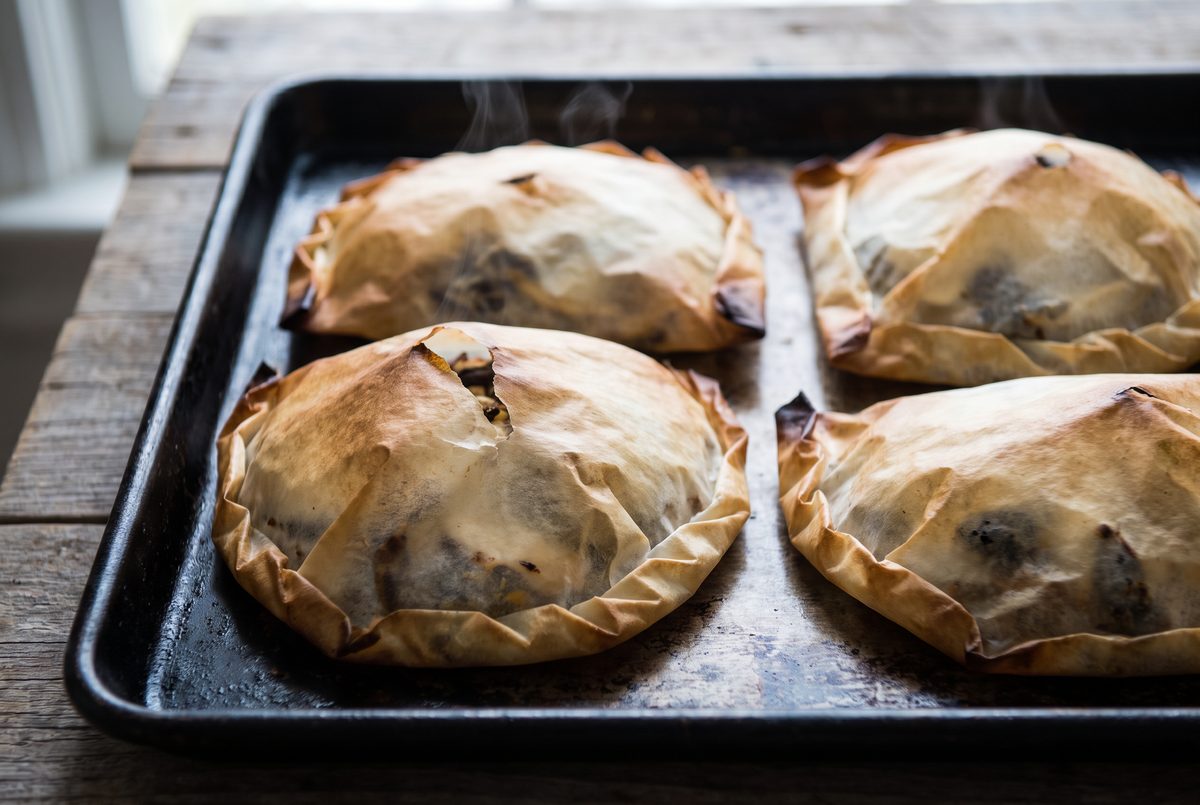
- Seal it so it puffs. Fold the empty half of the paper over the food and line up the edges. Now work around the three open sides making small overlapping folds, each one about an inch wide and pressing down hard as you go, the way you would crimp a pasty — or, simpler and just as good, fold each open edge over on itself twice and press the creases flat with the heel of your hand. Either way the test is the same: the packet should hold its shape when you lift it, with no gap you could slide paper through. Leave a little dome of air over the fish. Set all four on the sheet pan without touching.
- 15 to 16 minutes, and judge it by the paper. Bake 15 to 16 minutes for fillets about 1/2 inch thick at the center, 18 if yours are thicker. You are not going to open them to check, so read the outside: a sealed packet inflates like a pillow within the first eight minutes and the paper goes blotchy and translucent where the juices have soaked it. That dome is the whole doneness test — it means the inside hit steam temperature and stayed there. If a packet stays flat, it is leaking; it will still cook, just drier, and press the folds down harder next time. Trout is done at 135 to 140 °F (57 to 60 °C) at the thickest point, where it flakes in clean sheets and is barely opaque; the FDA's recommendation for fish is 145 °F. Take the pan out and let the packets sit 3 minutes — the fish is still cooking in there and the juices settle back into the potatoes.
- Open them at the table, and mind the steam. Serve each packet on its own plate, still shut, and cut it open across the top with scissors or the point of a knife — then stand back for a second, because what comes out is a jet of very hot steam and it will scald you if you are leaning over it. Peel the paper back, scatter the rest of the parsley, and eat it straight out of the packet: every drop of juice is in there, and moving the fish to a clean plate pours half of it away. A lemon wedge on the side, nothing else. This is the course a trattoria would follow with a plain salad, and it needs no bread unless you want something to chase the juices with.
Tips from our kitchen
- Buy the fillets boned and butterflied, and accept that the skin will be soft. American fish counters sell farmed rainbow trout as a butterflied whole fish — two fillets joined along the back — for about half the price of salmon; cut it down the middle and you have two portions. Run a fingertip across the thick end for pin bones before you build the packets. One thing to be clear about: this is not a crisp-skin dish. Fifteen minutes of steam leaves trout skin tender and pale, and it is perfectly good eating, but if you want crackle you want a pan, not paper.
- Waxy potatoes, and 1/8 inch is not a suggestion. Yukon Gold, red-skinned, fingerlings — anything waxy holds its slices through a boil and a bake. Russets fall into mash in the packet and make the bottom watery. Thickness is the one measurement in this recipe worth being fussy about: 1/8 inch (3 mm) boils to bendable in 7 minutes and finishes in the oven in 15, and a slice twice that thick will not, no matter how long you boil it.
- Parchment over foil, for a reason you can taste. There is a quarter cup of wine and two tablespoons of lemon juice in here, and acid sitting against aluminum for fifteen minutes at 425 °F can pick up a faint metallic edge. Foil is easier to seal and I use it when the parchment runs out — but if you have both, use the paper. What you cannot use is wax paper, which melts, or a loose tent of either material, which is just roasting with extra steps.
- Assemble ahead, bake from cold. The packets can be built, sealed and refrigerated up to 6 hours, which makes this the easiest dinner party main in the collection: four parcels on a sheet pan, one oven, no pan to scrub. Add 2 minutes to the bake if they go in fridge-cold. Do not build them the night before — the salt and lemon start curing the fish and the texture goes firm and faintly hammy.
- If you want a sauce, do not make one. The liquid in the bottom of each packet is already a sauce: wine, lemon, olive oil and the juices of the fish and the vegetables, emulsified by fifteen minutes of agitation in a sealed bag. Tip the packet and spoon it back over the fillet. Adding butter or cream at the table is not wrong, it is just a different recipe, and it costs about 100 calories a tablespoon.
- Scaling down to one or two. Everything divides cleanly: one fillet, 6 oz of potatoes, half a leek, 1 1/2 teaspoons of oil, a tablespoon of wine. The only thing that does not scale is the oven, so a single packet is a slightly extravagant way to heat a kitchen — two is the efficient minimum.
Variations
- With cod, for the lean version: 367 calories and 30 g of protein. Same packet, same bed, same 15 minutes, 8.2 g of fat instead of 16. Cod is the better arithmetic by a distance and a packet is the right place for it, because the one thing cod does badly is dry out. Cut the fillets to 5 oz pieces of even thickness; thick loin pieces want 18 minutes. If you would rather have the lean fish written out properly than swapped in, that is baked cod with chickpeas, tomatoes and olives.
- With salmon, right at the ceiling: 544 calories and 33 g of protein. A 5 oz salmon fillet pushes the packet to 26 g of fat and 544 calories — six calories under the 550 line this collection is built to, which is either reassuring or alarming depending on how you read it. It is an excellent packet and the skin-side-down trick matters more, since salmon skin left face up in steam is unpleasant. Worth knowing: the same fish seared in a pan with a lemon-oregano sauce is 497 calories, because the fennel-and-orange salad underneath weighs less than potatoes do.
- Without the potatoes: 319 calories, 12 g of carbohydrate. Drop them, double the leeks, and add a halved fennel bulb sliced thin — the packet becomes a light main for someone eating low-carbohydrate, and it loses the 7-minute boil along with them, which makes it a 30-minute recipe. The cost is specific and worth stating: fiber falls from 5.5 g to 1.7 g and the plate no longer eats like a full dinner. Add bread and you have given the calories back.
- For a bigger appetite: 2 1/2 lb of potatoes, 531 calories and 60 g of carbohydrate. The same four packets with 10 oz of potatoes each instead of 6, which is how an Italian household would actually portion this for someone who had been outdoors all day — 35 g of protein, 7.8 g of fiber. Be clear about what it is and is not: 60 g of carbohydrate is a good dinner, not a carb-load. The 80-to-120 g pre-race range lives in the endurance recipes and the carb-loading guide, and for potatoes and seafood in one dish at that scale the right answer is tiella barese.
- In summer, cherry tomatoes and zucchini instead of leeks. Halve a pint of cherry tomatoes, slice a zucchini into coins, keep the potatoes and the capers, and skip the wine — the tomatoes bring their own liquid. It is the Mediterranean version of the same packet and it is what you will want in July. We have not run the numbers on it, so the table above does not apply.
Storage & meal prep
A baked packet does not keep as a packet — the paper goes limp and the potatoes keep drinking the juices — so lift the contents into a container as soon as it is cool enough to handle. It keeps 2 days in the fridge and is genuinely good cold, the fish flaked over the potatoes with an extra squeeze of lemon, which is the way I prefer the leftovers to the reheated version. If you want it warm, a 300 °F oven for 8 to 10 minutes in a covered dish with a spoonful of water is the only method that does not toughen the trout; a microwave on full power drives the fat out of the fish and gives the kitchen the smell the packet was there to prevent. Do not freeze it, cooked: the potatoes go grainy and trout freezes badly twice. The two things that do keep ahead are the components — boiled potato slices hold 24 hours in the fridge spread on a plate under a damp towel, and washed leeks hold 2 days in a sealed bag — which turns this into a ten-minute assembly on the night.
Nutrition per serving
| Nutrient | Amount | % DV* |
|---|---|---|
| Calories | 450 kcal | 23% |
| Total fat | 16 g | 21% |
| Saturated fat | 2.9 g | 14% |
| Carbohydrates | 42 g | 15% |
| Fiber | 5.5 g | 20% |
| Sugars | 4.5 g | — |
| Protein | 33 g | 66% |
| Sodium | 586 mg | 25% |
*Percent Daily Values are based on a 2,000-calorie diet. Values are calculated from USDA FoodData Central and manufacturer data for the ingredients as listed; they are estimates, not lab analyses. Nutrition disclaimer.
Frequently asked questions
What does al cartoccio mean?
It is Italian for in a paper wrapper — the same word as the paper cone fried fish is handed to you in. Cooking al cartoccio means sealing food in parchment (or foil) and baking it, so it steams in its own juices instead of roasting in dry air. The French call the same technique en papillote. In Italy it is a home method, not a restaurant one, used above all for whole fish and fillets, and the point of it is that nothing escapes: not the moisture, not the aromatics, not the smell.
How many calories are in trout al cartoccio?
450 calories for a whole packet — a 5 oz trout fillet, 6 oz of potatoes, a leek, olive oil, wine, lemon and capers — with 33 g of protein, 42 g of carbohydrate, 16 g of fat and 5.5 g of fiber. The fish is 197 of those calories and the potatoes 131, which means the two things that make it a dinner account for three quarters of the total. The single biggest lever is the olive oil: each tablespoon you add pours 120 calories into the packet.
Is trout good for weight loss?
It is one of the better fish for it, and sits between the two obvious choices: 141 calories per 100 g raw with 19.9 g of protein, against 82 calories for cod and 208 for salmon. In this recipe a fillet delivers 27.9 g of protein for 197 calories, and the whole plate comes to 450 — inside the 550-calorie ceiling we use for mains in the weight-loss collection, with a starch on it. Trout is also in the lowest-mercury group of the FDA and EPA's advice on eating fish, so it is a fish you can eat twice a week without doing arithmetic about it.
Can I use foil instead of parchment paper?
Yes, and it seals more easily — crimped foil is more forgiving than crimped paper, which is why most recipes default to it. The reason to prefer parchment here is the acid: a quarter cup of wine and two tablespoons of lemon juice in contact with aluminum for fifteen minutes can leave a faint metallic taste. Fifteen minutes is short enough that most people will not notice. What does not work is wax paper, which melts, or a loosely folded tent of anything, which roasts the fish rather than steaming it.
How do I know when the fish is done without opening the packet?
Read the paper. A properly sealed packet inflates into a dome within about eight minutes and the parchment goes translucent and blotchy where the juices soak it — that dome means the inside reached steam temperature. For a 1/2-inch trout fillet, 15 to 16 minutes at 425 °F is right; 18 if the fillets are thick. If you want certainty, push an instant-read thermometer straight through the paper into the thickest part: 135 to 140 °F is trout that flakes in clean sheets, and the FDA recommends 145 °F for fish. The hole you make is not a problem in the last two minutes.
Can I assemble the packets ahead of time?
Up to 6 hours, sealed and refrigerated, and add 2 minutes to the bake if they go in cold. That makes this a good dinner for a night when you do not want to cook — the week of Thanksgiving, for instance, when four parcels on one sheet pan and no pan to wash is worth more than another roast. What does not work is building them the night before: the salt and the lemon juice start to cure the fish, and by morning the texture has gone firm and slightly ham-like. Boil the potatoes a day ahead instead and assemble in ten minutes.
Sources
- USDA FoodData Central — fish, trout, rainbow, farmed, raw (141 kcal, 19.9 g protein, 6.2 g fat per 100 g); fish, cod, Atlantic, raw and fish, salmon, Atlantic, farmed, raw (for the comparisons); potatoes, flesh and skin, raw; leeks, bulb and lower leaf, raw; capers, canned; garlic, raw; parsley, fresh; lemon juice, raw; lemon peel, raw; olive oil; wine, table, white
- Dietary Guidelines for Americans 2020–2025 — at least 8 oz of seafood per week for adults; sodium under 2,300 mg per day; dietary fiber at 14 g per 1,000 calories
- FDA and EPA — Advice About Eating Fish (2021): trout (freshwater) in the "Best Choices" group, the lowest-mercury category, 2 to 3 servings a week
- Rimm, E.B. et al. (2018). Seafood Long-Chain n-3 Polyunsaturated Fatty Acids and Cardiovascular Disease: A Science Advisory From the American Heart Association. Circulation 138(1)
- Leidy, H.J. et al. (2015). The role of protein in weight loss and maintenance. American Journal of Clinical Nutrition 101(6)
- Holt, S.H.A., Brand Miller, J.C., Petocz, P., Farmakalidis, E. (1995). A satiety index of common foods. European Journal of Clinical Nutrition 49(9), 675–690
- D'Agaro, E., Gibertoni, P., Esposito, S. (2022). Recent Trends and Economic Aspects in the Rainbow Trout (Oncorhynchus mykiss) Sector. Applied Sciences 12(17), 8773
- FDA — Food Code / FoodSafety.gov: minimum internal temperature of 145 °F for fish
You might also like
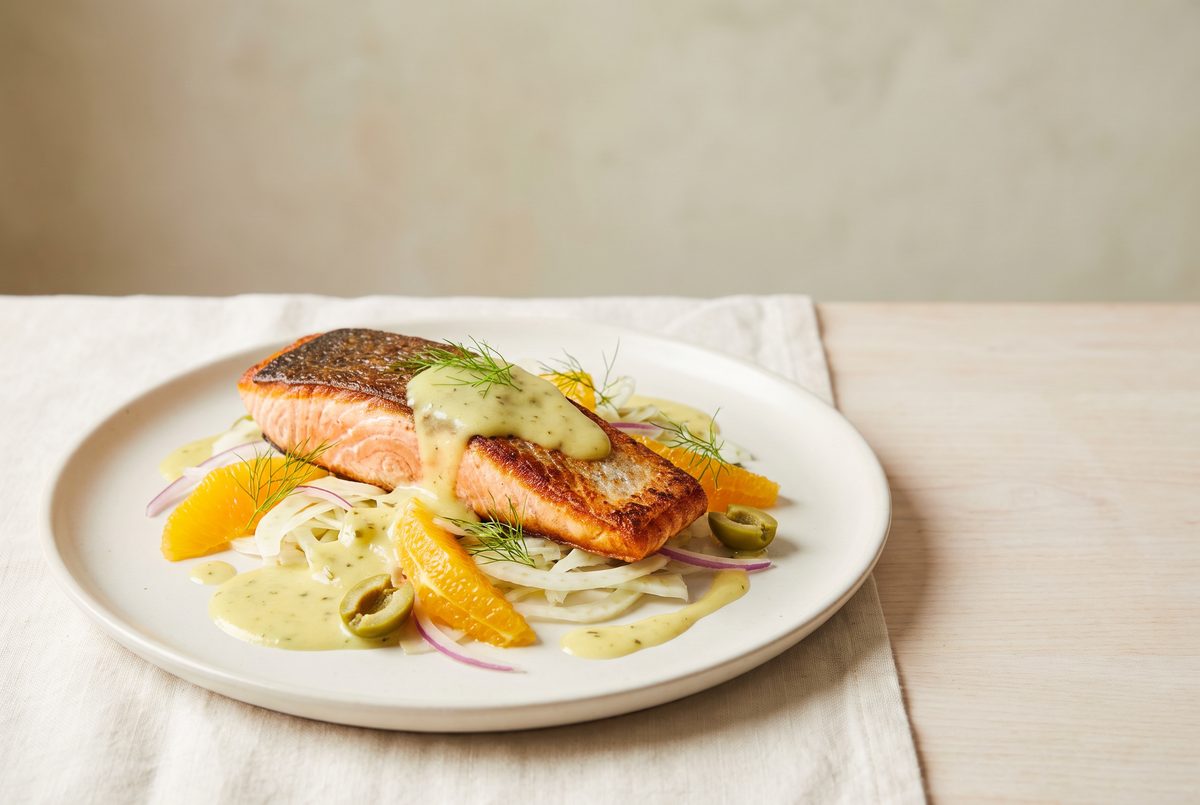
Pan-Seared Salmon with Salmoriglio
Salmoriglio is the Sicilian sauce for grilled fish — olive oil whisked with lemon juice, hot water and dried oregano…
- 30 min
- 497 kcal
- 31 g protein
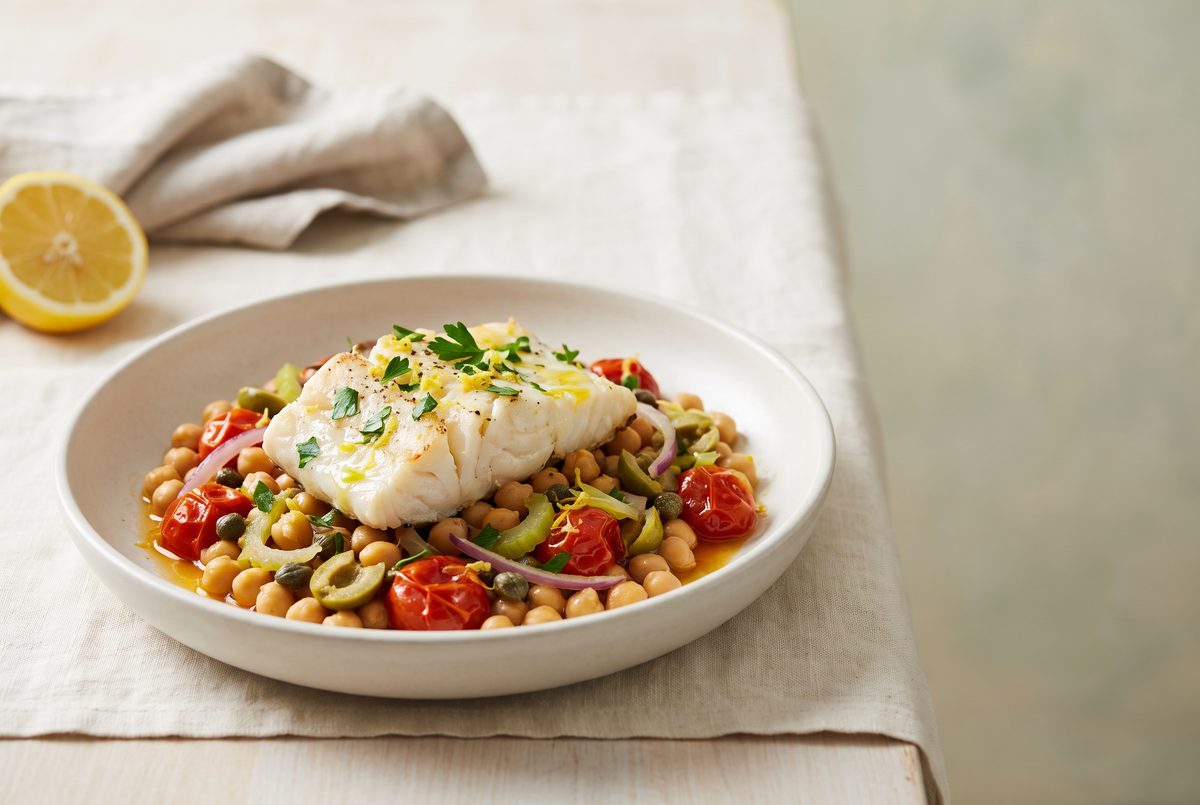
Baked Cod with Chickpeas, Tomatoes and Olives
Baked cod with chickpeas is a one-pan southern Italian dinner: cherry tomatoes, green olives and capers simmered with…
- 40 min
- 443 kcal
- 41 g protein
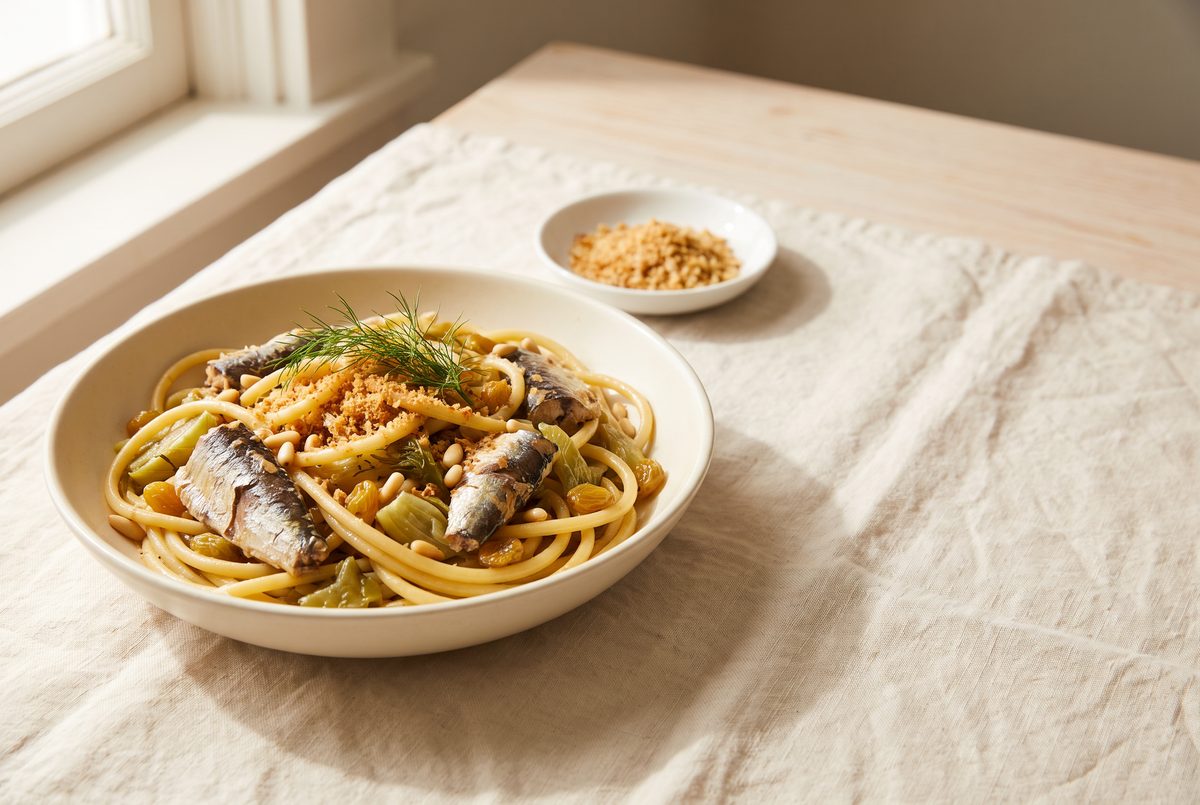
Pasta con le Sarde: Sicilian Bucatini with Sardines
Pasta con le sarde is the signature pasta of Palermo: bucatini with sardines, fennel, saffron, raisins and pine nuts…
- 45 min
- 499 kcal
- 23 g protein