Baked Rice, Potatoes and Mussels (Tiella)
The tiella of Bari is one dish, built in layers and never stirred: sliced potatoes on the bottom, mussels opened raw and left on the half shell, dry rice scattered over them, more potatoes on top, then liquid poured in until it reaches the surface and the whole thing goes into the oven for an hour.
Tiella barese is a layered bake from Puglia — potatoes, raw-opened mussels and dry rice in one dish, no stirring, an hour in the oven — and it is the only plate on this site that fills both endurance slots at once: 106 g of carbohydrate for the night before, 25 g of protein and 718 mg of sodium for the hours after. One serving is 669 calories.
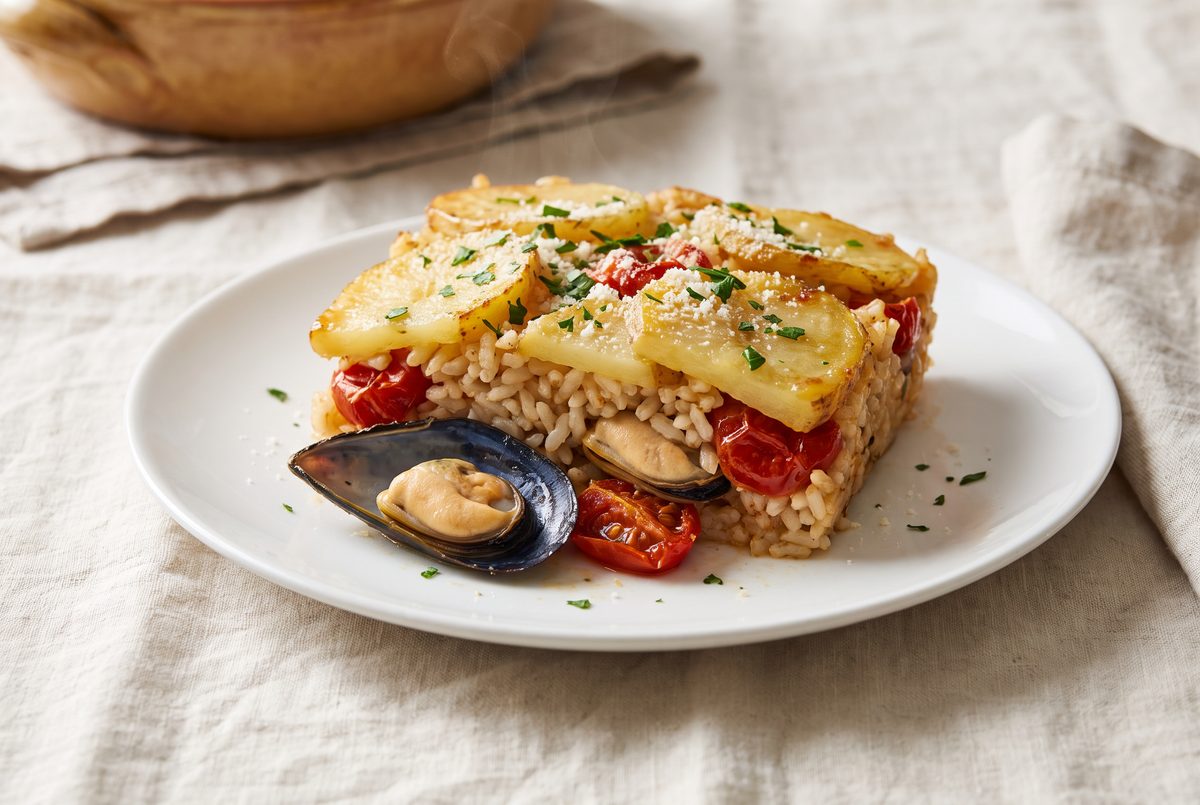
A tiella is not a recipe, it is a vessel: the shallow earthenware dish that gave its name to half the baked food of southern Italy. In Bari it means one specific thing, and if you order tiella anywhere near the old town you get rice, potatoes and mussels in layers, served warm rather than hot, cut into squares like a lasagna. Every family argues about the same three details — whether onion goes in, whether the tomatoes are fresh or canned, whether zucchini belongs in summer — and nobody argues about the mussels, which go in raw.
That last part is the thing to understand before you shop. It is tempting to steam the mussels open first: it takes two minutes, the shells pop, and the job is done. Do that and you have cooked them twice, because they still have an hour in the oven ahead of them, and the result is small and squeaky. Opened raw with a knife, over a bowl to catch the liquor, they poach gently inside their own shells while the rice swells around them. The liquor you catch is not a garnish either — it is salty, grey-green, intensely of the sea, and it is the stock. There is no other stock in this dish.
For an endurance kitchen the tiella is almost suspiciously well designed. Rice and potato together put 95 g of carbohydrate on the plate without a gram of pasta, which matters if you have eaten pasta for three days and cannot look at it again; the mussels bring protein and a lot of natural salt; and because it is built cold and baked in one dish, it is the only big carb dinner in our carb-loading guide that does not need anyone standing at a stove. We published it the day before the New York marathon on purpose: it is the Saturday dinner and, with a plate kept back, the Sunday afternoon recovery meal.
Why this recipe works for endurance
Both endurance slots, from one dish. A fuel-up meal needs 80–120 g of carbohydrate per serving and this one carries 106 g — 60 g from 75 g of dry rice per person, 35 g from 200 g of potato, the rest from onion and tomato. A recovery meal needs carbohydrate plus 20–30 g of protein, and this one carries 25 g. The position stand of the Academy of Nutrition and Dietetics, Dietitians of Canada and the American College of Sports Medicine puts post-exercise carbohydrate at 1.0–1.2 g per kilogram of body weight per hour for the first four hours when recovery time is short, with 20–30 g of protein to start repair (Thomas, Erdman & Burke, 2016). For a 150 lb (68 kg) athlete, one serving of this is roughly an hour and a half of that carbohydrate target and the whole protein target in a single plate.
Rice is not a compromise on pasta, and for some stomachs it is better. White rice and dry pasta sit within a few grams of each other per 100 g — 80 g of carbohydrate against 75 — but rice is lower in fiber and has no gluten, which is why it is the staple carb-load for athletes who get gastrointestinal trouble on pasta. Up to a third of endurance athletes report GI symptoms during long events, and the practical response is to reduce fiber and fat in the 24 hours before the start (de Oliveira, Burini & Jeukendrup, 2014). This plate is 16 g of fat, mostly the 3 tablespoons of olive oil.
Where the 7.1 g of fiber comes from, and when to lower it. Almost all of it is potato: 800 g of potatoes for four people is 4.4 g of the 7.1, and the tomatoes and onion carry most of the rest. That is a good number for a Tuesday and a slightly high one for the night before a race if you know you are sensitive. The honest fix is not to change the recipe but to halve the tomatoes and serve a smaller plate with a slice of white bread, which keeps the carbohydrate and drops the fiber. The plate as written is better placed two nights out, or as the recovery meal, where fiber does not matter at all.
The sodium is the part most recipes get wrong in the other direction. 718 mg a serving: 291 mg of added salt, 286 mg from the mussels, 120 mg from the pecorino, and the remainder from the vegetables. Sweat sodium losses run from about 500 to 1,500 mg per liter and a hard marathon can cost several liters, so the post-race plate is one of the few times in nutrition writing when more salt is the right advice. Sodium also determines how much of what you drink you keep: in controlled rehydration trials, drinks and meals with meaningful sodium restored plasma volume where plain water did not (Shirreffs et al., 1996; Evans et al., 2017). Against the 2,300 mg daily ceiling in the Dietary Guidelines this is 31% of the day, which is a lot if you are sitting at a desk and the right amount if you ran 26 miles.
Mussels are cheap protein with a nutrient profile this site cannot fully print. 400 g of mussel meat costs about what a single salmon fillet does and brings 48 g of protein to the dish. Mussels are also one of the densest common food sources of vitamin B12 and iron, and they are a farmed shellfish with a very low environmental footprint — but our nutrition table has no columns for B12, iron or omega-3, so you will find no milligram figures for any of them here. The claim is the food, not a number we did not calculate. What we can print is in the table: 86 calories and 11.9 g of protein per 100 g of raw meat, at 2.2 g of fat.
Ingredients
One 9x13-inch baking dish, 4 large plates
The mussels
The layers
The liquid
Instructions
- Clean the mussels, then open them raw over a bowl. Tip the mussels into the sink, scrub the shells under cold running water and pull off any beards — the tuft of fibers at the straight edge — by tugging them toward the hinge. Throw away any shell that is cracked, and any that is wide open and stays open after you tap it on the counter. A shell that closes slowly is alive and fine.
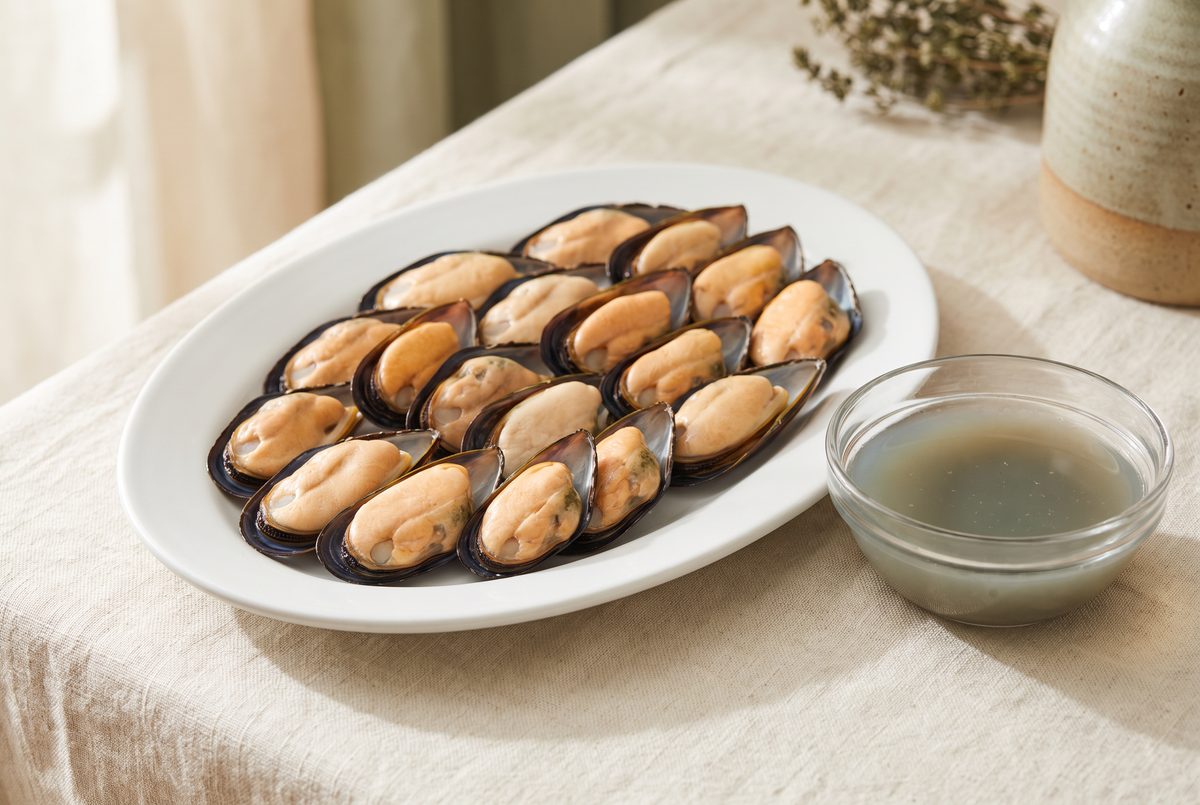
Now open them. Hold a mussel in a folded towel with the hinge toward your palm, slide a short stiff knife between the shells along the straight side, and twist: it takes more force than an oyster and less precision. Work over a bowl and catch every drop. Snap off and discard the empty top shell, leave the mussel sitting in the bottom one, and set it aside. Three pounds takes about 15 minutes once you find the angle.
Strain the liquor you have collected through a fine sieve lined with a paper towel — there is always grit — and keep it. You should have ½ to ¾ cup of cloudy grey-green liquid. That is the stock for the whole dish.
- Slice the potatoes thin, and do not rinse them. Peel the potatoes and slice them ⅛ inch (3 mm) thick — a mandoline if you have one, otherwise a sharp knife and some patience. Thickness is the one measurement in this recipe that decides whether it works: at ¼ inch the potatoes are still waxy when the rice is done, and the whole dish has to stay in the oven until the top burns. Slice the onion the same thickness. Leave the starch on both. Rinsing is correct for roast potatoes and wrong here, because that surface starch is part of what holds the layers together.
- Build it in layers, in a cold dish, and never stir. Rub a 9x13-inch baking dish or a wide shallow earthenware one with a little of the oil. Then, in this order:
1. Half the potatoes, overlapping like roof tiles, over the whole base.
2. All the onion, half the garlic, half the parsley, half the tomatoes, a third of the pecorino, a third of the salt and pepper, a spoonful of oil.
3. The mussels in their half shells, shell side down, spaced out so every portion gets some.
4. All the rice, scattered dry and evenly over and between the shells — it should disappear into the gaps and sit level, not in heaps.
5. The rest of the garlic, parsley, tomatoes, another third of the pecorino, the rest of the salt and pepper.
6. The remaining potatoes on top, overlapping again and covering the rice completely. Any rice left exposed will bake hard.
7. The last of the pecorino and the last spoonful of oil over the surface.
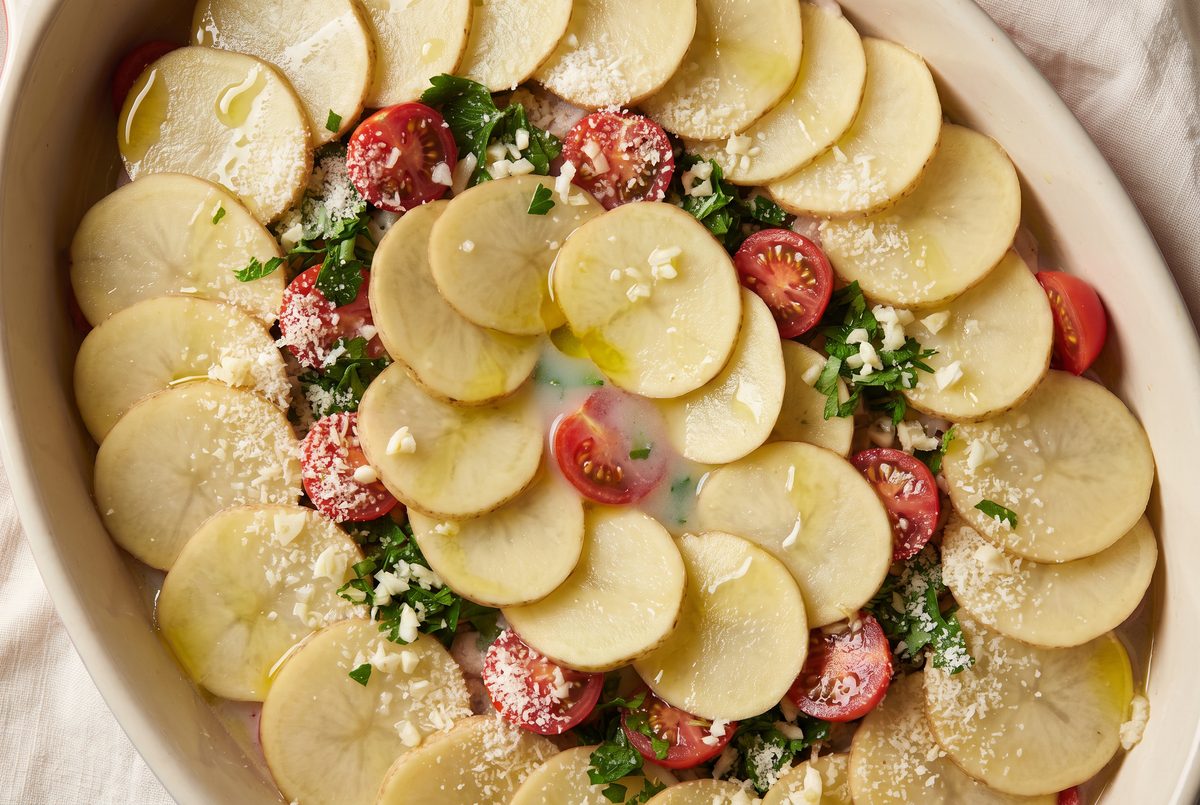
- Pour the liquid in at the edge, until it reaches the top layer. Mix the strained mussel liquor with enough hot water to make 2½ cups (600 ml) to start. Pour it slowly down one corner of the dish, not over the top, so the surface stays arranged. Stop when the liquid is level with the top layer of potato — you can see it rise through the gaps. Depending on your dish and how juicy the tomatoes are, that is 2½ to 3 cups. Too little and the rice stays chalky in the middle; too much and you get a very good soup.
- Bake covered, then uncovered: 400 °F, about an hour. Cover tightly with foil and bake at 400 °F (200 °C) for 35 minutes. Take the foil off and give it another 20 to 25 minutes, until the top potatoes are browned at the edges, the surface is dry and the liquid has gone. Check the rice with the tip of a knife through a gap: it should be tender with no chalk in the center. If it is still firm and the dish looks dry, pour ½ cup of hot water down the side, re-cover and give it 10 more minutes. Ovens and dishes vary more than recipes admit, and the rice is the only thing you are cooking to a point.
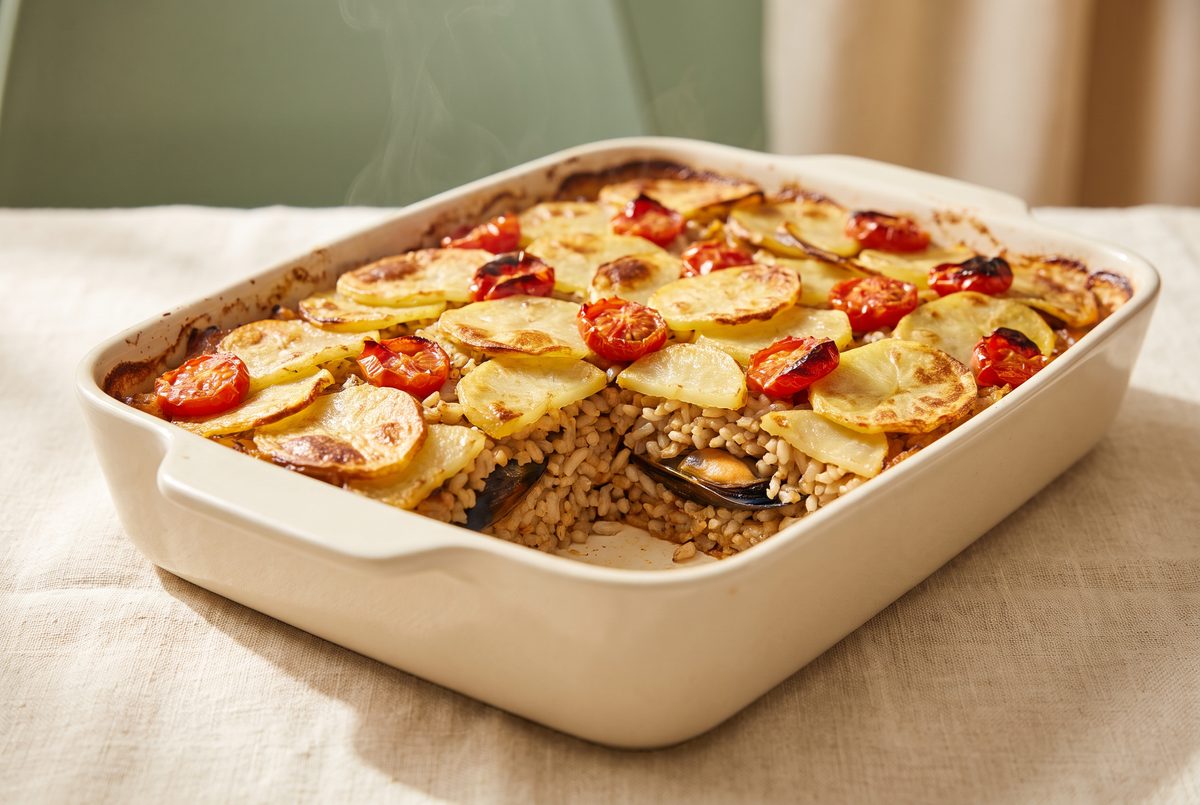
- Rest 15 minutes, and serve it warm rather than hot. Leave it on the counter 15 minutes before you cut it. The rice is still absorbing, the layers are still loose, and a tiella served straight from the oven slumps on the plate instead of coming out in a square. In Bari it is often eaten closer to room temperature, hours later, which is also why it travels so well to a table of people who finished a race at different times. Cut it into squares with a knife and lift the portions out with a spatula, shells and all.
Tips from our kitchen
- If opening them raw defeats you, there is an honest shortcut — and it costs you something. Put the scrubbed mussels in a wide pan over high heat with the lid on, no liquid, and pull them out one by one the second they crack open, about 60 to 90 seconds. Strain and keep every drop of the liquid. You lose a little plumpness, because they get two cooks instead of one, and the difference is noticeable side by side but perfectly acceptable. Fifteen minutes in the freezer before shucking also relaxes the muscle and makes the knife much easier.
- The thickness of the potato is the recipe. Everything else here is forgiving. If you slice at ⅛ inch, the potatoes and the rice finish within a couple of minutes of each other, which is the entire design of the dish. If you slice thick, you will be choosing between hard rice and burnt potato at the 50-minute mark, and no amount of extra water fixes it.
- Use a wide, shallow dish, not a deep one. The tiella is meant to be two or three inches deep in total. In a deep casserole the bottom steams while the top bakes and the rice cooks unevenly; in a wide dish everything is close to both the heat and the surface. Earthenware is traditional and holds heat longer, but a glass or ceramic 9x13 is what most people have and it works.
- Keep the shells in. They look rustic and they are also useful: they hold their mussel off the hot base and they tell everyone at the table exactly how the dish was built. If you are serving people who would rather not deal with them, take the meat out of the shells after cleaning and tuck it into the rice layer instead — the cooking does not change, but you lose a little of the liquor that stays trapped in the shell.
- No cheese on the fish? Not in Puglia. The rule that Italians never put cheese on seafood is a tourist rule, and the tiella is one of the dishes that disproves it: pecorino goes in, in quantity, and has done for as long as anyone has written it down. If you would rather leave it out, use 2 extra tablespoons of breadcrumbs for the surface instead and add ¼ teaspoon of salt — but the plate loses 3 g of protein a serving and a lot of savor.
Variations
- With clams instead of mussels: 657 calories and 26 g of protein. Same weight of shucked meat, same method; littlenecks or Manila clams, opened raw over a bowl exactly the same way. Clams are leaner than mussels — 74 calories per 100 g against 86 — and slightly higher in protein, so the plate comes out 12 calories lower and a gram of protein higher. What really changes is the salt: clams carry far less of their own, the plate drops to 488 mg of sodium a serving, and it wants an extra ¼ teaspoon added. If you want the clam version written out as its own dinner, our spaghetti alle vongole is the one to cook.
- Vegetarian, with zucchini and cannellini: 692 calories, 21 g of protein and 12 g of fiber. The summer tiella in Puglia often has zucchini in it anyway. Drop the mussels, add 1 lb (450 g) of zucchini sliced the same thickness as the potatoes in the middle layer, and a 15 oz can of cannellini beans (260 g drained) over the rice to replace the protein. Use 3 cups of vegetable broth instead of the mussel liquor, since there is no liquor to catch, and add ¼ teaspoon more salt. Two numbers move: fiber goes from 7.1 g to 12 g, and carbohydrate climbs to 122 g, just past the top of the fuel-up range. That makes it a fine Tuesday dinner and a poor night-before-the-race one.
- A smaller plate, for a normal day: cut it into 6 instead of 4. Same dish, 446 calories and 71 g of carbohydrate a serving with 17 g of protein, which is a sensible portion for anybody not running a marathon this week. The tiella is sized for athletes in the recipe above because that is the file it lives in; nothing stops you from treating it as a side dish to a plate of greens.
- With rice swapped for farro, as a training-day version. Pearled farro takes about the same hour and gives a chewier, nuttier result that holds its shape better on day two. We have not calculated the numbers for that version, so the table above does not apply to it — expect more fiber and a little more protein. It is not traditional and it is not for the night before a race, but it is very good in November with the last of the tomatoes.
- Without potatoes, which is heresy in Bari. Some families in Taranto build it with zucchini only and more rice. It is lighter, cooks in 45 minutes, and is a different dish — worth knowing about, not worth doing if you came here for the carbohydrate.
Storage & meal prep
A tiella is better on day two than most seafood has any right to be, because the mussels are protected by their shells and the rice keeps absorbing. Cool it quickly — uncovered on the counter for no more than an hour, then into the fridge — and it keeps 3 days covered. Reheat it covered with foil at 325 °F (165 °C) for 20 to 25 minutes, or eat it at room temperature like a tortino, which is what half of Bari does with the leftovers. A microwave works for a single square at 50% power but it will tighten the mussels. Do not freeze it: the potato slices go grainy and the rice turns to paste, and unlike a sauce there is nothing to hide behind. If you are deliberately cooking it to have a recovery plate ready after a long run the next morning, that is exactly the right plan — it is one of the few dishes in our Mediterranean meal prep guide territory that is designed to be eaten warm, cold or in between.
Nutrition per serving
| Nutrient | Amount | % DV* |
|---|---|---|
| Calories | 669 kcal | 33% |
| Total fat | 16 g | 21% |
| Saturated fat | 3.6 g | 18% |
| Carbohydrates | 106 g | 39% |
| Fiber | 7.1 g | 25% |
| Sugars | 5 g | — |
| Protein | 25 g | 50% |
| Sodium | 718 mg | 31% |
*Percent Daily Values are based on a 2,000-calorie diet. Values are calculated from USDA FoodData Central and manufacturer data for the ingredients as listed; they are estimates, not lab analyses. Nutrition disclaimer.
Frequently asked questions
How many calories are in tiella barese?
669 for one of four servings of the recipe above, with 106 g of carbohydrate, 25 g of protein, 16 g of fat and 7.1 g of fiber. The rice is 270 of those calories, the potatoes 154, the mussels 86, the olive oil 88 and the pecorino 39. Cut the same dish into six portions instead of four and it is 446 calories with 71 g of carbohydrate, which is the version to make if you are not fueling for a long event.
Do you cook the mussels before putting them in the tiella?
No, and this is the detail the dish lives or dies by. The mussels are opened raw with a knife, left in their bottom shells and baked for an hour inside the layers, so they cook once rather than twice. Steaming them open first is quicker but gives you small, firm mussels by the time the rice is done. If you cannot manage the knife, crack them open over high heat in a dry covered pan and pull each one out the instant it gapes — about 60 to 90 seconds — and keep all the liquid.
Is rice as good as pasta for carb loading?
Yes, and for some athletes better. Dry pasta is about 75 g of carbohydrate per 100 g and dry white rice about 80 g, so the fuel is equivalent; rice is lower in fiber and gluten-free, which is why it is the standard carb-load for anyone who gets gastrointestinal trouble on big pasta meals. Up to a third of endurance athletes report GI symptoms in long events, and the usual advice for the 24 hours before the start is to cut fiber and fat rather than change the carbohydrate source (de Oliveira, Burini & Jeukendrup, 2014). Our carb-loading guide has the per-kilogram numbers.
How do I know when the rice in the middle is done?
Slide a knife tip down through a gap between the top potatoes at about 55 minutes and taste a few grains: tender all the way through with no chalky point in the center. The surface tells you the other half of the story — when the liquid has gone and the top potatoes are browned at the edges, the dish is finished. If the rice is still firm but the dish looks dry, pour half a cup of hot water down the side, cover it again and give it 10 more minutes. That rescue works and nobody will know.
Can I make tiella ahead of time?
You can assemble the whole thing, liquid and all, and keep it in the fridge for up to 4 hours before baking — add 10 minutes to the covered time because it goes in cold. It also keeps 3 days baked, which is the more useful answer: a tiella made on Saturday afternoon is the carb-load dinner that night and the recovery plate on Sunday, reheated covered at 325 °F for 20 to 25 minutes. What does not work is assembling it the night before, because the salt draws water out of the potatoes and the rice starts swelling without heat.
What makes a mussel safe to eat, and which ones do I throw away?
Buy them live from a counter that keeps them cold and loose rather than sealed in a bag of water, and cook them the same day. Before shucking, tap any wide-open shell on the counter: a live mussel closes, slowly, and a shell that stays open goes in the bin, as does any shell that is cracked. Farmed rope-grown mussels, which is most of what American fish counters sell, come from monitored waters and need little more than a scrub. The FDA's guidance on selecting and serving seafood is the reference, and the short version is that the discard test happens before cooking, not after.
Sources
- USDA FoodData Central — mollusks, mussel, blue, raw; mollusks, clam, mixed species, raw (for the variation); rice, white, short-grain, raw; potatoes, white, flesh and skin, raw; onions, raw; tomatoes, cherry, raw; cheese, pecorino romano; olive oil; garlic, raw; parsley, fresh; beans, cannellini, canned
- Thomas, D.T., Erdman, K.A. & Burke, L.M. (2016). Position of the Academy of Nutrition and Dietetics, Dietitians of Canada, and the American College of Sports Medicine: Nutrition and Athletic Performance. Journal of the Academy of Nutrition and Dietetics 116(3)
- Shirreffs, S.M., Taylor, A.J., Leiper, J.B. & Maughan, R.J. (1996). Post-exercise rehydration in man: effects of volume consumed and drink sodium content. Medicine & Science in Sports & Exercise 28(10)
- Evans, G.H., James, L.J., Shirreffs, S.M. & Maughan, R.J. (2017). Optimizing the restoration and maintenance of fluid balance after exercise-induced dehydration. Journal of Applied Physiology 122(4)
- de Oliveira, E.P., Burini, R.C. & Jeukendrup, A. (2014). Gastrointestinal complaints during exercise: prevalence, etiology, and nutritional recommendations. Sports Medicine 44(S1)
- Dietary Guidelines for Americans 2020–2025 — sodium under 2,300 mg per day; dietary fiber at 14 g per 1,000 calories
- FDA — Selecting and Serving Fresh and Frozen Seafood Safely (live shellfish: discard shells that are cracked or that do not close when tapped)
You might also like
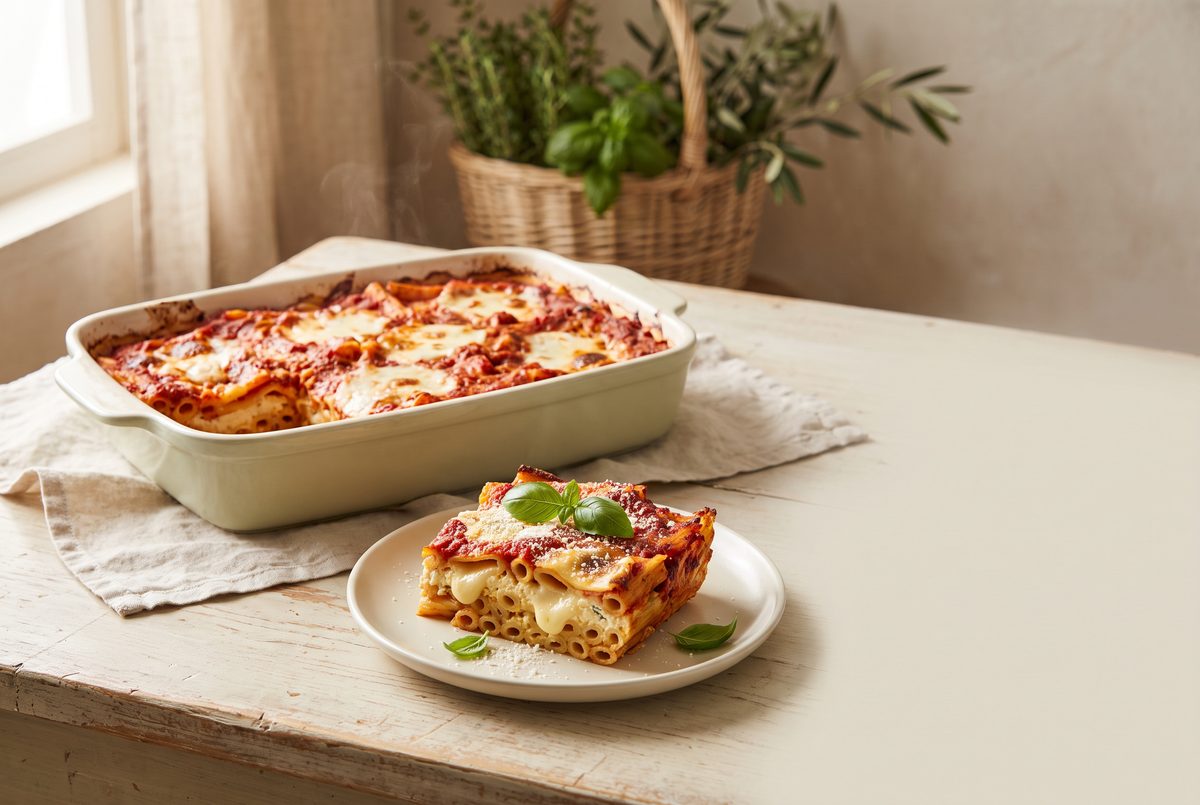
Baked Pasta with Ricotta (Pasta al Forno)
Pasta al forno is the Southern Italian way of baking a tray of ziti in tomato sauce with ricotta and mozzarella, and…
- 1 hr 5 min
- 646 kcal
- 30 g protein
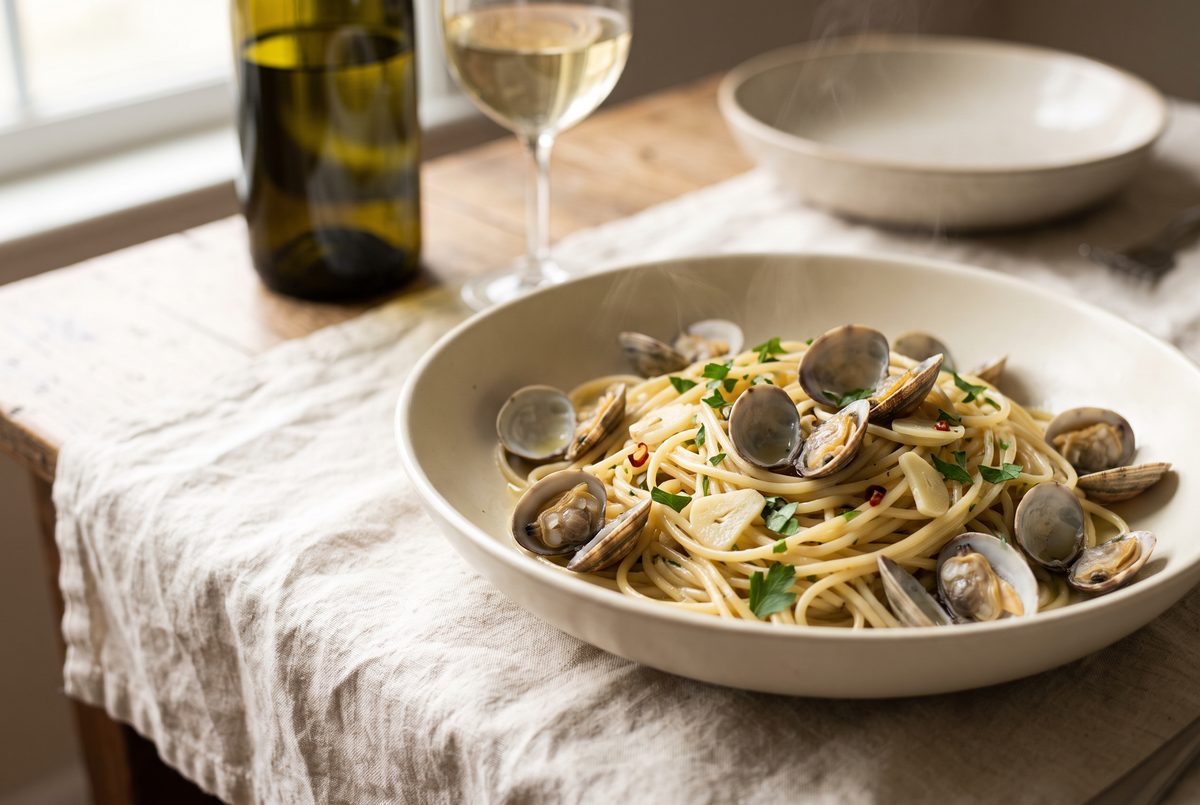
Spaghetti alle Vongole
Spaghetti alle vongole is fresh clams opened in white wine and garlic, their liquor reduced and emulsified with the…
- 35 min
- 602 kcal
- 24 g protein
Italian Semolina Porridge (Semolino al Latte)
Semolino al latte is the Italian breakfast porridge: semolina rained into hot milk and cooked down for ten minutes…
- 20 min
- 561 kcal
- 20 g protein