Baked Pasta with Ricotta (Pasta al Forno)
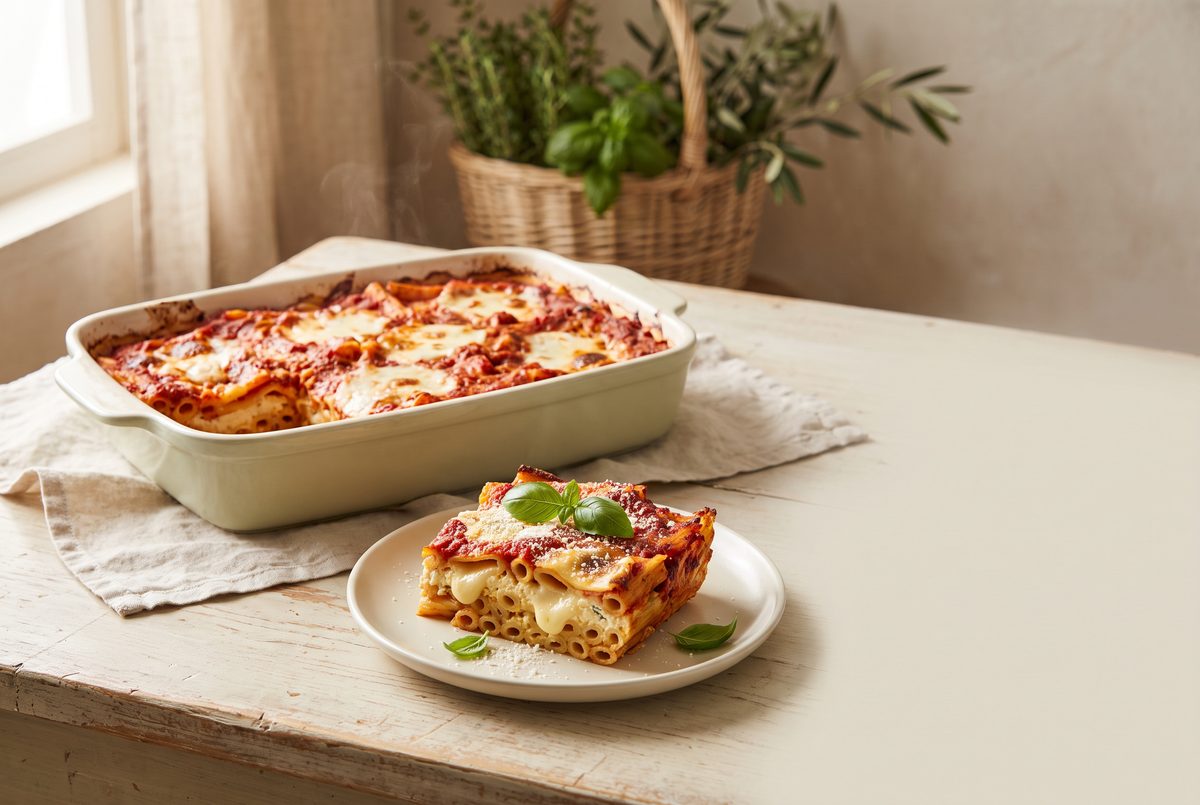
The Southern Italian tray of baked pasta, built on a plain tomato sauce, a ricotta cream loosened with pasta water, and cubes of low-moisture mozzarella that melt into pockets instead of a lid — the one carb-loading dinner on this site that is already cooked when you walk in the door.
Pasta al forno is the Southern Italian way of baking a tray of ziti in tomato sauce with ricotta and mozzarella, and it is built to be assembled a day before it is eaten. One of four portions is 646 calories with 90 g of carbohydrate and 30 g of protein, which makes it both a carb-loading dinner and a recovery meal; it takes 65 minutes to make and 35 minutes to bake from cold.
There is a particular kind of hunger that arrives about forty minutes after a long run, and it does not wait for you to cook. It is the reason a lot of good training weeks end with a delivery app, and the reason the most useful dinner is not the fastest one but the one that was already made.
Southern Italy solved this a long time ago, for its own reasons. Pasta al forno — pasta in the oven — is Sunday food from Naples down through Calabria and Sicily, and it exists because a tray feeds a lot of people, it travels, it can be built in the morning and put in the oven when the family turns up, and it is just as good at room temperature two hours later. The festive version is a monument: ragù cooked for an afternoon, hard-boiled eggs, cubes of salami, sometimes little fried meatballs buried in the middle. This is not that one. This is the red weekday tray that gets made with what is in the kitchen — a plain tomato sauce, a tub of ricotta, whatever mozzarella is in the fridge — and it is the version that happens to be almost exactly what an endurance athlete needs on a plate.
The logic is not complicated. A hundred grams of dry pasta is 75 g of carbohydrate, and the oven lets you put four of those portions on the table in one dish while the dairy brings the protein up to a number you would normally need meat for. What takes some care is the texture, and there are two places people lose it: they cook the pasta properly before baking it, which guarantees mush, and they are frightened of using enough sauce. Fix those two things and this is a hard recipe to get wrong.
Why this recipe works for endurance
90 g of carbohydrate is a real portion of a loading day, not a gesture. Carbohydrate loading means 8–12 g of carbohydrate per kilogram of body weight per day for the 24 to 48 hours before a long event (Burke et al., 2011; Thomas, Erdman & Burke, 2016), and the modern protocol needs only one or two days with training tapered — Bussau and colleagues reached maximal muscle glycogen in trained athletes after a single day at 10 g/kg in 2002. For a 150 lb (68 kg) runner at 10 g/kg that is 680 g in a day, and one portion of this tray is 90 g of it: about an eighth of the day's target in one sitting, which is the kind of density that makes those numbers reachable without living on gels. The full arithmetic, including a worked loading day, is in our guide to carb loading the Italian way.
The dairy makes it the only dish on this site that does both jobs. After a long effort the recommendation is carbohydrate plus 20–30 g of protein within a couple of hours, because the protein does something for muscle repair that carbohydrate alone does not (Thomas, Erdman & Burke, 2016). A plain tomato pasta gives you the first half and about 15 g of protein. Here the ricotta (23 g to the tray), the mozzarella (24 g) and the Parmigiano (9 g) add 56 g on top of the 52 g that durum wheat contributes on its own, and the plate lands at 30 g — inside the recovery window with no meat in the dish at all. Both slots for this and the other endurance recipes are spelled out on the category page.
Two honest numbers: the fat and the fiber. This is not the lowest-fat plate in the category — 18 g of fat a portion, 7.2 g of it saturated, nearly all from the three cheeses. Fat and fiber both slow the stomach, which is why the dinner closest to the start line should be the plainest thing you can face: the cacio e pepe is 11 g of fat, and the spaghetti alle vongole is 12 g with 341 mg of sodium. Eat this one on the loading day, at lunch or at an early dinner, or the night after the race rather than the night before it. The fiber here, 6.1 g, is moderate and about 40% of it is the passata; if you have a nervous stomach, a smooth passata rather than crushed tomatoes is the version to make.
Where the sodium actually comes from, because it is not where people look. 747 mg a portion, and the largest single source is the teaspoon of salt in the pasta water: 388 mg, more than the mozzarella (155 mg), the Parmigiano (100 mg) and the ricotta (62 mg). Our nutrition script counts every gram of salt that goes into the pot, which is the cautious way to do it — in reality pasta absorbs only a fraction and the rest goes down the drain — so treat 747 mg as a ceiling rather than a measurement. No salt is added to the sauce at all for the same reason, and that is also why the dish is seasoned with cheese: 1 tsp of salt in 4 quarts of water is already enough to season 400 g of pasta properly, and the Dietary Guidelines ceiling of 2,300 mg a day is a day, not a plate.
Ingredients
one 9x13 inch dish, 4 large portions
The tomato sauce
The pasta
The ricotta cream
To finish
Instructions
- Start the sauce and give it 20 minutes. Warm the 2 tablespoons of oil in a wide saucepan over medium-low heat, add the sliced garlic and the chili flakes, and cook 2 minutes until the garlic is barely blond at the edges. Pour in the passata, add 6 of the basil leaves torn in half, and bring it to a lazy simmer — a bubble every second or so, not a boil. Leave it 20 minutes, stirring now and then. It will darken from orange-red to brick red and lose the tinny smell that raw passata has straight out of the carton; that smell is the main reason quick baked pastas taste like a cafeteria. Add no salt. The three cheeses bring 317 mg of sodium to each plate between them and you want the room.
- Loosen the ricotta into a cream. While the sauce simmers, put the ricotta, the grated Parmigiano and the black pepper in a bowl and work them together with a fork until smooth. It will be stiff, like cold mashed potato — that is expected, and it gets fixed in the next step with pasta water. Ricotta added to a tray in cold lumps stays as cold lumps: dry, slightly grainy pockets that taste of nothing. Worked into a cream it coats the pasta instead, and that is where the dish gets the texture people associate with béchamel without anyone having to make one.
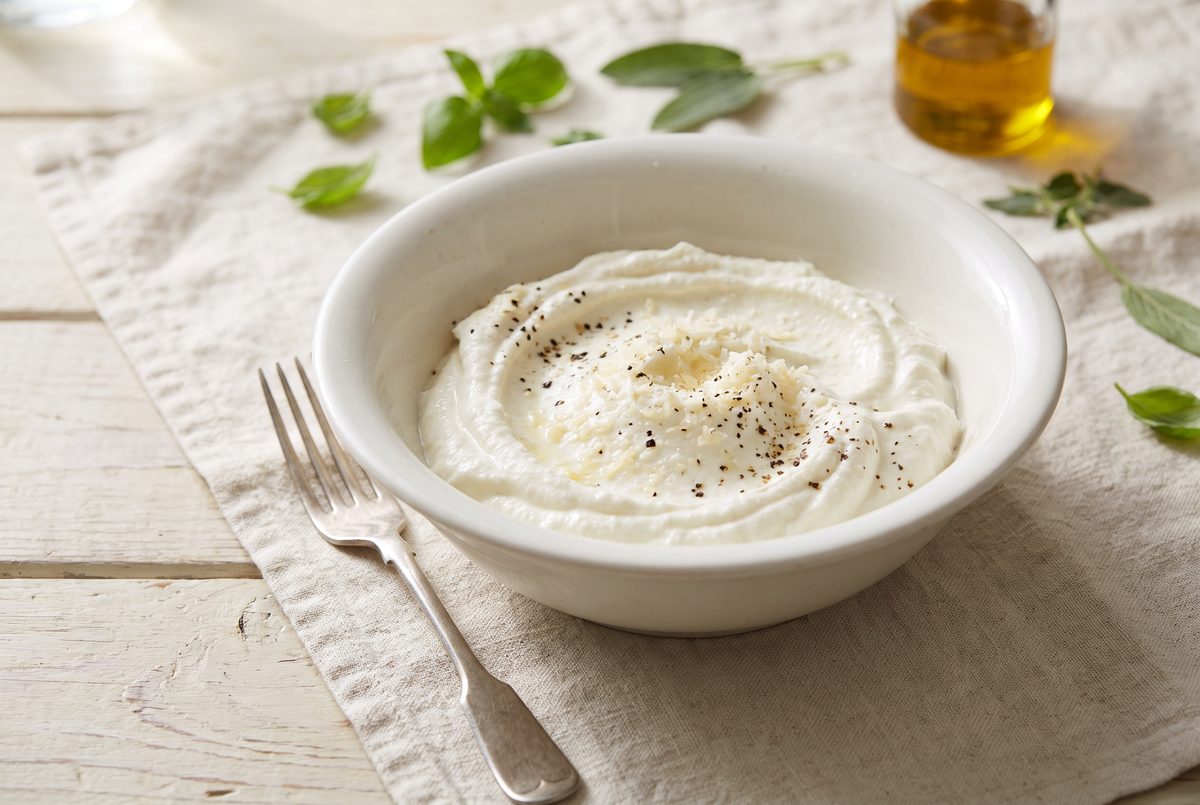
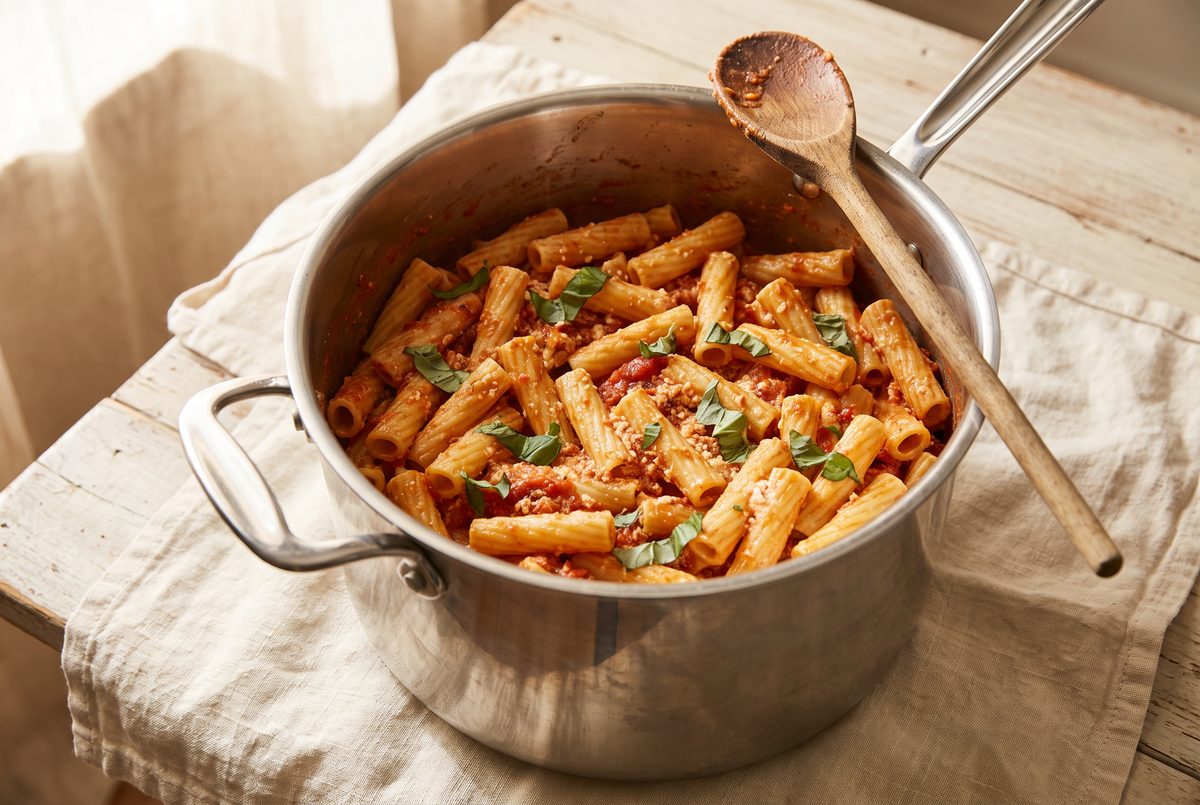
- Heat the oven to 400°F and boil the pasta 3 minutes short. Heat the oven to 400°F (200°C). Bring 4 quarts (4 L) of water to a rolling boil, add the teaspoon of salt, and drop in the pasta. Look at the box, take the lower number, and subtract 3 minutes — for most ziti that means 8 minutes instead of 11. It should be genuinely underdone when you bite it: still chalky white in the very center. Before you drain it, dip out 1½ cups (350 ml) of the cooking water and keep it. You will use most of it, and it is the one thing you cannot go back for.
- Build the dish in the pot, not in the baking dish. Stir ½ cup of the hot pasta water into the ricotta cream, a splash at a time, until it pours off the spoon in a thick ribbon. Drain the pasta and tip it back into its own dry pot, off the heat. Add about three quarters of the tomato sauce and all of the ricotta cream and fold it over until every tube is coated inside and out, adding more pasta water — usually another ½ cup — until the whole thing looks a shade too loose and slides rather than clumps. Tear in the remaining 6 basil leaves. Taste it now: this is the last moment when seasoning is still easy.
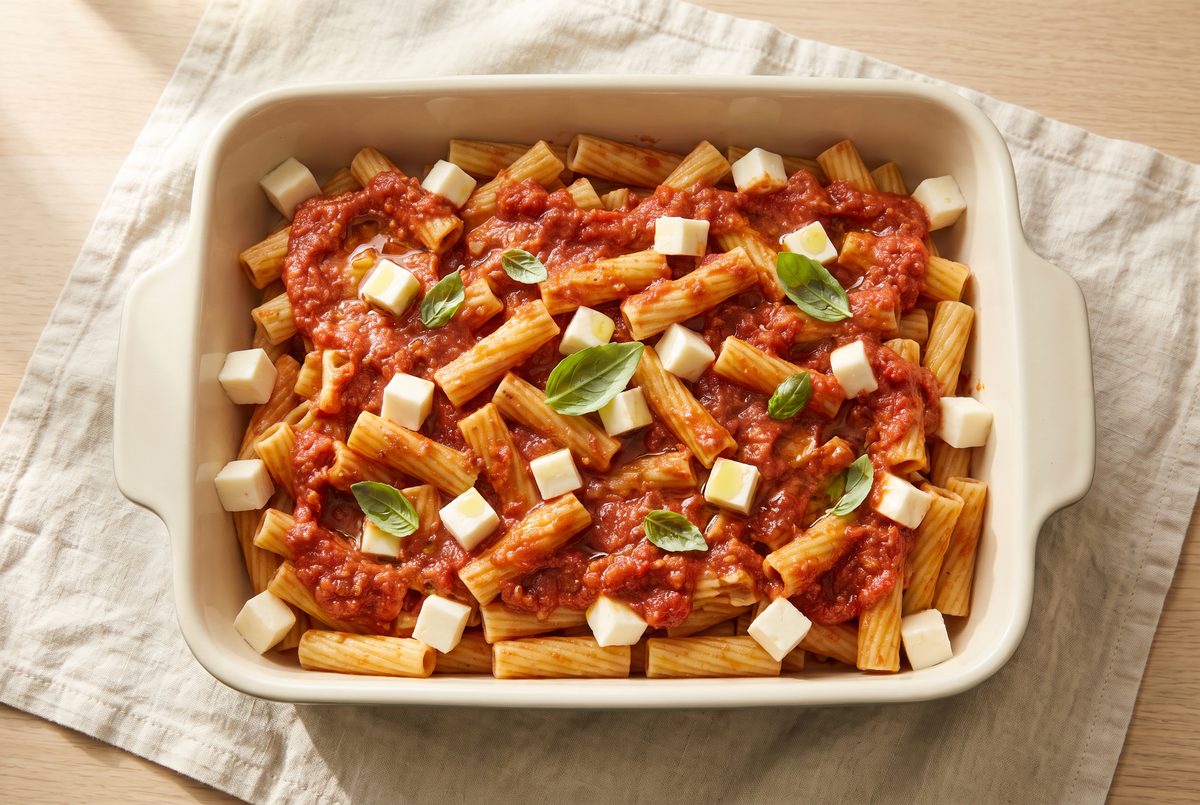
- Layer it, bury the mozzarella, sauce the top. Spread 2 tablespoons of the reserved sauce over the bottom of a 9x13 inch (23x33 cm) ceramic or glass baking dish. Add half the pasta, scatter half the mozzarella cubes over it, then the rest of the pasta, then the rest of the mozzarella, and spoon the remaining sauce over the top in a thin layer that reaches the corners. Cubes buried in the middle melt into pockets you find with a fork; cheese piled only on top turns into a rubber lid that keeps the steam in and the crust off. The top should look sauced, not dry — dry pasta ends sticking up out of the tray are the ones that come out like splinters.
- Bake 30 to 35 minutes, uncovered the whole time. Bake on the middle rack for 30 to 35 minutes, uncovered — or 45 to 50 if the dish came out of the fridge. It is done when the sauce is bubbling slowly at the edges and the surface has gone matte and patchy brown in the places where the mozzarella has caught. No foil: foil is for reheating, and a tray covered through the bake steams instead of browning. If the top is still pale at 35 minutes, give it 3 minutes under the broiler and stand there watching it, because that step takes about ninety seconds longer than you think and then suddenly it is burnt.
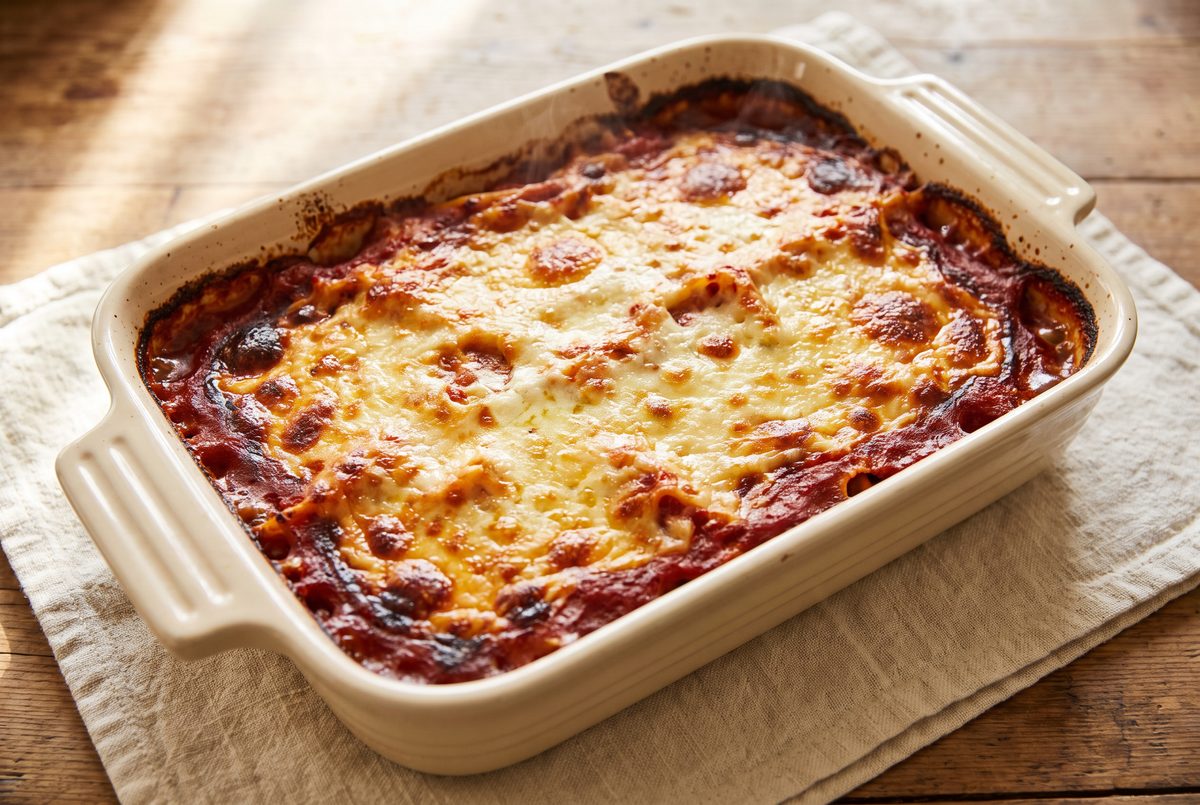
- Rest it 10 minutes. This is not optional. Take it out and leave it on the counter 10 minutes before you cut into it. Straight from the oven the sauce is still thin and the whole thing slumps onto the plate; ten minutes and it sets enough to lift out in a square with a corner that holds its shape. It is also far too hot to taste anything at the minute it comes out. If you are eating it an hour later at room temperature, which Southern Italy considers the correct way, it will be better still.
Tips from our kitchen
- The shape matters more than the brand. You want a short tube with ridges — ziti, rigatoni, mezze maniche, penne rigate — because baked pasta is the one application where sauce gets inside the pasta and stays there. Smooth penne lisce sheds it, and long pasta mats together into a layer you have to cut with a knife. Bronze-cut pasta has a rougher surface and holds noticeably more sauce, which is worth the extra dollar here in a way it is not in a bowl of spaghetti.
- Buy passata, not sauce. Strained tomato purée in a carton or jar, with tomatoes as the only ingredient, is the base this is built on: nothing to cook out, no sugar, no dried herbs. If all you can find is canned crushed tomatoes they work, but they bring about 190 mg more sodium per portion and a coarser texture, and they want 25 minutes of simmering rather than 20. Jarred marinara is already seasoned and already salted — if you use it, you are making a different and saltier dish.
- Save more pasta water than you think you need. A cup and a half, and expect to use a full cup of it: half in the ricotta, half in the pot. Starchy water is what turns ricotta into a sauce and what keeps the pasta from drinking the tray dry in the oven. There is no substitute once the water is down the drain — plain hot water loosens the ricotta but will not bind it, and the difference shows up as a slightly broken, grainy surface.
- Ceramic or glass, and let it come up to room temperature if it is glass. Metal pans conduct faster and brown the bottom before the middle is hot; ceramic and glass are slower, more forgiving, and hold the heat on the table. Pyrex and similar glass should not go from the fridge straight into a 400°F oven — thermal shock is a real risk with a cold glass dish. If the tray has been refrigerated overnight, give it 20 minutes on the counter first, which also takes about 10 minutes off the bake.
- Double it and freeze the second tray unbaked. Build it in a foil pan, wrap it tight, freeze up to 3 months, then bake from frozen, covered, at 375°F (190°C) for about 60 minutes, uncover, and give it another 20 at 400°F. It is a better freezer dish unbaked than baked, because the pasta has not yet been through the oven once. For a week of this kind of cooking, our Mediterranean meal prep guide has the full Sunday plan.
Variations
- Whole-wheat ziti, for the training weeks rather than race week. The same tray made with whole-wheat pasta comes to 623 calories with 90 g of carbohydrate, 31 g of protein and 12 g of fiber instead of 6.1 — a better everyday plate and a worse pre-race one, for exactly the same reason. It also needs a little more pasta water, because whole wheat absorbs more.
- With peas, which is what a Neapolitan kitchen does in spring. A cup of frozen peas (150 g), thawed and folded in at the end of step 4, adds about 30 calories and 2 g of protein a portion and makes the tray look like food rather than carbohydrate. Spinach works the same way if you squeeze it properly dry first — wet greens are the other way to end up with a loose tray.
- For recovery with more protein, add the meat to the sauce, not the top. Half a pound of 93% lean ground beef or turkey browned before the garlic goes in takes the portion to roughly 42 g of protein and 732 calories. That is the direction the sheet-pan chicken parmesan takes much further, and if you want the carbohydrate with the protein already built in, the Sicilian tuna pasta gets to 31 g in 25 minutes on the stove.
- Smaller trays, for one person who runs. Build it in two 8x8 inch dishes or four single-portion gratin dishes and cut the bake to 22 to 25 minutes; the small ones brown more, which most people consider an improvement. This is the format worth knowing if the tray is for a training week rather than a table.
- The Sunday version, if there is an afternoon. Ragù instead of passata, cubes of provolone instead of mozzarella, hard-boiled eggs sliced into the middle layer, and a handful of fried eggplant if you are in Sicily, where the dish is called pasta 'ncasciata. The numbers on this page no longer apply to that one, and it is not a pre-race dinner by any reading, but it is the dish this recipe is a weekday translation of.
Storage & meal prep
This is a dish whose whole design is keeping, so the useful answer has two halves. Unbaked, assembled and covered tight, it holds 24 hours in the fridge — build it in the morning, bake it at night, add 15 minutes to the time and 20 minutes on the counter first if the dish is glass. That is the version to plan around the day before a long effort. Baked, it keeps 4 days covered in the fridge and is genuinely good cold or at room temperature, which is a sentence worth taking literally: a square of yesterday's pasta al forno wrapped in foil is what Southern Italians take to the beach. To reheat a portion, add a tablespoon of water, cover it with foil and give it 20 minutes at 350°F (175°C), or 2 minutes in the microwave at 70% power — the USDA asks for 165°F (74°C) in the middle of reheated leftovers, and a tray this dense takes longer than it looks to get there. It freezes 3 months either baked or unbaked, and unbaked is better: bake from frozen, covered, 60 minutes at 375°F (190°C), then uncovered 20 minutes at 400°F. What it does not survive is being reheated twice, which turns the pasta floury.
Nutrition per serving
| Nutrient | Amount | % DV* |
|---|---|---|
| Calories | 646 kcal | 32% |
| Total fat | 18 g | 23% |
| Saturated fat | 7.2 g | 36% |
| Carbohydrates | 90 g | 33% |
| Fiber | 6.1 g | 22% |
| Sugars | 10 g | — |
| Protein | 30 g | 60% |
| Sodium | 747 mg | 32% |
*Percent Daily Values are based on a 2,000-calorie diet. Values are calculated from USDA FoodData Central and manufacturer data for the ingredients as listed; they are estimates, not lab analyses. Nutrition disclaimer.
Frequently asked questions
Is baked pasta healthy?
It depends almost entirely on how much cheese is in it, and this version is written to keep that number honest: 646 calories a portion with 90 g of carbohydrate, 30 g of protein, 18 g of fat and 747 mg of sodium, using part-skim ricotta and 3½ oz of mozzarella for the whole tray rather than the pound a typical American baked ziti calls for. A restaurant baked ziti with ragù, whole-milk mozzarella and béchamel runs closer to 900 or 1,000 calories with twice the saturated fat. As written it is a legitimate endurance meal; it is not a light dinner, and it is not meant to be.
Can I make pasta al forno ahead of time?
Yes, and it is better for it. Assemble the whole dish, cover it and refrigerate it up to 24 hours, then bake it straight from the fridge at 400°F (200°C) for 45 to 50 minutes instead of 30 to 35. A glass dish should sit on the counter 20 minutes first to avoid thermal shock, which also shortens the bake by about 10 minutes. You can also freeze it unbaked for 3 months. The one thing not worth doing is baking it, refrigerating it and reheating the whole tray — reheated twice, the pasta goes floury.
How many calories are in pasta al forno?
646 calories in one of four portions as written here, which works out at 90 g of carbohydrate, 30 g of protein, 18 g of fat, 6.1 g of fiber and 747 mg of sodium. The pasta is 371 of those calories and the three cheeses together are 157. Made with whole-wheat ziti it comes down slightly, to 623 calories, with the fiber going from 6.1 g to 12 g. Portions are the variable that matters most: this is a 9x13 dish cut in four, and cut in six it is 431 calories with 60 g of carbohydrate.
Why is my baked pasta dry?
Almost always one of two things, and usually both. The pasta was boiled to al dente before baking, so it had no capacity left to absorb and the sauce cooked away around it instead; and there was not enough sauce to begin with. The ratio here is 1¾ parts passata to 1 part dry pasta by weight — 700 g to 400 g — plus about a cup of starchy pasta water, and the mixture should look slightly too wet going into the dish. The third, smaller cause is a bare top: any pasta sticking up out of the sauce dehydrates into something closer to a cracker.
Should I cover baked pasta with foil?
Not for this one. Covered, the tray steams and never browns, and browning is where most of the flavor of a baked pasta lives. Bake it uncovered the full 30 to 35 minutes and only reach for foil if the top is clearly darkening before the center is hot, which happens in metal pans more than ceramic. Foil does belong on a frozen tray for the first hour, and on leftovers being reheated, where the point is to trap moisture rather than drive it off.
Is this a good carb-loading meal before a marathon?
It is a good loading-day meal and an excellent post-race one, but it is not what we would eat the night before the gun. One portion is 90 g of carbohydrate, about an eighth of the 680 g a 150 lb runner needs on a 10 g/kg loading day, and the 30 g of protein makes it one of the few pasta dishes that also fits the recovery window. The caveat is fat: 18 g a portion, mostly cheese, and fat slows the stomach. For the last dinner before an early start, something plainer — cacio e pepe at 11 g of fat, or spaghetti alle vongole at 12 — is the safer plate. The reasoning is in our carb-loading guide.
Sources
- USDA FoodData Central — pasta, dry, enriched, unenriched and whole-wheat; ricotta cheese, part skim milk; mozzarella cheese, part skim, low moisture; Parmigiano-Reggiano; tomatoes, canned, purée; olive oil; garlic, raw; basil, fresh
- Burke, L.M., Hawley, J.A., Wong, S.H.S. & Jeukendrup, A.E. (2011). Carbohydrates for training and competition. Journal of Sports Sciences
- Bussau, V.A., Fairchild, T.J., Rao, A., Steele, P. & Fournier, P.A. (2002). Carbohydrate loading in human muscle: an improved 1 day protocol. European Journal of Applied Physiology
- Thomas, D.T., Erdman, K.A. & Burke, L.M. (2016). Position of the Academy of Nutrition and Dietetics, Dietitians of Canada, and the American College of Sports Medicine: Nutrition and Athletic Performance. Journal of the Academy of Nutrition and Dietetics
- Dietary Guidelines for Americans 2020–2025 — sodium under 2,300 mg per day for adults; dietary fiber 25 to 34 g per day
- USDA Food Safety and Inspection Service — reheat leftovers to an internal temperature of 165°F (74°C)
You might also like
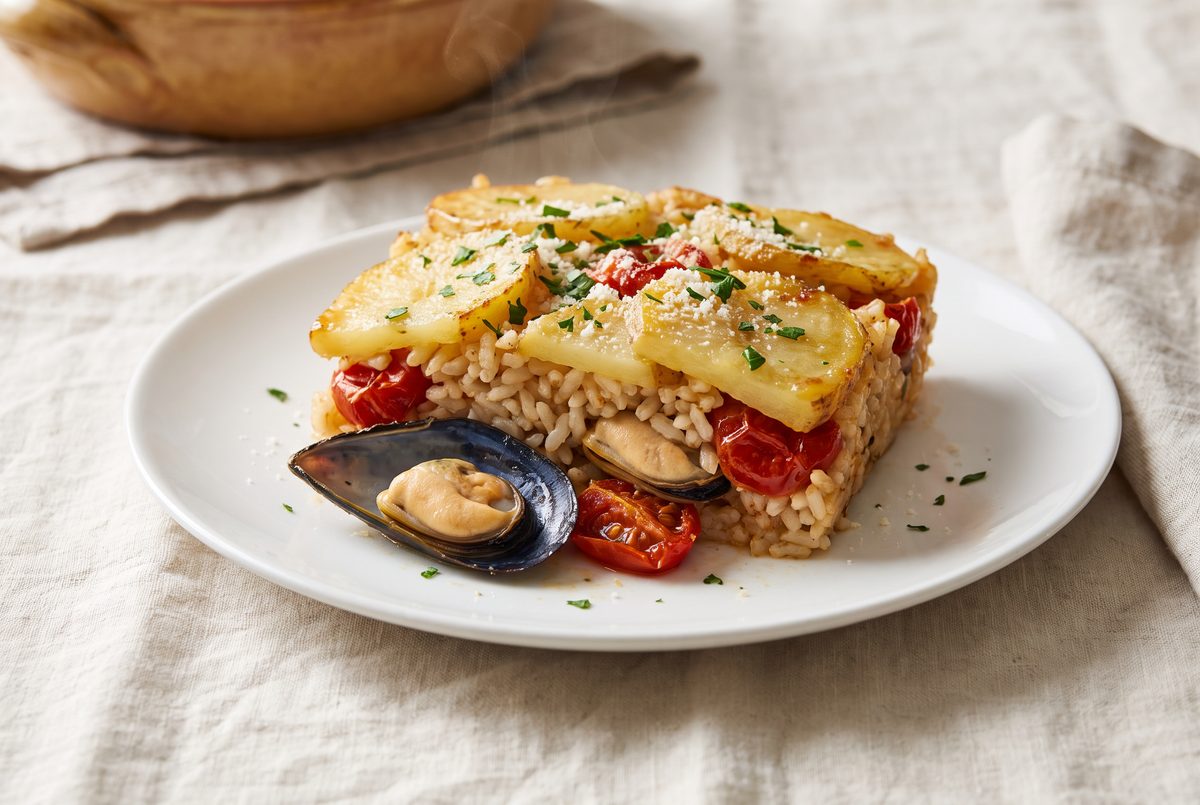
Baked Rice, Potatoes and Mussels (Tiella)
Tiella barese is a layered bake from Puglia — potatoes, raw-opened mussels and dry rice in one dish, no stirring, an…
- 1 hr 35 min
- 669 kcal
- 25 g protein
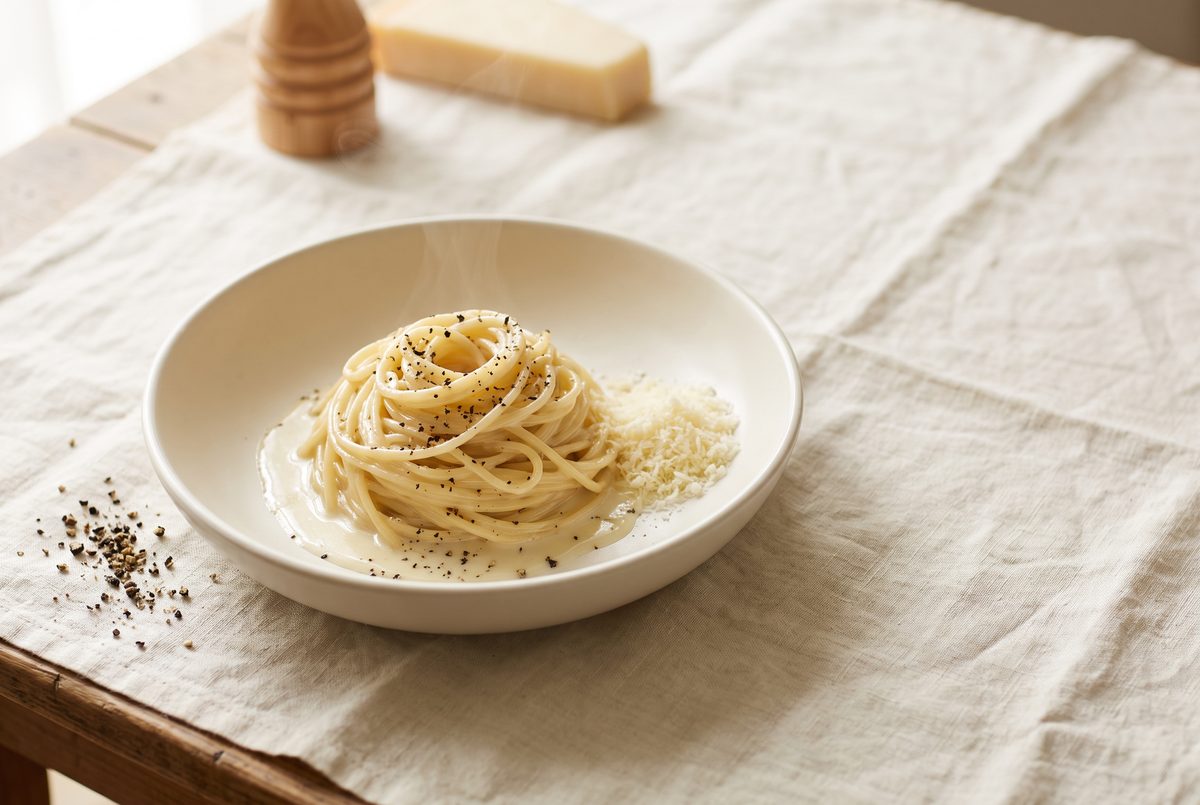
Cacio e Pepe, No Cream
Cacio e pepe is spaghetti dressed with nothing but grated Pecorino Romano, cracked black pepper and the starchy water…
- 25 min
- 561 kcal
- 26 g protein
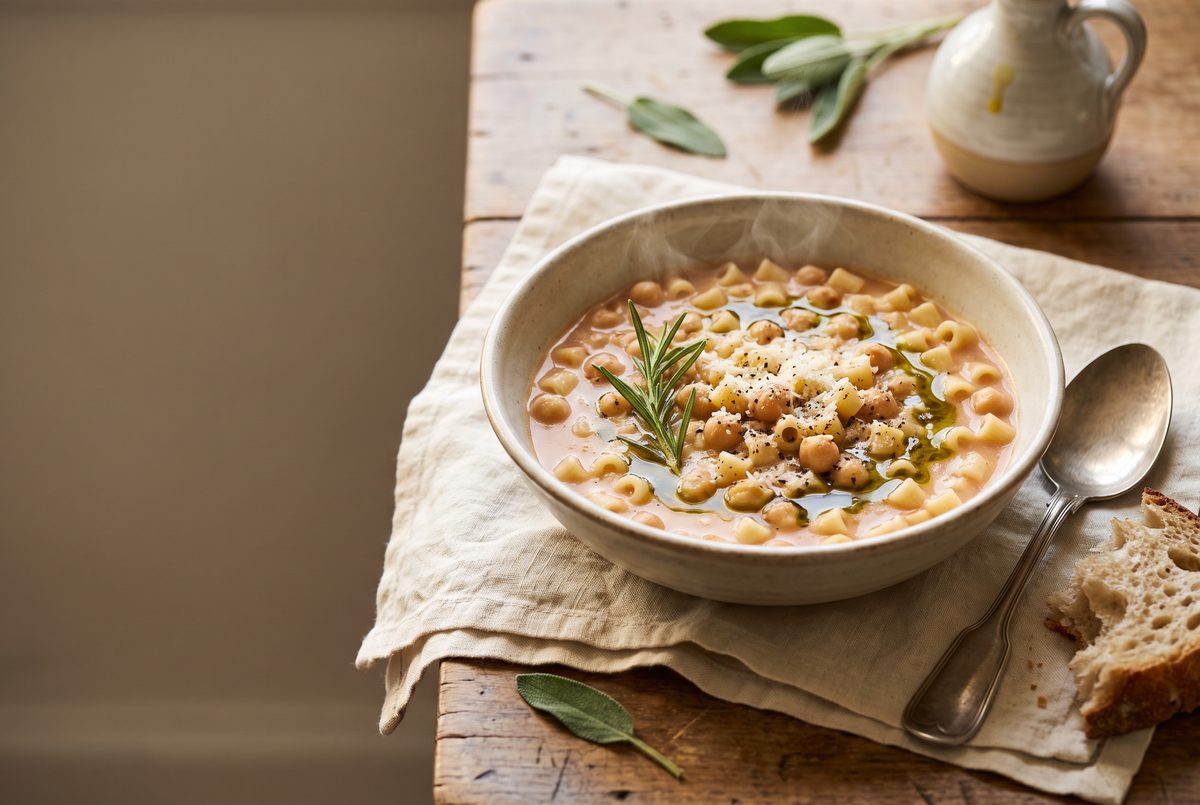
Pasta e Ceci (Roman Pasta with Chickpeas)
Pasta e ceci is a Roman one-pot dish of short pasta simmered with chickpeas, rosemary, garlic and a spoon of tomato…
- 35 min
- 611 kcal
- 23 g protein