Italian Semolina Porridge (Semolino al Latte)
Semolina rained into hot milk and cooked down for ten minutes until a spoon leaves a furrow in it, then topped with banana, berries and a thread of honey — the breakfast Italian children grow up on, and the one plate in the Italian repertoire that puts a marathon's worth of carbohydrate on the table before 7 a.m. without any fat to slow it down.
Semolino al latte is the Italian breakfast porridge: semolina rained into hot milk and cooked down for ten minutes, then finished with banana, berries and honey. One bowl is 561 calories with 108 g of carbohydrate, 20 g of protein and just 7.2 g of fat — the high-carbohydrate, low-fat breakfast sports nutrition asks for three to four hours before a long run, and it takes 20 minutes.
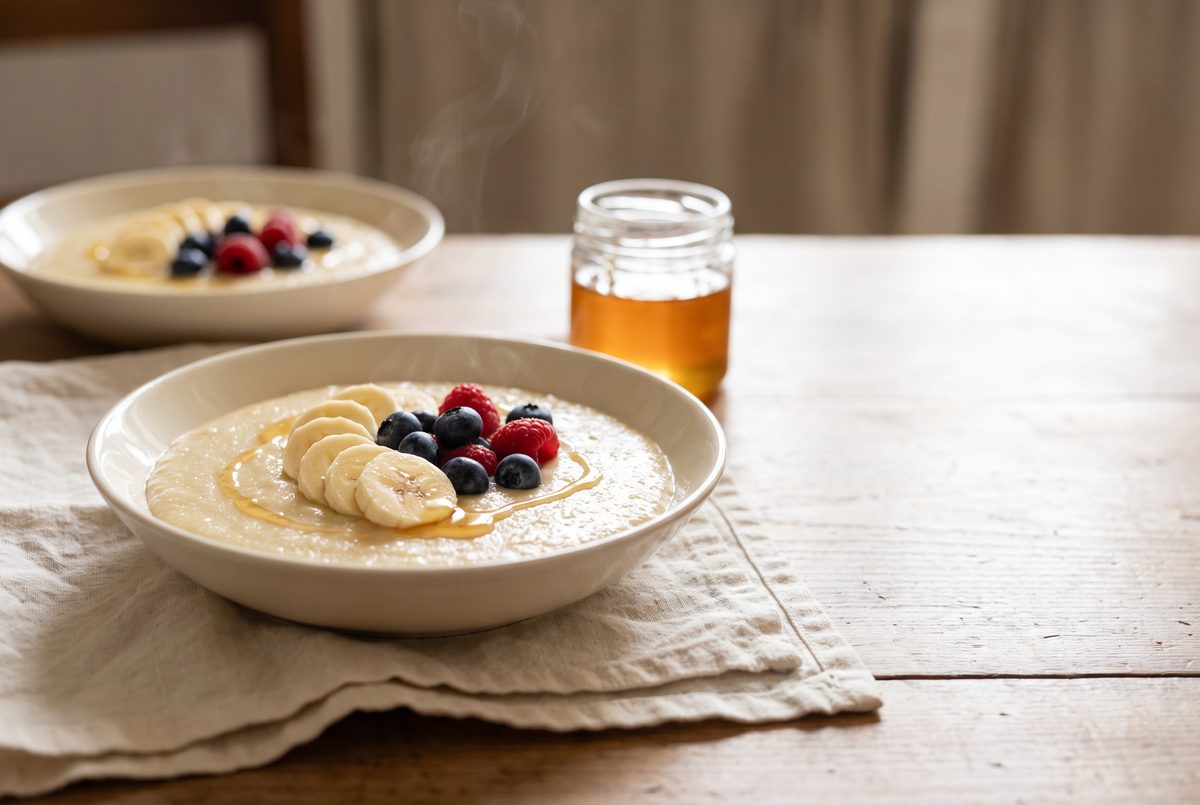
The hardest thing to explain to an American visitor about Italian food is the breakfast, because there essentially isn't one. A coffee standing at the bar, a pastry if it is that sort of morning, and lunch is four hours away. What does exist, in houses with children in them, is semolino al latte: semolina cooked into hot milk until it thickens, sweetened with honey or sugar, eaten out of a bowl with a spoon while it is still too hot. It is the first warm food most Italians remember eating. No restaurant has ever put it on a menu and no cookbook sold abroad bothers with it.
It is also, by complete accident, the best pre-race breakfast in the Italian repertoire. Everything that makes a race-morning meal work is already in it and nothing that ruins one is: it is almost entirely carbohydrate, it has barely any fat, it is warm and bland and goes down when nerves have closed your throat, and it is made from a box of dry grain and a carton of milk, which is what you can actually buy near a hotel in a strange city at six in the morning. Our carb-loading guide makes the case for the Italian breakfast in general — bread, honey, fruit, coffee, sweet and white and nearly fat-free. This is the cooked version of the same idea, and it is denser, so you get the carbohydrate down in one bowl instead of three slices of bread.
The technique is ten minutes long and has exactly one failure mode. Semolina tipped into hot milk in a lump seizes instantly and you spend the rest of the morning chasing pellets around the pan with a whisk. Added in a thin stream, with the whisk already moving, it turns into a smooth pale cream that thickens under your hand in about a minute. After that it only needs time on low heat to stop tasting of raw flour, which is the part most recipes rush and the reason people think they don't like semolina.
Why this recipe works for endurance
The pre-race breakfast has an actual number, and it is per kilogram of you. The position stand of the Academy of Nutrition and Dietetics, Dietitians of Canada and the American College of Sports Medicine puts pre-exercise carbohydrate at 1–4 g per kilogram of body weight, one to four hours before the start (Thomas, Erdman & Burke, 2016). For a 150 lb (68 kg) runner that is a range from 68 g to 272 g, and the practical marathon-morning figure most coaches land on is 100–150 g eaten three to four hours out. One bowl of this is 108 g. That is the entire reason the recipe is portioned for two rather than four: the serving size is the dose.
7.2 g of fat is the number that decides how you feel at mile 18. Fat and fiber both slow the stomach, and gastrointestinal trouble is reported by up to a third of athletes in long events — the standard advice for the hours before a start is to cut fat and fiber rather than change the carbohydrate source (de Oliveira, Burini & Jeukendrup, 2014). Almost all the fat here is the 2½ cups of 2% milk, at 6.1 g a serving. The semolina contributes 0.7 g and the fruit 0.5 g. For comparison, the item this bowl replaces on an Italian morning is the cornetto, which is a butter pastry: that is where an Italian breakfast keeps its fat, and it is the one thing our carb-loading guide tells you to leave in the case.
6.5 g of fiber, where it comes from, and how to halve it. Semolina is milled from the endosperm of durum wheat with the bran taken off, so it is low in fiber for a wheat product: 3.9 g per 100 g dry, against 9 g for whole-wheat pasta. The fiber in this bowl is mostly fruit — 3.1 g from the two bananas, 2.4 g from the semolina, 0.8 g from the berries. For most people on most mornings 6.5 g is a good number. If you know your stomach is sensitive on race day, the honest fix is one very ripe banana and no berries, which gives you 91 g of carbohydrate and 4.1 g of fiber for 495 calories — still inside the fuel-up range, with a third less fiber.
Milk is doing two jobs, and a plant milk only does one of them. The 2½ cups of 2% milk bring 10 g of protein and 15 g of carbohydrate as lactose, which is why the bowl reaches 20 g of protein without anything added to it. Carbohydrate eaten with a little protein is also the standard shape of a recovery meal rather than a fuel-up one (Burke, Hawley, Wong & Jeukendrup, 2011), which is what makes the Greek yogurt variation below a genuinely different meal and not a garnish. Unsweetened almond milk would take the protein down to about a third of this; we have not calculated those numbers, so the table above does not describe that bowl.
What this is not: a weight-loss breakfast. 561 calories and 49 g of sugar is a lot of breakfast, and we are not going to dress it up. 17 g of that sugar is added sugar from the honey, which against the Dietary Guidelines ceiling of about 50 g a day for a 2,000-calorie diet is roughly a third of the day's allowance spent before eight in the morning. This is a performance meal, eaten on the mornings you are going to run for two hours or more, and on the other days three bowls out of the same pan is 374 calories with 72 g of carbohydrate. The weight-loss collection is where the sub-550-calorie plates live.
Ingredients
Two deep bowls, about 1¼ cups of porridge each plus toppings
The porridge
On top
Instructions
- Warm the milk with the zest and the salt, and do not let it boil. Pour the 2½ cups of milk into a medium saucepan — a heavy one with a pale interior, so you can see the colour at the bottom — and add the lemon zest and the salt. Set it over medium heat and bring it to the point where the surface trembles and a ring of small bubbles forms around the edge, about 5 minutes. Stir it two or three times on the way up and scrape the bottom as you do. Milk scorches on the base before it ever boils, and a scorched base goes right through the finished bowl as a flat burnt note you cannot cover with honey. Medium heat, not high. If it climbs and looks like going over, lift the pan off the burner for twenty seconds rather than stirring harder.
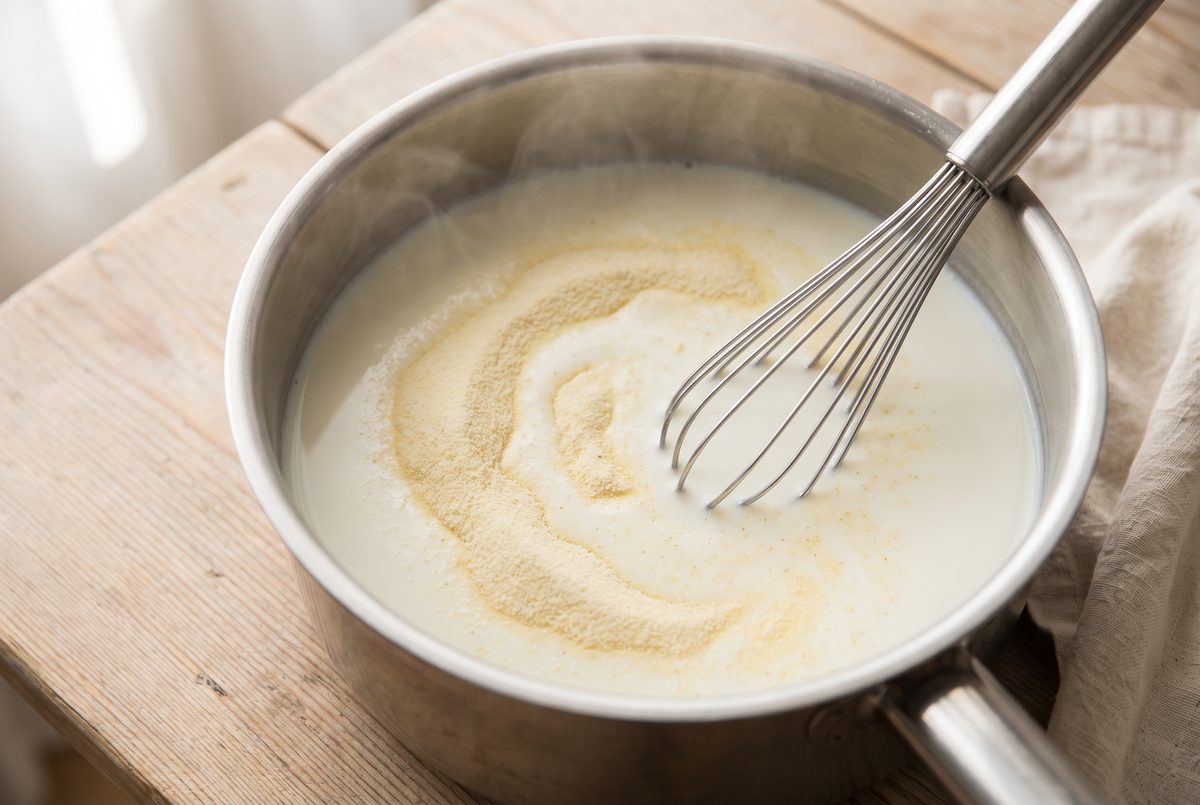
- Rain the semolina in, in a thin stream, with the whisk already moving. Turn the heat down to low. Add the ¾ cup of semolina in a thin steady stream, whisking the whole time it is going in — count on about twenty seconds to get it all in.
This is the one step that can fail. Semolina tipped in as a lump hits hot milk, gelatinises on the outside and sets into pellets with dry flour inside them, and no amount of whisking afterwards will break them up. A thin stream into a moving whisk gives you a smooth cream instead. You will feel it thicken under the whisk within 60 to 90 seconds, which is faster than seems reasonable. If you want insurance, slake the semolina with 3 tablespoons of cold milk into a loose paste before you start and whisk that in instead.
- Cook it 8 to 10 minutes on low, and judge it by the spoon. Swap the whisk for a wooden spoon and keep the pan on low, stirring every half minute and going round the corners where it catches. The semolina needs 8 to 10 minutes to lose its raw floury taste. Taste a little at six minutes and again at nine and the difference is obvious: undercooked semolina is chalky on the tongue and sits heavy afterwards, which is the single reason people decide they don't like it.
It is done when a spoon dragged through the middle leaves a furrow that holds its shape for a second before closing over. If it tightens past that before the ten minutes are up, add a splash of warm milk and keep going — time on the heat matters more than thickness, because you can always loosen it and you cannot un-chalk it.
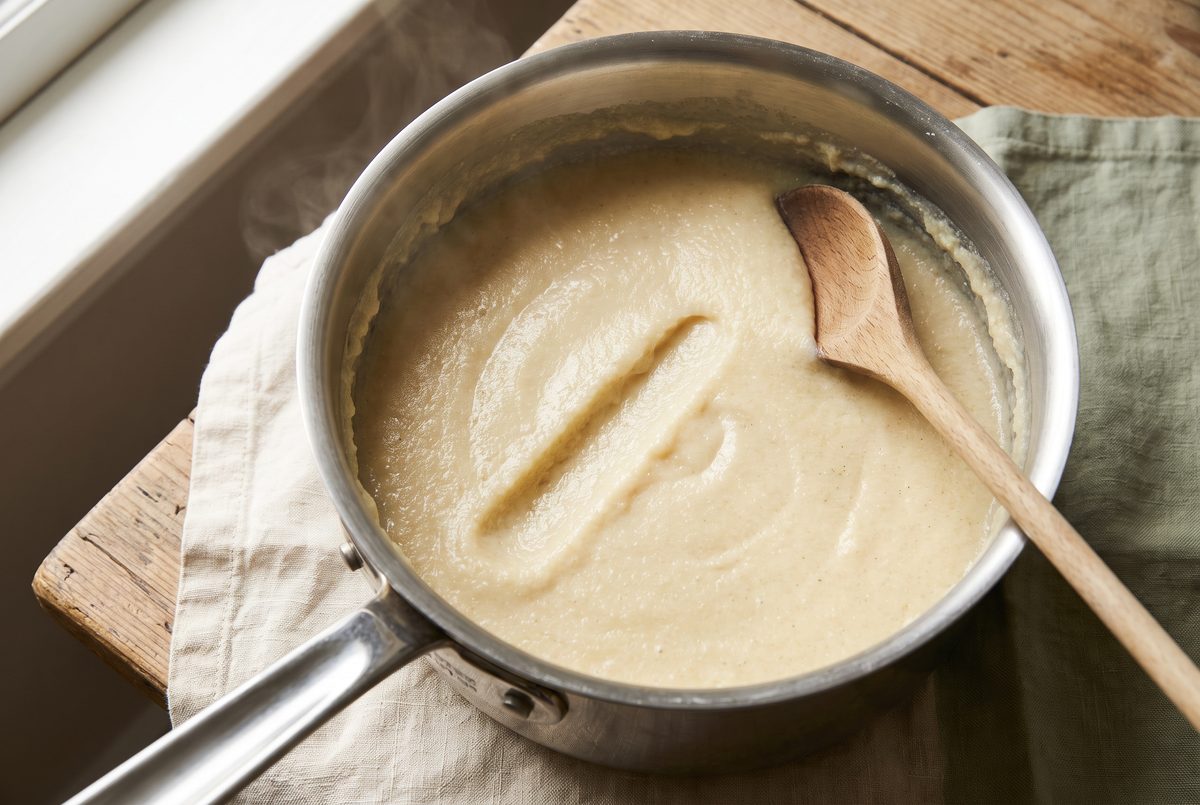
- Rest it 2 minutes off the heat, then loosen it if it has gone too far. Take the pan off the heat and leave it 2 minutes. It carries on thickening as it cools — semolina always sets further than you expect — so judge the texture at the end of those two minutes and not before.
If it has gone past a thick, just-pourable cream, beat in 2 to 4 tablespoons of warm milk until it slackens. Do that while the pan is still hot: cold milk stirred into cooling porridge seizes in streaks and you get a grainy bowl. The target is something that mounds on the spoon but still settles flat in the bowl.
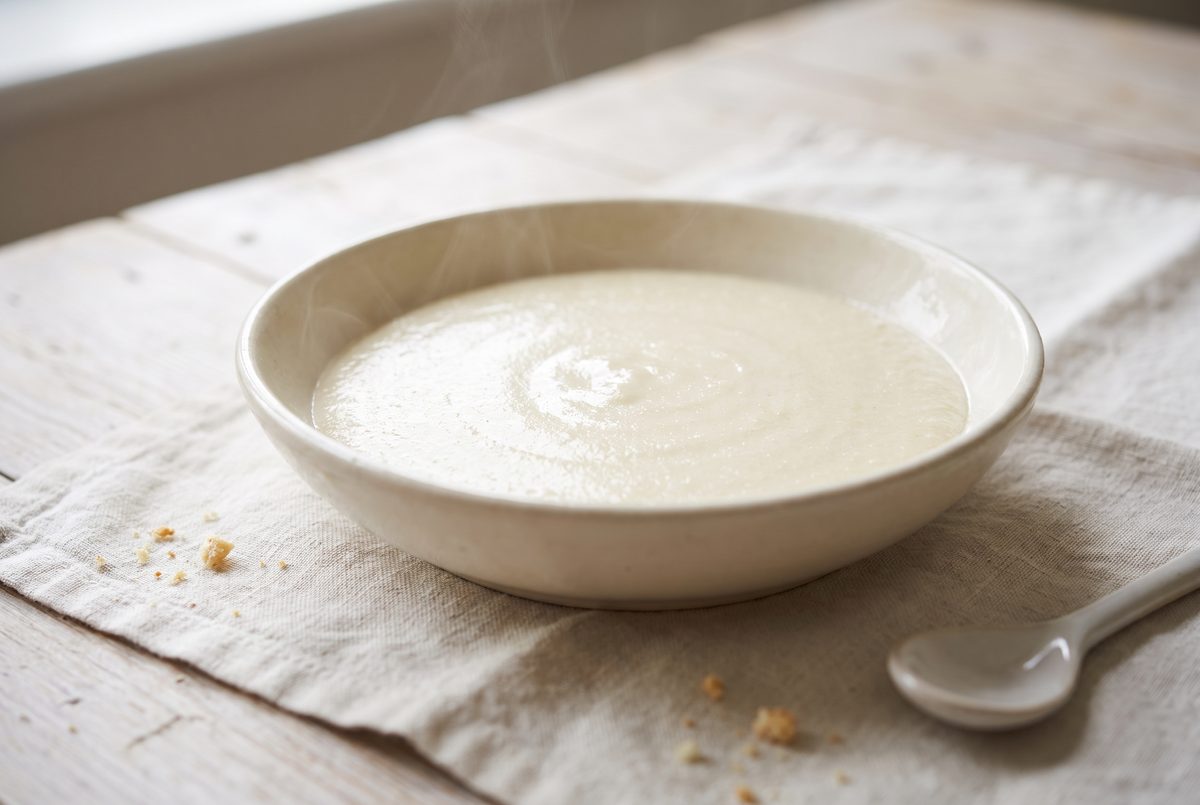
- Fill the bowls, top them, and eat it hot. Spoon it into two deep bowls, warmed under the hot tap and dried if you have thirty seconds to spare — 561 calories of porridge in a cold bowl is lukewarm by the fourth mouthful. Fan the banana coins over the top, scatter the berries, and trail 1 tablespoon of honey over each bowl rather than stirring it in, so it stays as a sweet thread through an otherwise mild spoonful. Eat it straight away. Semolino left standing for twenty minutes becomes a set pudding, which is a perfectly good thing and a completely different one.
Tips from our kitchen
- If you do get lumps, you have about thirty seconds to fix them. Push the whole thing through a coarse sieve back into the pan while it is still loose and hot, and carry on cooking — nobody will know. Once it has thickened, a sieve will not take it and a blender turns it into glue. The permanent fix is the slurry: whisk the dry semolina into 3 tablespoons of cold milk first, then pour that paste into the hot milk. It is marginally less good because the starch hydrates unevenly, and it is completely reliable.
- Semolina, semolino, farina and Cream of Wheat are four names and two things. Semolina is coarsely milled durum endosperm — hard wheat, pale yellow, slightly sandy between the fingers, the grain dry pasta is made from. American boxed farina, including Cream of Wheat, is milled from softer wheat and ground finer: it cooks in two or three minutes instead of ten and gives a smoother, blander, more baby-food bowl. Both work here. What does not work is semola rimacinata, the flour-fine double-milled durum sold for bread, which turns to paste.
- Use the smallest burner you have, or a heat diffuser. Starch and milk on a wide gas ring will scorch in the two spots where the flame curls up the sides of the pan, and the burnt flavour is the most common way this dish gets ruined after lumps. Low and slow for ten minutes is the whole technique. If your stove only does violence at the low setting, put the pan on a diffuser or make it in a double boiler and give it fifteen minutes instead of ten.
- Treat the honey as the dial, not as decoration. One tablespoon is 17 g of carbohydrate and 64 calories. If you need 120 g of carbohydrate because you are running further, make it two tablespoons a bowl and you are at 125 g. If you are eating this on a training morning rather than a race morning, leave it out entirely and the bowl drops to 497 calories with 91 g of carbohydrate and 31 g of sugar, all of it from fruit and milk. The rest of the recipe does not change.
- Zest the lemon before you do anything else, and use the zest, not juice. Lemon juice in hot milk curdles it; the zest only gives you the oil in the peel, which is the point. Grate it fine on a rasp so there are no chewy strips, and take only the yellow — the white pith underneath is where the bitterness lives. Orange zest works and is sweeter. A split vanilla pod warmed in the milk is the other classic, and a strip of cinnamon bark is the Sicilian version.
Variations
- The low-fiber race-morning version: 495 calories, 91 g of carbohydrate, 19 g of protein, 4.1 g of fiber. One very ripe banana instead of two, and skip the berries. This is the bowl to make on the morning of an actual race if you have ever had stomach trouble in a long event — it keeps you inside the 80–120 g fuel-up range while cutting the fiber by more than a third. Everything else about the method is identical.
- The recovery bowl: 1½ cups (300 g) of 2% Greek yogurt alongside takes it to 671 calories, 34 g of protein and 114 g of carbohydrate. Spoon the cold yogurt into the bowl next to the hot porridge rather than on top of it, so it stays distinct. Carbohydrate with 20–30 g of protein inside a couple of hours of finishing is the shape a recovery meal wants, and this version overshoots the protein slightly and is all the better for it. What to eat after a long run has the timing.
- Chocolate semolino: 1 tablespoon (6 g) of unsweetened cocoa whisked in with the semolina — 555 calories, 107 g of carbohydrate, 20 g of protein (drop the berries, keep the banana and the honey). This is how most Italian children actually ate it, and the cocoa covers up a slightly undercooked batch, which is presumably why. The numbers barely move because 6 g of cocoa is 14 calories.
- Three bowls instead of two: 374 calories, 72 g of carbohydrate, 13 g of protein. Same pan, same ten minutes, divided three ways with the toppings spread over three bowls. This is the sensible everyday portion for anybody who is not running long that morning, and it is the version to make for a family. The recipe above is sized as a dose for an athlete because of the file it lives in, not because anyone needs 108 g of carbohydrate at breakfast.
- With 20 g of toasted almonds: 619 calories, 22 g of protein, 12 g of fat, 7.7 g of fiber. Good on a training day and wrong before a race, because the fat almost doubles and fat is the thing you are trying to keep out of the hours before a start. Chop them coarse and put them on at the last second so they stay crisp. The same caution applies to a spoonful of nut butter stirred in, which is the obvious American instinct here and the one to resist on race morning.
Storage & meal prep
Semolino sets firm in the fridge, which is a feature rather than a problem once you know it. Covered, it keeps 3 days. To bring it back, put a portion in a small pan with ¼ cup of milk per serving over low heat and beat it with a wooden spoon until it is a cream again — it takes two or three minutes and it comes back completely. The microwave also works at 50% power with the milk stirred in first, in 30-second bursts. Add the fruit and the honey after reheating, never before.
The traditional thing to do with a cold leftover is the one worth knowing about: pour the hot porridge into an oiled dish about ¾ inch deep, chill it until it is sliceable, then cut it into diamonds. In Italy those get fried or baked as a sweet. It is very good and it is no longer a low-fat breakfast, so we have not put numbers on it. Do not freeze it — the starch separates on thawing and you get water in the bottom of the container and a grainy porridge above it, and there is nothing to hide behind in a dish this plain. If you want breakfast ready for an early start, make it the night before and reheat with milk; that works far better than freezing.
Nutrition per serving
| Nutrient | Amount | % DV* |
|---|---|---|
| Calories | 561 kcal | 28% |
| Total fat | 7.2 g | 9% |
| Saturated fat | 3.9 g | 20% |
| Carbohydrates | 108 g | 39% |
| Fiber | 6.5 g | 23% |
| Sugars | 49 g | — |
| Protein | 20 g | 40% |
| Sodium | 301 mg | 13% |
*Percent Daily Values are based on a 2,000-calorie diet. Values are calculated from USDA FoodData Central and manufacturer data for the ingredients as listed; they are estimates, not lab analyses. Nutrition disclaimer.
Frequently asked questions
What do Italians actually eat for breakfast?
Something sweet, and not much of it. At the bar it is an espresso or cappuccino with a cornetto; at home it is bread or fette biscottate with jam or honey, biscuits dunked in milk, sometimes yogurt and fruit, and for children warm milk or semolino al latte. A savoury breakfast is essentially absent — eggs and bacon at eight in the morning would be regarded as a slightly alarming lunch. The structural consequence, which matters if you are an athlete, is that the Italian breakfast is high in carbohydrate and almost free of fat except in the pastry. Our carb-loading guide works through what that means on a race morning.
How much carbohydrate should I eat for breakfast before a long run?
One to four grams per kilogram of body weight, one to four hours before the start, is the range in the Academy of Nutrition and Dietetics position stand (Thomas, Erdman & Burke, 2016). For a 150 lb (68 kg) runner that works out at 68–272 g, and in practice people land on 100–150 g three to four hours before a marathon and 60–100 g before something shorter. One bowl of this porridge is 108 g of carbohydrate with 7.2 g of fat, which is why it is portioned for two people rather than four. The further out from the start you eat, the more you can get away with.
Is semolina the same as Cream of Wheat?
Not quite. Semolina is the coarsely milled endosperm of durum wheat — hard, pale yellow, the grain dry pasta is made from. Cream of Wheat and other boxed farina are milled from softer wheat and ground finer, which is why they cook in two or three minutes instead of eight to ten. Either one makes this recipe; semolina gives a bowl with more body and a faint nutty flavour, farina a smoother and blander one. Nutritionally they are close, around 360 calories and 73 g of carbohydrate per 100 g dry, and the enriched American versions carry added iron and B vitamins that Italian semolino usually does not.
Can I make semolina porridge ahead of time?
Yes, and for a 6 a.m. start it is the better plan. Cook it the night before, cool it, and refrigerate it covered for up to 3 days — it will set firm. Reheat a portion with ¼ cup of milk per serving in a small pan over low heat, beating with a wooden spoon for two or three minutes until it is a cream again, then add the banana, berries and honey. What does not work is assembling it with the fruit on: the banana goes grey and weeps, and the honey disappears into the porridge overnight.
Can I make it with almond or oat milk?
You can, and the table above stops describing it. The 2½ cups of 2% dairy milk supply 10 g of the 20 g of protein in a serving; unsweetened almond milk has roughly an eighth as much protein, so that bowl loses about half of its protein and stops being a plate with any meaningful protein in it. Oat milk keeps the texture and adds carbohydrate and sugar instead of protein, which is not a bad trade for a pure fuel-up meal. We have not run either version through our nutrition script, so we are not printing numbers for them — if you make the swap, the carbohydrate claim still roughly holds and the protein claim does not.
Sources
- USDA FoodData Central — semolina, enriched; milk, reduced fat, fluid, 2% milkfat, with added vitamin A and vitamin D; honey; bananas, raw; blueberries and raspberries, raw; lemon peel, raw
- Thomas, D.T., Erdman, K.A. & Burke, L.M. (2016). Position of the Academy of Nutrition and Dietetics, Dietitians of Canada, and the American College of Sports Medicine: Nutrition and Athletic Performance. Journal of the Academy of Nutrition and Dietetics 116(3)
- Burke, L.M., Hawley, J.A., Wong, S.H.S. & Jeukendrup, A.E. (2011). Carbohydrates for training and competition. Journal of Sports Sciences 29(S1)
- de Oliveira, E.P., Burini, R.C. & Jeukendrup, A. (2014). Gastrointestinal complaints during exercise: prevalence, etiology, and nutritional recommendations. Sports Medicine 44(S1)
- Dietary Guidelines for Americans 2020–2025 — added sugars under 10% of daily calories; dietary fiber at 14 g per 1,000 calories
- FDA — 21 CFR Part 137 (cereal flours and related products): the standards of identity that separate semolina, farina and enriched farina
You might also like
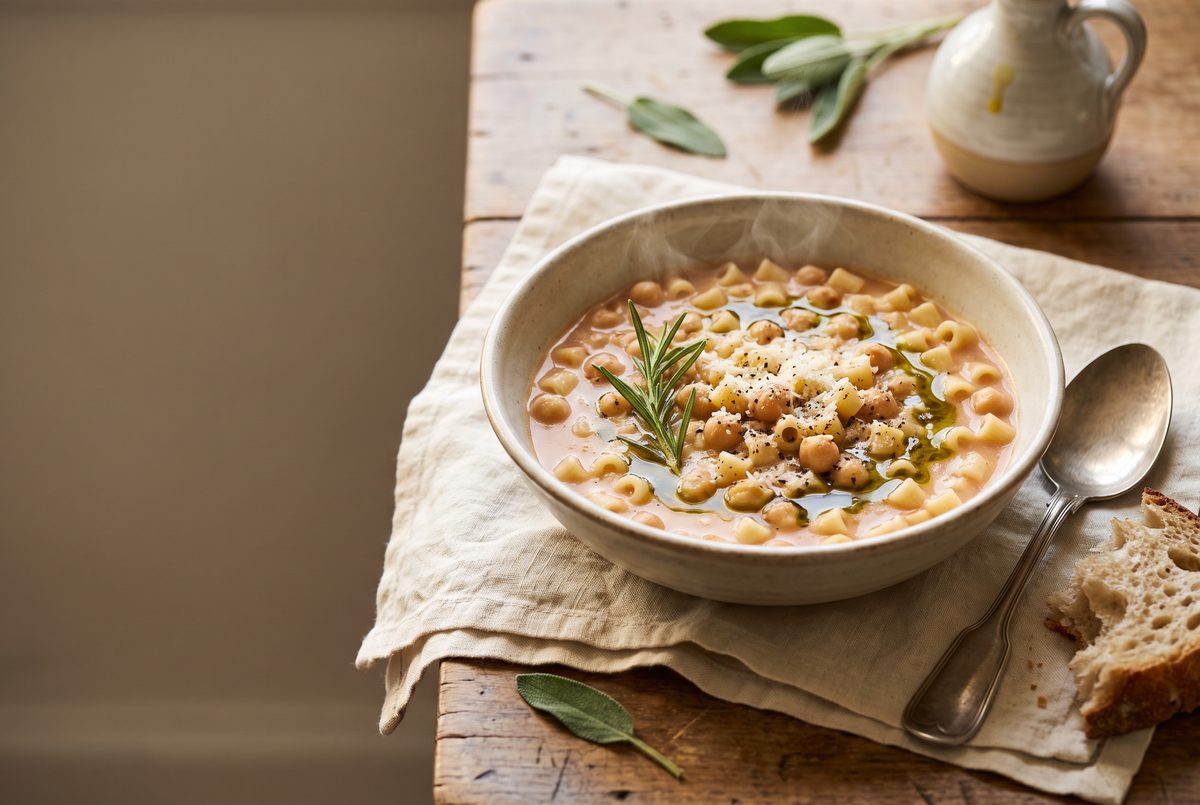
Pasta e Ceci (Roman Pasta with Chickpeas)
Pasta e ceci is a Roman one-pot dish of short pasta simmered with chickpeas, rosemary, garlic and a spoon of tomato…
- 35 min
- 611 kcal
- 23 g protein
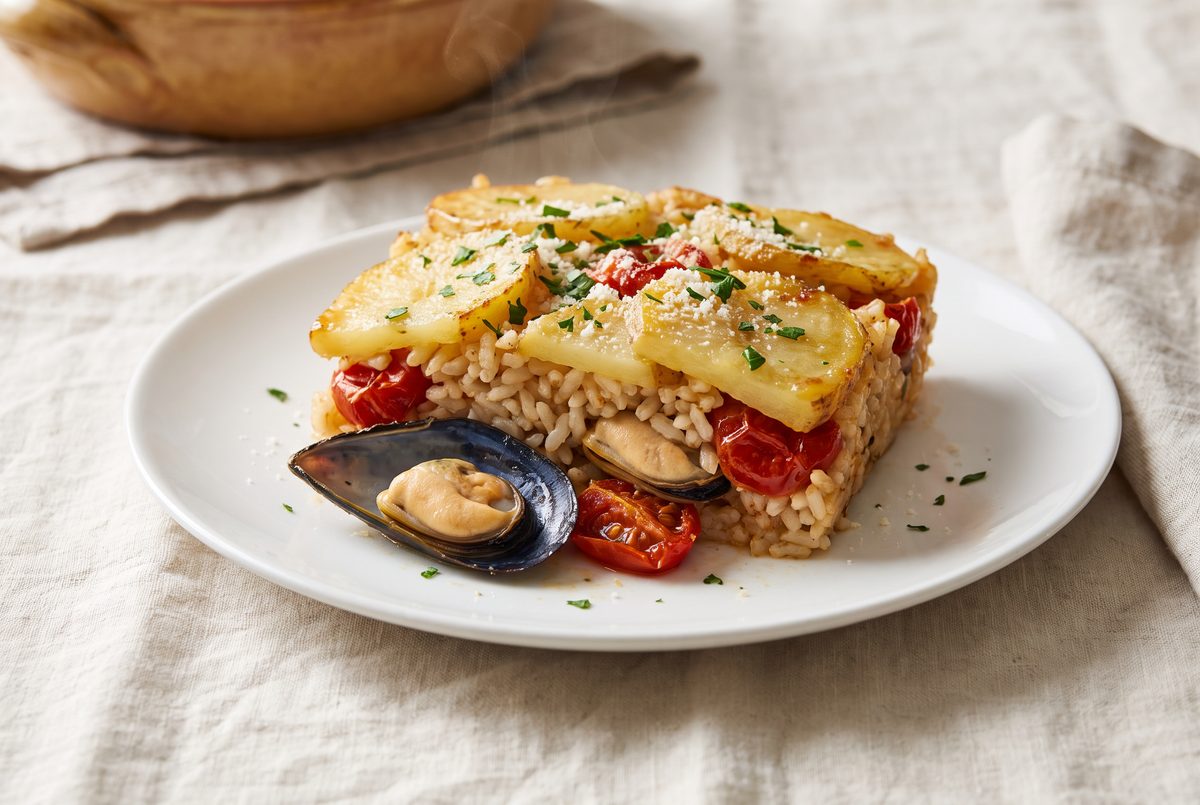
Baked Rice, Potatoes and Mussels (Tiella)
Tiella barese is a layered bake from Puglia — potatoes, raw-opened mussels and dry rice in one dish, no stirring, an…
- 1 hr 35 min
- 669 kcal
- 25 g protein
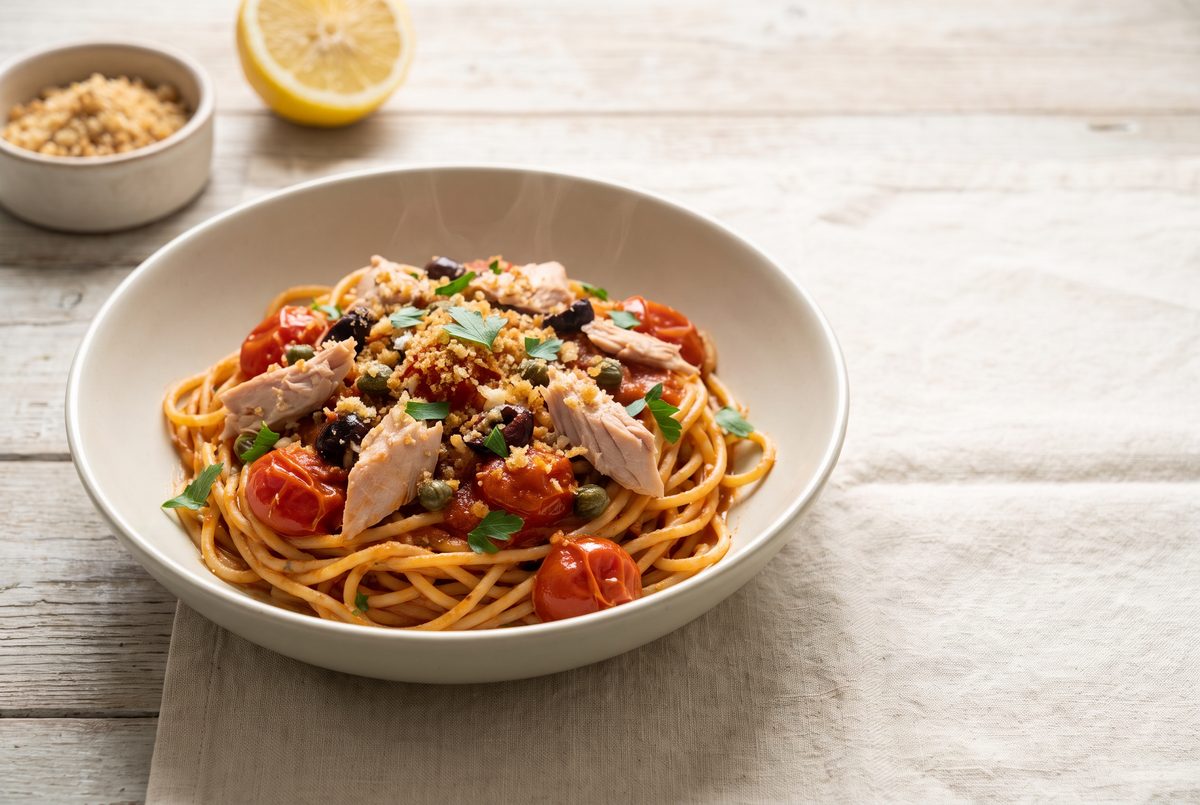
Sicilian Tuna Pasta (Pasta al Tonno)
Sicilian tuna pasta is a 25-minute pantry dinner: spaghetti tossed with olive-oil-packed tuna, burst cherry tomatoes…
- 25 min
- 662 kcal
- 31 g protein