Endurance
What to Eat After a Long Run: Recovery, Italian Style
Carbohydrate, 20–30 g of protein, fluid and salt, in the first few hours. What the research asks for, and what it looks like on an Italian table.
The finish line of a marathon is a strange place to make nutrition decisions. You are handed a foil blanket, a banana and a plastic bag of things you did not choose, your stomach has been bounced for three hours, and the only clear thought is that you would like to sit down. Most people get recovery nutrition wrong not because the science is complicated — it is unusually simple — but because the half hour in which they are supposed to act is the half hour they are least capable of acting in.
So the useful version of this guide is not a list of rules for the finish line. It is a plan made the day before, for a meal that is already in the fridge, built out of the four things the research actually asks for: carbohydrate, a moderate dose of protein, fluid, and salt.
The window, and how much of it is real
The 30-minute window is the most repeated idea in sports nutrition and the most oversold. It comes from a genuine finding: in 1988, Ivy and colleagues showed that muscle glycogen is restored significantly faster when carbohydrate is eaten immediately after exercise than when it is delayed by two hours. The muscle is more insulin-sensitive straight after work, and glycogen synthase is more active.
What happened next is that the finding got detached from its condition. A 2017 review by Burke, van Loon and Hawley — three of the people who did most of the original work — set out the modern position plainly: rapid refueling matters when the recovery period is short, roughly eight hours or less between sessions. When you have a day, total carbohydrate intake over 24 hours is what determines how much glycogen you have restored, and the first 30 minutes are a rounding error.
In practice that gives two different answers:
- Racing or training again within about eight hours — a double session, a stage race, a Saturday long ride followed by a Sunday race. Target 1.0–1.2 g of carbohydrate per kilogram of body weight per hour for the first four hours. For a 150 lb (68 kg) runner that is 68–82 g an hour, which is a real plate of food every hour, not a gel.
- Next session tomorrow — which is almost everyone, almost always. Eat a proper meal when you are ready for one, keep eating normally for the rest of the day, and stop worrying about the clock.
Protein: 20–30 g, and more is not better
The number has been stable for fifteen years. Moore and colleagues, in a 2009 dose-response study, found that muscle protein synthesis rises with the amount of protein eaten up to roughly 20 g in a single feeding and then flattens; above that, the extra is oxidized rather than used for repair. Later work puts the practical range at 0.25–0.3 g per kilogram of body weight per meal, which is 17–20 g for a 68 kg runner and 25–30 g for a 90 kg one.
Endurance athletes often skip this part entirely, on the theory that protein is a gym concern. It is not: long runs damage muscle and the repair runs on amino acids. But the amount is modest, and the far more common mistake is to eat 45 g of protein at dinner and almost none at breakfast and lunch. Four feedings of 25 g beat one of 100 g.
What 20–30 g looks like without a tub of powder: a 5 oz can of tuna (32 g), three eggs (19 g), 150 g of Greek yogurt (15 g), 100 g of pecorino's worth of cheese across a dish, a chicken breast, or most main courses on this site. Our guide on how much protein you need to build muscle works through the daily arithmetic.
Fluid and salt: the part everyone skips
Weigh yourself before and after a long run, naked, and you have the only recovery measurement that matters. Every pound lost is about 16 oz of fluid. The position stand of the Academy of Nutrition and Dietetics, Dietitians of Canada and the ACSM asks for 125–150% of that deficit over the following two to four hours — more than you lost, because you keep producing urine while you drink.
Volume alone is not enough. Shirreffs and colleagues, in a much-replicated 1996 experiment, gave subjects the same volumes of drinks with different sodium contents after dehydration: the low-sodium groups urinated most of it out and were still in deficit hours later. Plain water also dilutes plasma sodium, which is the mechanism behind the rare but genuinely dangerous hyponatremia seen in slower marathon finishers who drink heavily at every aid station.
A meal is the easiest solution. Aim for 500–800 mg of sodium in the recovery plate — which is a normally salted dish, not a special product. Sweat sodium losses run from about 500 to 1,500 mg per liter and vary enormously between people; if your race shirt dries white and stiff, you are at the top of that range.
What an Italian kitchen puts on the table
Here is where the cuisine turns out to be well designed for this, in the same unplanned way it is well designed for carb loading. The Italian primo is a plate of starch, moderately dressed, eaten first — exactly the carbohydrate vehicle a depleted athlete needs. The things Italians add to it for flavor, rather than for nutrition, are mostly salty: anchovy, pecorino, cured pork, olives, bottarga, the water the pasta boiled in. And a great deal of the seafood in the south brings protein and sodium in the same bite.
The dish we published the day before this guide does all of it at once:
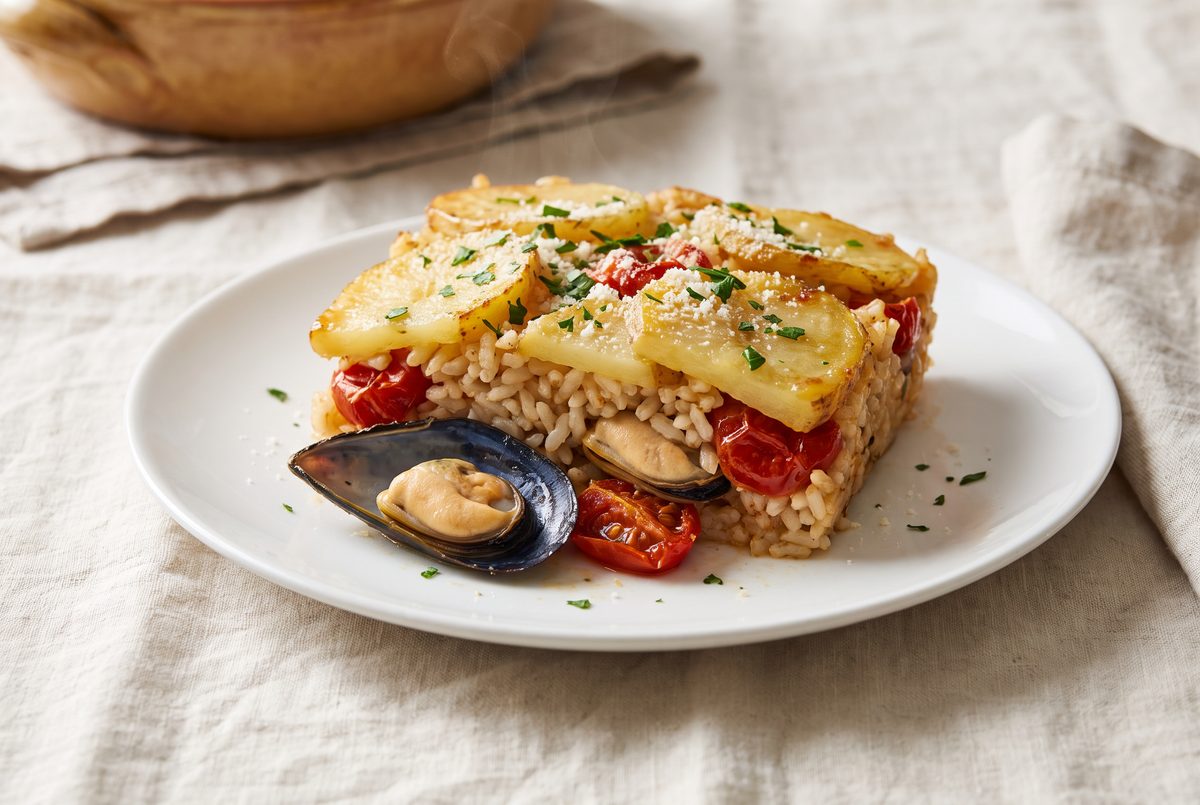
Rice and potatoes for the carbohydrate, mussels for the protein and for most of the salt, and — the point for a race weekend — it is better on the second day than the first, which means it can be the Saturday dinner and the Sunday recovery meal from the same dish.
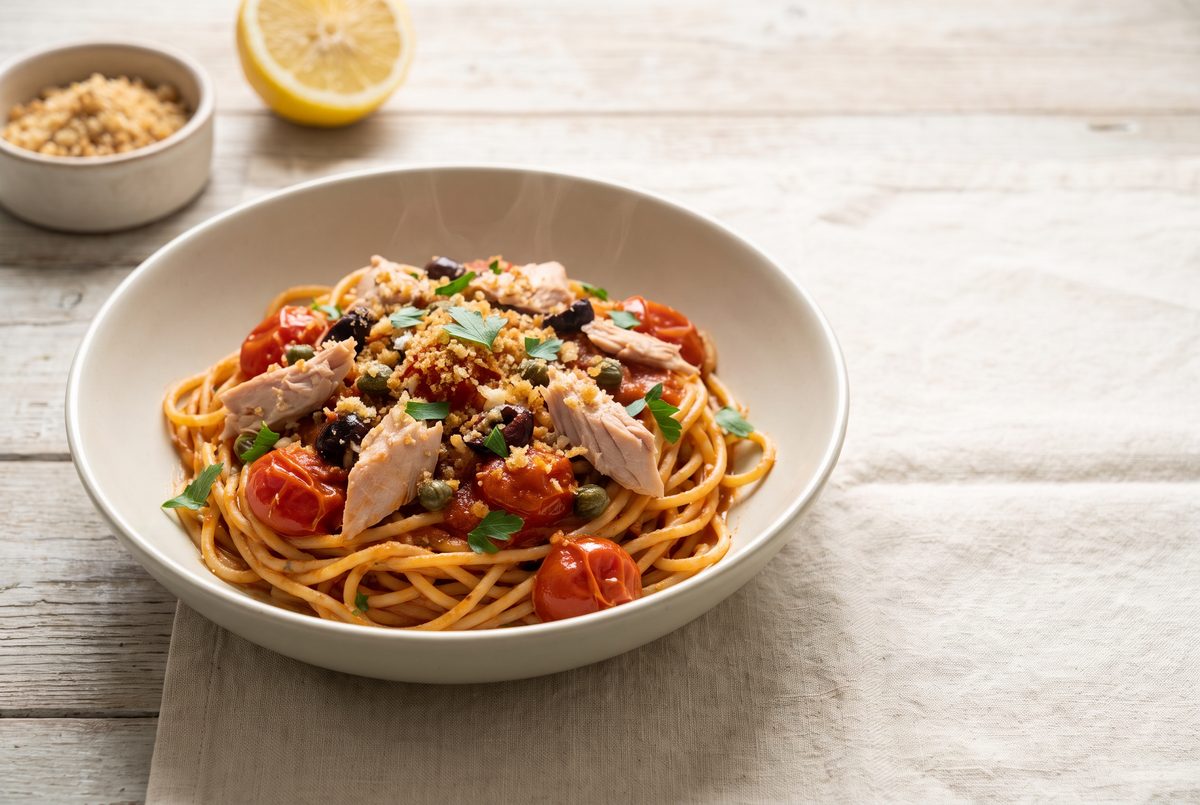
When there is no second day and you are cooking from nothing, this is the 25-minute version:
Three plates, by how much time you have
You have ten minutes and no appetite. This is the real post-marathon state. Something liquid or soft and salty: a bowl of pasta in broth, bread with prosciutto, a glass of milk, a banana. Appetite is suppressed by hard exercise for an hour or two, which is a physiological fact and not a lack of discipline. Eat something small and salty now and a real meal when hunger comes back.
You have half an hour and a kitchen. Pasta with tuna, capers and tomato; eggs with potatoes; rice with whatever is in the fridge and a lot of grated cheese. The formula is a fist of starch, a palm of protein, and salt you can taste.
You cooked yesterday. The best version. A baked dish that reheats — a tiella, a baked pasta, a tray of roast potatoes and a piece of fish — removes the decision entirely at the moment you are least able to make one.
The drink question
Alcohol is the only common post-race habit with a measured cost. Parr and colleagues, in 2014, had trained men complete a hard session and then eat protein with or without alcohol: myofibrillar protein synthesis fell by 24% when alcohol was taken with protein, and by 37% when it was taken with carbohydrate alone. Alcohol is also a diuretic at exactly the moment you are trying to retain fluid.
None of which means a beer after a marathon is a sin. It means the order matters: rehydrate, eat, and then have the drink with the meal rather than on an empty stomach at the finish area. Italy, for what it is worth, has been drinking a glass of wine with food and almost never without it for several thousand years.
What matters less than the internet says
- Protein timing to the minute. Within a couple of hours is fine. Within three is fine if your next run is tomorrow.
- Specific recovery products. A chocolate milk, a plate of pasta with cheese, and a commercial recovery drink do the same job at very different prices.
- High-dose antioxidant supplements. Paulsen and colleagues found in 2014 that large doses of vitamin C and E during a training block blunted some of the cellular adaptations to endurance training. Soreness is partly the signal that drives adaptation. Eat the tomatoes, skip the megadose.
- Cold plunges for performance. They feel wonderful and there is reasonable evidence they interfere with some adaptations when used habitually after training. Race day is not training day, so enjoy one after a marathon if you like.
If you are not racing
Most runs do not need any of this. A 40-minute easy run is not a glycogen-depleting event, and your next normal meal is your recovery meal. Recovery nutrition earns its keep after sessions over about 90 minutes, hard interval work, and back-to-back days — and treating every easy jog as an occasion for a shake is the most reliable way to eat back more than you burned.
Where to start
Our endurance collection is built around two slots, and recovery is one of them: carbohydrate plus 20–30 g of protein, with enough salt to hold the fluid you drink. If you are racing this weekend, cook the tiella on Saturday and eat the second half of it on Sunday afternoon. If you are reading this at the finish line with one hand, eat what is in the bag, drink something with salt in it, and make a decent plate in an hour.
General information for healthy adults, not medical advice. Hyponatremia, heat illness and persistent post-exercise symptoms are medical matters: if you feel confused, nauseated or unwell after a long event, seek medical help rather than a meal plan. See our nutrition disclaimer.
Sources: Thomas D. T., Erdman K. A. & Burke L. M., Position of the Academy of Nutrition and Dietetics, Dietitians of Canada, and the American College of Sports Medicine: Nutrition and Athletic Performance, J Acad Nutr Diet 2016; Ivy J. L. et al., Muscle glycogen synthesis after exercise: effect of time of carbohydrate ingestion, J Appl Physiol 1988; Burke L. M., van Loon L. J. C. & Hawley J. A., Postexercise muscle glycogen resynthesis in humans, J Appl Physiol 2017; Moore D. R. et al., Ingested protein dose response of muscle and albumin protein synthesis after resistance exercise in young men, Am J Clin Nutr 2009; Shirreffs S. M. et al., Post-exercise rehydration in man: effects of volume consumed and drink sodium content, Med Sci Sports Exerc 1996; Evans G. H. et al., Optimizing the restoration and maintenance of fluid balance after exercise-induced dehydration, J Appl Physiol 2017; Parr E. B. et al., Alcohol ingestion impairs maximal post-exercise rates of myofibrillar protein synthesis, PLoS ONE 2014; Paulsen G. et al., Vitamin C and E supplementation hampers cellular adaptation to endurance training in humans, J Physiol 2014; Betts J. A. & Williams C., Short-term recovery from prolonged exercise, Sports Med 2010; USDA FoodData Central for food values.
Frequently asked questions
Is there really a 30-minute anabolic window after exercise?
Less of one than the supplement industry implies. The classic finding is real — Ivy and colleagues showed in 1988 that muscle glycogen is restored faster when carbohydrate is eaten immediately rather than two hours later — but it only changes the outcome when you have another hard session within about eight hours. For a runner whose next workout is tomorrow morning, total carbohydrate and protein across the day is what matters, and a proper meal an hour after you stop beats a rushed shake at the finish line.
How much protein should I eat after a long run?
20–30 g, which is about 4 oz of tuna, three eggs, 150 g of Greek yogurt or a serving of most main courses on this site. Dose-response work by Moore and colleagues found muscle protein synthesis essentially plateaus around 20 g, or roughly 0.25–0.3 g per kilogram of body weight, in a single feeding. Eating 60 g in one sitting does not double anything; spreading 20–30 g across three or four meals in the rest of the day does more.
What should I drink after a marathon?
Enough to replace 125–150% of the weight you lost, over the following two to four hours, and it should contain sodium. Sports drinks work, but so does any normal meal with salt in it alongside water — soup, a plate of pasta, bread and cured ham. Shirreffs and colleagues showed in 1996 that the sodium content of what you drink, not just the volume, determines how much of it you still have hours later.
Is beer a good recovery drink?
No, although it is a good drink. Alcohol impairs the rate at which muscle rebuilds after hard exercise — Parr and colleagues measured a 24–37% reduction in myofibrillar protein synthesis in 2014, even when protein was eaten alongside it — and it also increases urine output when you are trying to hold on to fluid. The practical compromise most Italian athletes arrive at by instinct: rehydrate and eat first, then have the drink with dinner rather than instead of it.
Do I need to eat straight after an easy run?
No. Recovery nutrition is for sessions that actually deplete you: anything over about 90 minutes, a hard interval workout, or a second session later the same day. After a 40-minute easy run, your next normal meal is the recovery meal, and treating every jog as an event that requires a protein shake is the quickest way to eat back more than you spent.
Are antioxidant supplements good for recovery?
Probably not, and possibly the opposite. High doses of vitamin C and E during a training block were shown by Paulsen and colleagues in 2014 to blunt some of the cellular adaptations to endurance training — the soreness you are trying to suppress is part of the signal that makes you fitter. Food is a different matter: tomatoes, greens, olive oil and fruit carry the same compounds at doses that have never been shown to interfere with anything.