Butternut Squash Risotto (Risotto alla Zucca)
The Northern Italian autumn risotto, measured for the night before a long run: 105 g of carbohydrate, 14 g of fat, and nothing in it that sits heavy.
Risotto alla zucca is the autumn risotto of Lombardy and the Veneto: arborio rice cooked slowly in broth with butternut squash until half the squash dissolves into the grains. Each plate carries 105 g of carbohydrate with only 14 g of fat and 5 g of fiber at about 620 calories, which is the exact profile sports nutritionists ask for in the meal before a long run or race.
Butternut squash shows up in American markets in the second half of September, which is also when everyone training for a fall marathon starts to dread pasta. Chicago is three weeks out, New York six, and by then the night-before dinner has been spaghetti so many times that the sight of a dry box is discouraging.
Northern Italy solved this a long time ago without meaning to. In Lombardy and around Mantua, risotto alla zucca is what you cook when the squash comes in: rice, broth, a wedge of squash, sage, a handful of Parmigiano. It happens to be almost pure starch with very little fat, which is the same thing as saying it is a carb-load in a bowl. Italians eat it because it is sweet and comforting in October; runners can eat it for the glycogen.
The one thing people get wrong is the broth. Adding cold broth to a hot pan of rice drops the temperature, stalls the cooking, and you end up with grains that are chalky inside and blown out on the surface. Keep the broth at a bare simmer in a second pot the whole time. That single habit is most of the difference between good risotto and wallpaper paste.
Why this recipe works for endurance
Carb-loading tops up muscle glycogen before events lasting longer than about 90 minutes, and the published target is 8–12 g of carbohydrate per kilogram of body weight per day in the 24–48 hours beforehand (Burke et al., 2011). For a 150-lb (68 kg) runner that is 550–800 g a day — unreachable without meals built on starch. This plate contributes 105 g.
The fat and fiber are deliberately low. Fat and fiber both slow gastric emptying, and pre-event meals heavy in either are among the strongest predictors of the stomach cramps and nausea that ruin races (de Oliveira, Burini & Jeukendrup, 2014). At 14 g of fat and 5 g of fiber per serving, this is a gentler pre-race meal than most "healthy" dinners, including our own bean and lentil dishes.
Risotto rice is the right starch for the job. Arborio is bred for a starch that is high in amylopectin and low in amylose — that is what makes risotto creamy, and it is also what makes it digest quickly, putting arborio in the moderate-to-high band of published glycemic index tables (Foster-Powell, Holt & Brand-Miller, 2002). Fast-available carbohydrate is exactly what you want when the goal is to fill glycogen, and the opposite of what you want on a rest day.
Protein is modest on purpose — 14 g. A fuel-up meal is not the place to push protein; it competes for room in the stomach and does nothing for glycogen. If you are eating this after the run rather than before it, see the recovery variation below, which brings it to 31 g.
The squash is not just color. Six hundred grams of butternut across four plates supplies a substantial amount of provitamin A carotenoid and potassium, and it dissolves enough to thicken the rice without any added cream. More on timing in our endurance collection and in the guide on carb loading the Italian way.
Ingredients
4 plates, about 1½ cups each
Instructions
- Get the broth hot and the squash ready. Bring the broth to a bare simmer in a saucepan and leave it there, uncovered, with a ladle in it. Peel the squash, scrape out the seeds, and cut it into ½-inch cubes — small and even matters more than pretty, because you want half of them to collapse and half to stay whole.
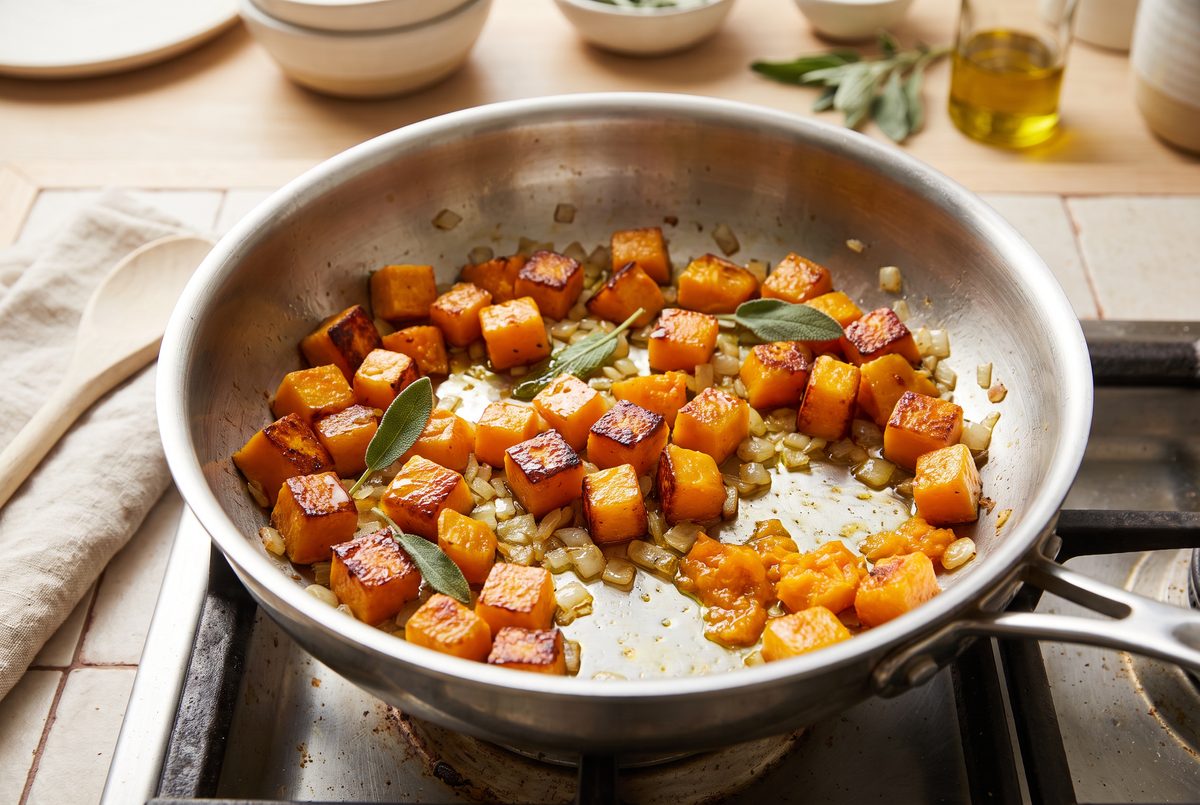
- Brown the squash with the onion. Warm the oil in a wide, heavy pot over medium heat. Add the onion and cook 5 minutes until translucent, then add the squash and the sage and cook 8–10 minutes, turning occasionally, until the cubes have caramelized edges and the smallest ones are starting to break down. This browning is where the sweetness comes from; pale squash makes a flat risotto.
- Toast the rice, then the wine. Add the rice and stir it through the squash over medium heat for about 2 minutes, until the grains are hot to the touch and the edges look glassy while the center stays chalky white. Pour in the wine and let it bubble away almost completely — 1–2 minutes. The pot should smell of wine, not taste of it.
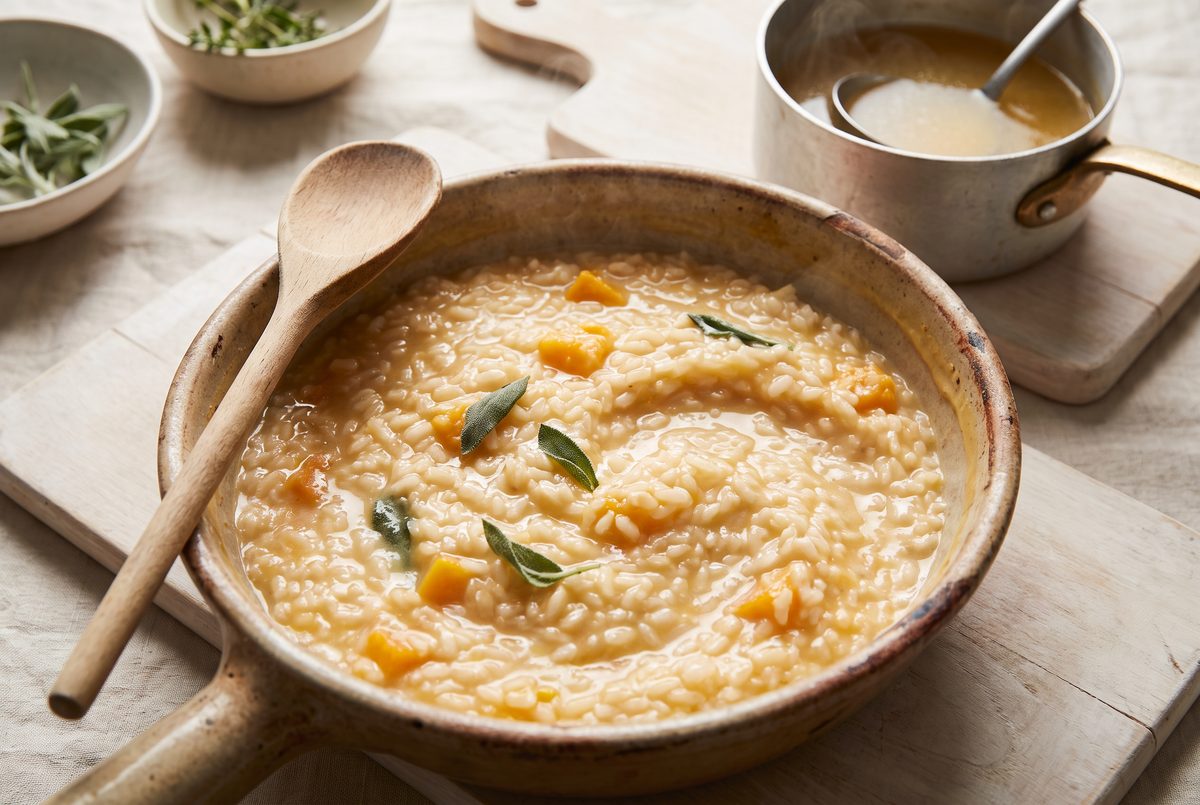
- Add the broth a ladle at a time, 18 minutes. Add a ladle of hot broth, enough to just cover the rice, and stir. When the surface stops looking soupy and the spoon leaves a trail across the bottom, add the next ladle. Keep going at a steady, gentle bubble for about 18 minutes, stirring often. Start tasting at 15. It is done when the grain is tender with the faintest firm core, and the risotto is all'onda — loose enough to move in a slow wave when you tip the pot.
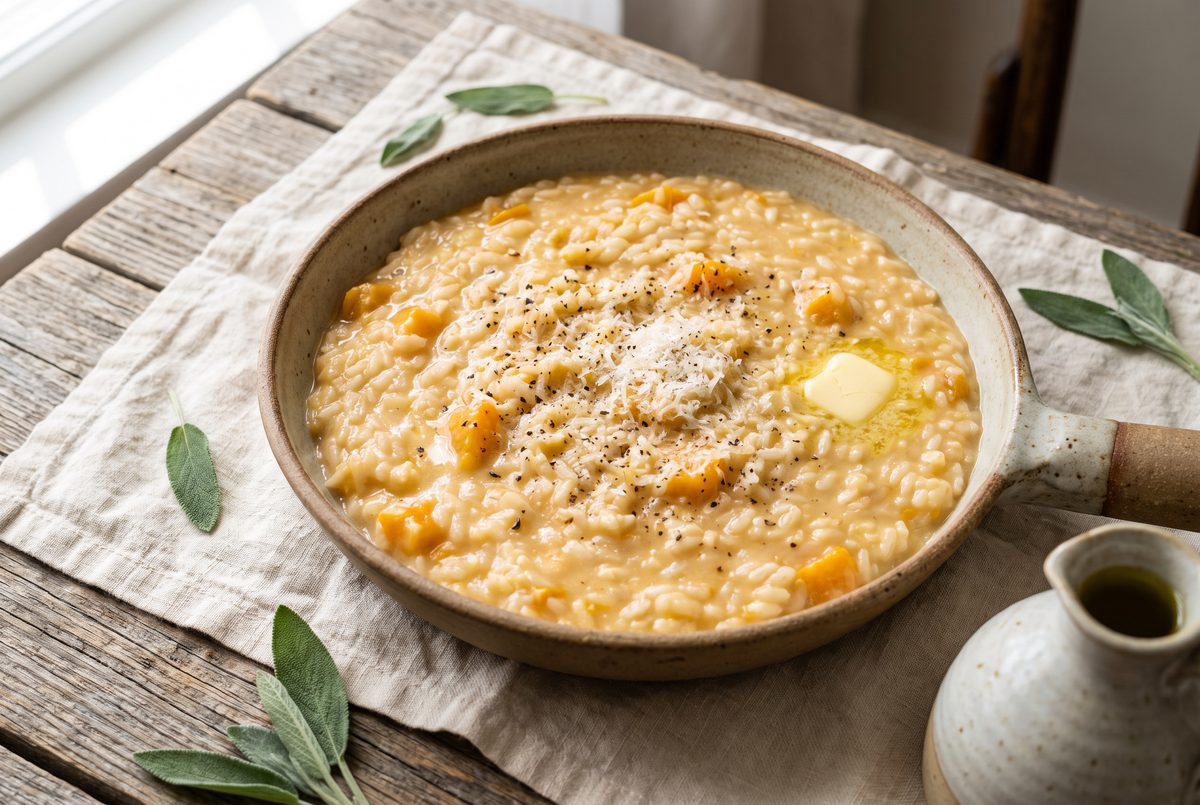
- Mantecatura: off the heat, butter and cheese. Take the pot off the heat. Add the cold butter and the grated Parmigiano and beat it in briskly with a wooden spoon for 30 seconds — off the heat, so the cheese emulsifies instead of turning stringy. Now taste and add the salt, the pepper and the nutmeg. It should look glossier and slightly looser than you think is right.
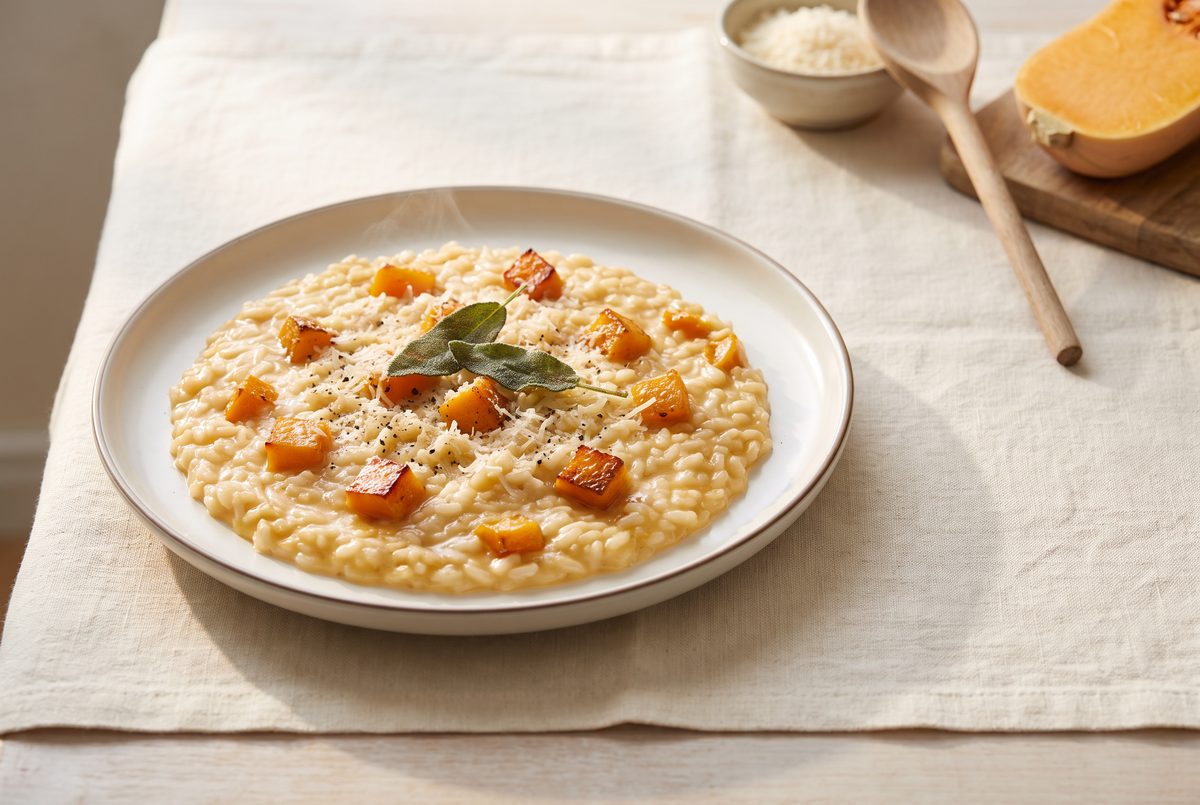
- Rest two minutes, then serve flat. Cover and let it sit 2 minutes. Spoon it onto warm flat plates rather than into bowls and tap the base of each plate once so the risotto spreads itself into an even layer — that is how it is served in Italy, and it keeps it from stewing in its own heat. Finish with more cheese, black pepper and a couple of sage leaves.
Tips from our kitchen
- Hot broth, always. Cold broth stalls the pan and cooks the grains unevenly. Keep the second pot simmering the entire time.
- Never rinse risotto rice. The surface starch is the sauce. Rinsing it is the single fastest way to end up with soup and hard rice.
- Use a wide pot, not a deep one. A 12-inch sauté pan or a low Dutch oven gives you the evaporation you need; in a tall pot the rice steams instead of reducing.
- If you run out of broth, finish with hot water. It is better than adding cold liquid or under-cooking the rice.
- Race-week note: the recipe as written is already low in fiber. If you are sensitive, peel the squash generously and skip the sage garnish, and eat it 12–16 hours out rather than the same evening.
Variations
- Recovery version, 31 g of protein: stir 12 oz (340 g) of peeled raw shrimp into the risotto for the last 4 minutes of step 4, and finish with lemon zest instead of nutmeg. Carbohydrate stays at 105 g. For a recovery plate that needs no new shopping, our Sicilian tuna pasta carries 91 g of carbs with 31 g of protein.
- Mantuan, with amaretti: crumble two amaretti biscuits over the finished plates. It sounds wrong and it is centuries old — the bitter almond cuts the sweetness of the squash.
- Vegan: skip the butter and Parmigiano; mantecare with 1 tbsp of good olive oil and 2 tbsp of the squash mashed to a purée. You keep the carbohydrate and the creaminess, and protein drops to about 9 g.
- Farrotto, for training days: swap pearled farro for the rice, cook 25–30 minutes, and you get a nuttier dish with roughly three times the fiber — better on an ordinary Tuesday, worse the night before a race.
- Brown-butter sage finish: fry 8 sage leaves in the tablespoon of butter until it smells like hazelnuts, then use both to finish. Same numbers, more aroma.
Storage & meal prep
Risotto is a dish you eat when it is made; it keeps 2 days in the fridge but sets into a dense cake as the starch retrogrades, and reheating it with broth never quite brings it back. The Italian answer is risotto al salto: press the cold risotto into a thin disk, fry it in a lightly oiled nonstick pan over medium heat for 4–5 minutes a side until crisp, and eat it like a rösti. Do not freeze it.
Nutrition per serving
| Nutrient | Amount | % DV* |
|---|---|---|
| Calories | 622 kcal | 31% |
| Total fat | 14 g | 18% |
| Saturated fat | 5.2 g | 26% |
| Carbohydrates | 105 g | 38% |
| Fiber | 5.2 g | 19% |
| Sugars | 6.7 g | — |
| Protein | 14 g | 28% |
| Sodium | 738 mg | 32% |
*Percent Daily Values are based on a 2,000-calorie diet. Values are calculated from USDA FoodData Central and manufacturer data for the ingredients as listed; they are estimates, not lab analyses. Nutrition disclaimer.
Frequently asked questions
Is risotto good for carb loading?
It is one of the best options there is. A plate of this risotto holds 105 g of carbohydrate with just 14 g of fat and 5 g of fiber — high carbohydrate, low fat, low fiber is precisely the profile recommended for the meal before an endurance event. It is easier on the stomach than most pasta dishes with sauce, and considerably easier than anything built on beans.
How many carbs are in butternut squash risotto?
In this recipe, 105 g per serving of about 1½ cups, at 622 calories. Roughly 80 g of that comes from the arborio rice (2 cups dry for four people) and about 18 g from the squash itself. A restaurant portion of risotto is often half the size, so don't assume the numbers transfer.
Can I make risotto ahead of time?
Not fully, but you can get 80% of the way there — it is what restaurants do. Cook through step 4 for 12 minutes instead of 18, spread the rice on a sheet pan to cool quickly, and refrigerate up to 24 hours. To finish, return it to the pan with hot broth and cook the last 6 minutes, then do the mantecatura. Made and reheated the next day from finished risotto, it is a different and worse dish.
Do you really have to stir risotto constantly?
No. Constant stirring is a myth; what you need is frequent stirring, every 20–30 seconds or so, to rub the starch off the grains and keep the bottom from catching. You can walk away for a minute to set the table. You cannot walk away for five.
Can I use regular rice instead of arborio?
Carnaroli and vialone nano are both better than arborio if you can find them. Long-grain rice, basmati and jasmine will not work — they lack the surface starch that makes the sauce, and you will get seasoned rice in broth rather than risotto. Short-grain sushi rice is a distant last resort.
Is this recipe gluten-free?
Yes, as written — rice, squash, cheese and broth contain no gluten. Check the label on your broth, which is the one place gluten sometimes hides, and skip the amaretti variation.
Sources
- USDA FoodData Central — rice (white, short-grain, raw), squash (winter, butternut, raw), Parmigiano-Reggiano
- Burke, L. M., Hawley, J. A., Wong, S. H. S. & Jeukendrup, A. E. (2011). Carbohydrates for training and competition. Journal of Sports Sciences 29(S1) — carbohydrate loading at 8–12 g/kg/day
- Thomas, D. T., Erdman, K. A. & Burke, L. M. (2016). Position of the Academy of Nutrition and Dietetics, Dietitians of Canada, and the American College of Sports Medicine: Nutrition and Athletic Performance. Journal of the Academy of Nutrition and Dietetics
- de Oliveira, E. P., Burini, R. C. & Jeukendrup, A. (2014). Gastrointestinal complaints during exercise: prevalence, etiology, and nutritional recommendations. Sports Medicine 44(S1) — low-fat, low-fiber pre-event meals
- Foster-Powell, K., Holt, S. H. A. & Brand-Miller, J. C. (2002). International table of glycemic index and glycemic load values. American Journal of Clinical Nutrition 76(1) — risotto rice
You might also like
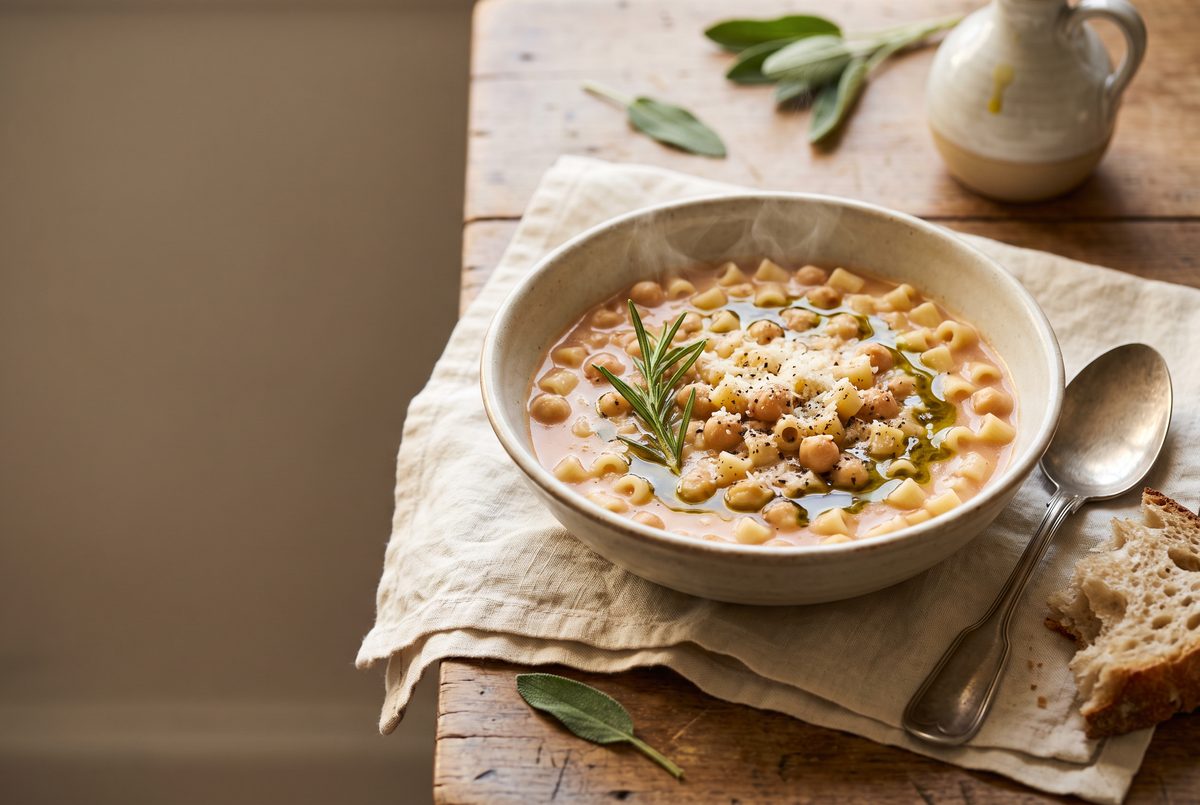
Pasta e Ceci (Roman Pasta with Chickpeas)
Pasta e ceci is a Roman one-pot dish of short pasta simmered with chickpeas, rosemary, garlic and a spoon of tomato…
- 35 min
- 611 kcal
- 23 g protein
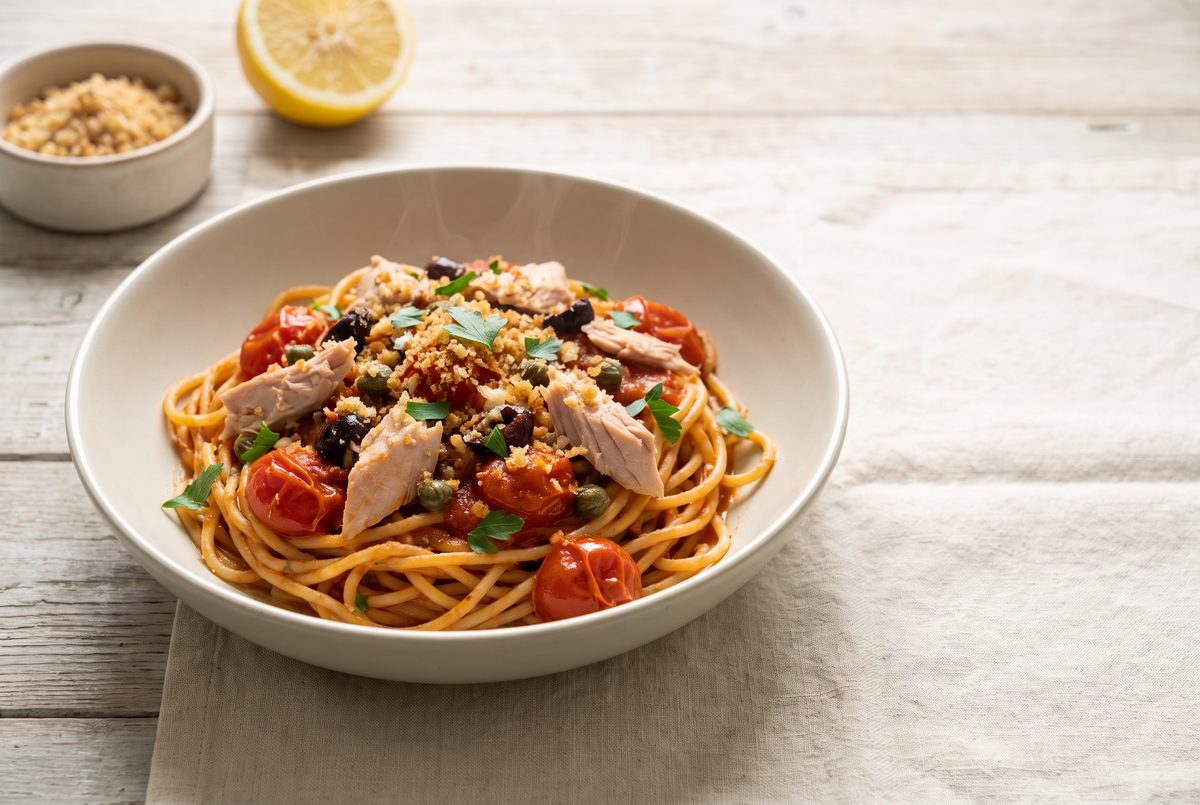
Sicilian Tuna Pasta (Pasta al Tonno)
Sicilian tuna pasta is a 25-minute pantry dinner: spaghetti tossed with olive-oil-packed tuna, burst cherry tomatoes…
- 25 min
- 662 kcal
- 31 g protein
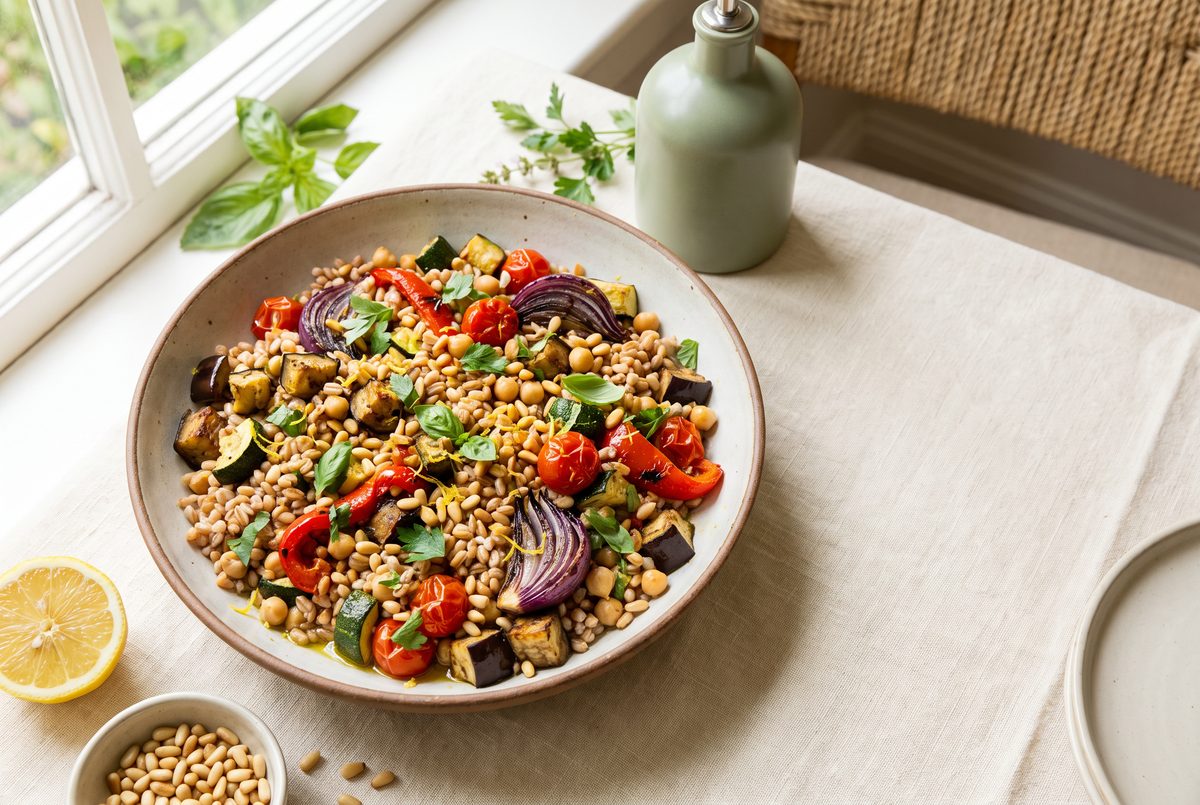
Farro Salad with Roasted Vegetables and Lemon
Farro salad with roasted vegetables tosses chewy pearled farro with oven-caramelized zucchini, eggplant, peppers, red…
- 45 min
- 481 kcal
- 14 g protein