Baked Eggplant Parmesan, Roasted Not Fried
Two and a half pounds of eggplant, three tablespoons of oil, and no skillet of frying fat to stand over.
Eggplant parmesan becomes a weeknight dinner instead of a project when you roast the slices on sheet pans rather than frying them one batch at a time: 2½ lb of eggplant takes 2 tablespoons of olive oil instead of a cupful, and a quarter of the dish comes to 403 calories with 23 g of protein and 11 g of fiber. There is no flour, no egg wash and no breadcrumb coating anywhere in it, which makes it naturally gluten-free and keeps the eggplant tasting like eggplant.
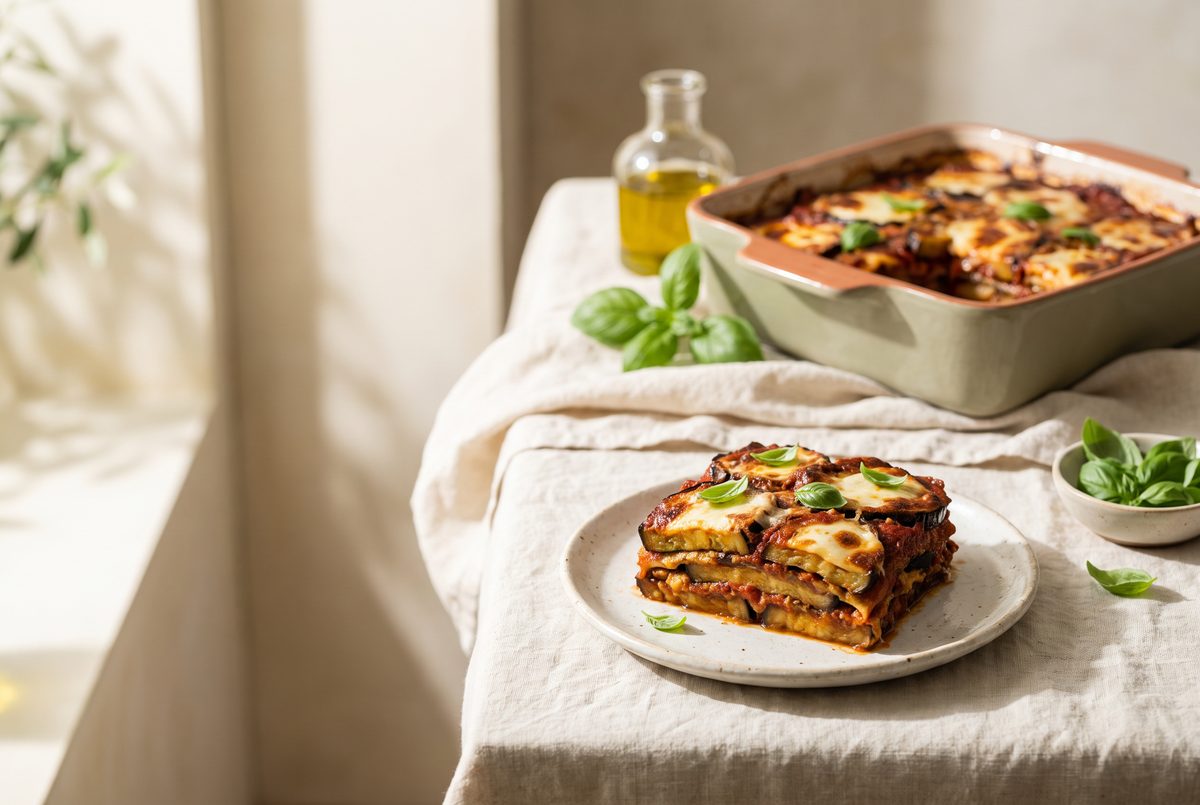
Most eggplant parmesan goes wrong in one of two directions. Either the slices were fried, and the dish comes out of the oven sitting in a pool of orange oil that no amount of draining on paper towels pulled back out, or the eggplant was never cooked properly before it was layered, and what you cut into is a tray of grey sponge under cheese. Both problems have the same cause: eggplant is about 92% water with the texture of a kitchen sponge, and until you drive that water off, it will take in whatever fat you put near it and give back nothing.
An oven solves this better than a pan does, which is a slightly heretical thing to say about a Neapolitan dish. Spread the slices on sheet pans with a brush of oil and 25 minutes at 425°F, and the water leaves as steam while the sugars at the cut edges go brown. The slices come out limp, deep gold and concentrated — the same state frying gets them to, reached by evaporation instead of by immersion. The difference shows up in the arithmetic at the bottom of this page, and it shows up again on the plate, where the layers hold their shape.
It is also the right week for it. Eggplant is at the end of its American season — field eggplant runs into October in most of the country and then disappears into greenhouse fruit that costs twice as much and tastes like less — so this is the moment to buy two heavy ones that squeak when you rub them.
Why this recipe works for weight loss
A 403-calorie dinner that includes two cheeses has to earn its room somewhere. Here the room comes from the eggplant: it is 25 calories per 100 g, so 2½ lb of it contributes 69 calories a serving while taking up most of the baking dish.
Where the calories are, and where they aren't. Of the 403, roughly 144 are mozzarella, 93 are olive oil, 51 are passata and 41 are Parmigiano — the eggplant, which is the bulk of what you eat, is the cheapest thing on the list. The lever this recipe pulls is energy density: a large portion of food with few calories in it is the most reliable way to eat less at a meal without deciding to eat less, which is the finding that keeps showing up in Barbara Rolls's work on portion and energy density (Rolls, 2009). Frying is what breaks that lever. Oil absorbed by the slices is invisible on the plate and goes straight onto the total, and the counterfactual is in the takeaways above: 523 calories and 37 g of fat instead of 403 and 23, on an estimate of retained oil that is generous to the frying pan.
Protein: 23 g, all of it dairy. 8 oz of part-skim low-moisture mozzarella and 1½ oz of Parmigiano-Reggiano between four people is 17.6 g of the total, with the rest coming in small change from the eggplant and tomato. Twenty grams is the floor we hold mains in this collection to, because protein is the macronutrient that does most to protect lean mass and appetite in a calorie deficit (Leidy et al., 2015) — and in a vegetarian dish built on a watery vegetable, hitting it means the cheese is not decoration. Do not cut it to save calories; cut the oil first.
Fiber: 11 g, which is the number worth noticing. Eggplant carries 3 g of fiber per 100 g, so 275 g a serving is 8.3 g before the tomato adds 2.6. That puts it just behind our lentil soup at 12 g and well past the 6 g a serving we ask of everything in the weight-loss collection. Higher fiber intakes track with lower body weight over time (Howarth et al., 2001), and in the short run fiber is simply what makes a plate feel like a meal.
The olive oil stays. Three tablespoons across four servings is 10.5 g each, and it is doing two jobs: it conducts the heat that browns the eggplant, and it is the fat that the Mediterranean pattern is built on. In the PREDIMED trial, a Mediterranean diet supplemented with extra-virgin olive oil and eaten without calorie restriction reduced major cardiovascular events against a low-fat control (Estruch et al., 2018). Olive oil is not what makes fried parmigiana heavy; the quantity is.
What this dish is not. It is not low in sodium — 851 mg a serving, the highest in this collection though only by a little — the cod, the cacciatore and the minestrone all sit between 804 and 841 — and about 520 mg of that is the two cheeses. The Dietary Guidelines for Americans 2020–2025 put the daily limit at 2,300 mg, so one portion is roughly a third of the day. Nor is it low in saturated fat: 8.9 g a serving against the roughly 22 g that a 2,000-calorie day allows at the recommended 10% of energy. Both numbers are cheese, and both are the honest price of the dish being the dish. The levers, in order, are fresh mozzarella instead of low-moisture, then less of it — see the variations.
Ingredients
one 9-inch square baking dish, 4 main-course portions
Instructions
- Slice ½ inch thick, and skip the salting. Heat the oven to 425°F (220°C) with racks in the upper and lower thirds. Trim the stems and cut the eggplant crosswise into rounds a generous ½ inch (1 cm) thick. Thickness is the one measurement that matters: thinner rounds dry to leather in the oven, thicker ones are still spongy in the middle when the dish comes out. Do not salt and drain them first — that step exists to pull water out of bitter older varieties and to stop frying oil soaking in, and neither applies here. American globe eggplant has had the bitterness bred out of it, and the oven removes the water for you.
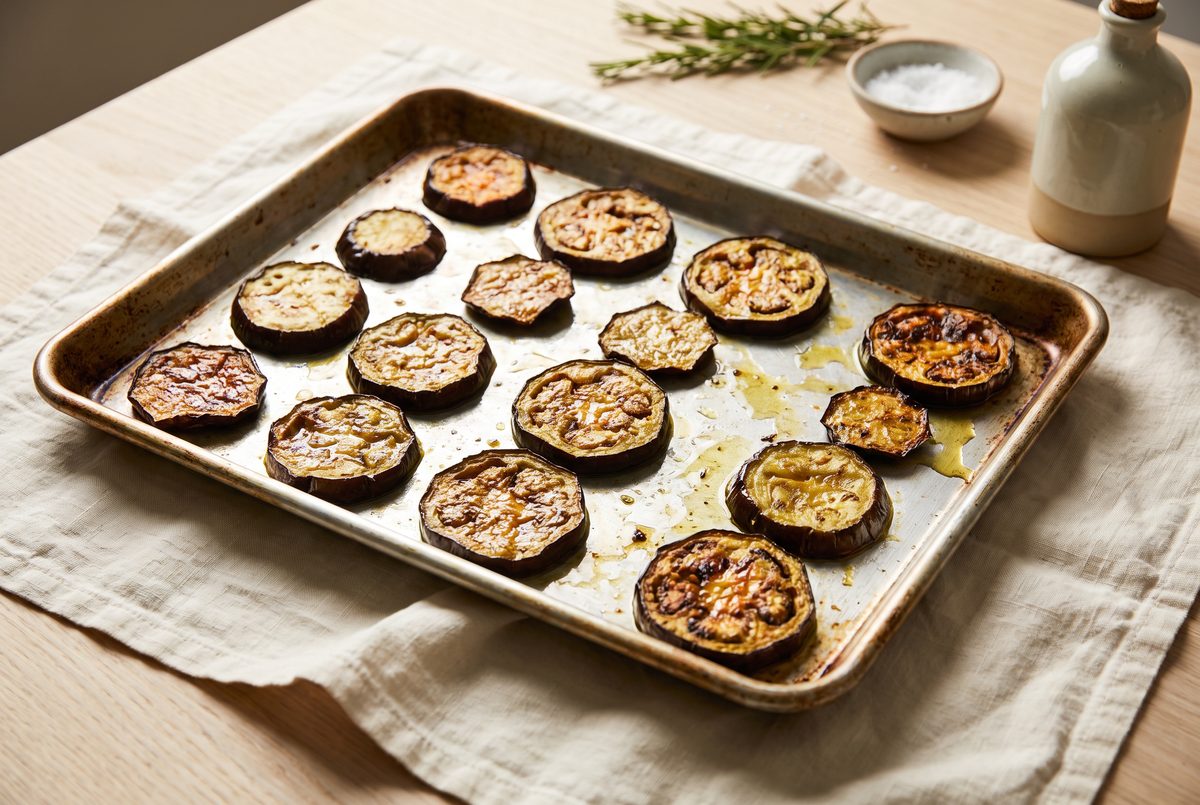
- Roast until deeply golden, 25–30 minutes. Brush both sides of the rounds with 2 tablespoons of the oil — a brush uses a third of what tossing in a bowl does — and lay them in a single layer on two rimmed sheet pans. Season with half the salt and all the pepper. Roast 25–30 minutes, swapping the pans between racks at the halfway mark, until the slices are limp, shrunk by about a third and brown at the edges. Pale, firm slices are not done; put them back for 5 minutes. This is the step that replaces frying, and it is where the flavor of the finished dish comes from.
- Make the sauce while they roast. Warm the last tablespoon of oil in a saucepan over medium heat, add the garlic and cook 1 minute, until it smells like garlic and before it takes any color — browned garlic turns the whole sauce bitter. Pour in the passata, add the basil stems and the rest of the salt, and simmer uncovered for 20 minutes, stirring now and then. You want it thick enough to hold a line when you draw a spoon through it. A loose sauce is the other reason parmigiana comes out soupy; the eggplant will release a little more liquid in the bake, so start drier than you think you need. Fish out the stems.
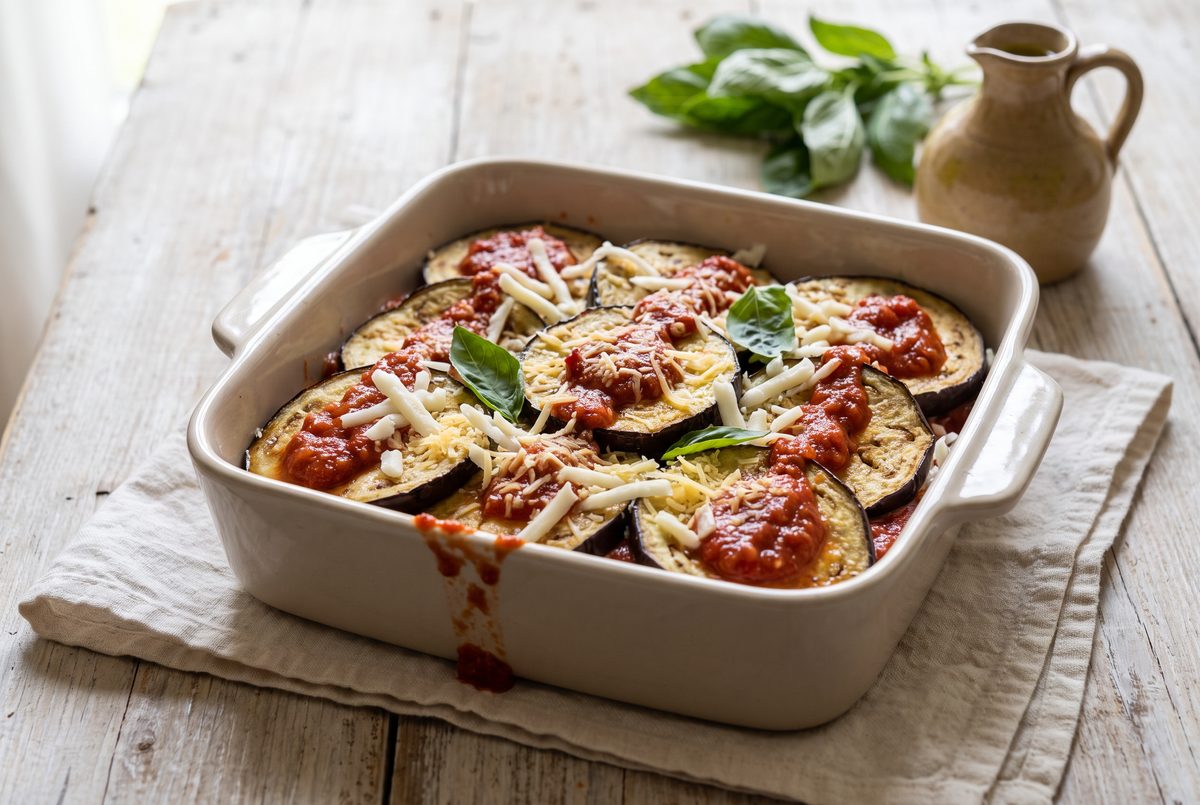
- Build three layers. Turn the oven down to 400°F (200°C). Spread 3 tablespoons of sauce over the bottom of a 9-inch square ceramic or glass baking dish. Add a third of the eggplant in an overlapping layer, then a third of the remaining sauce, a third of the mozzarella, a third of the Parmigiano and a few torn basil leaves. Repeat twice, finishing with sauce, then cheese. Keep a handful of basil back — leaves baked on top of the dish turn black and taste of nothing.
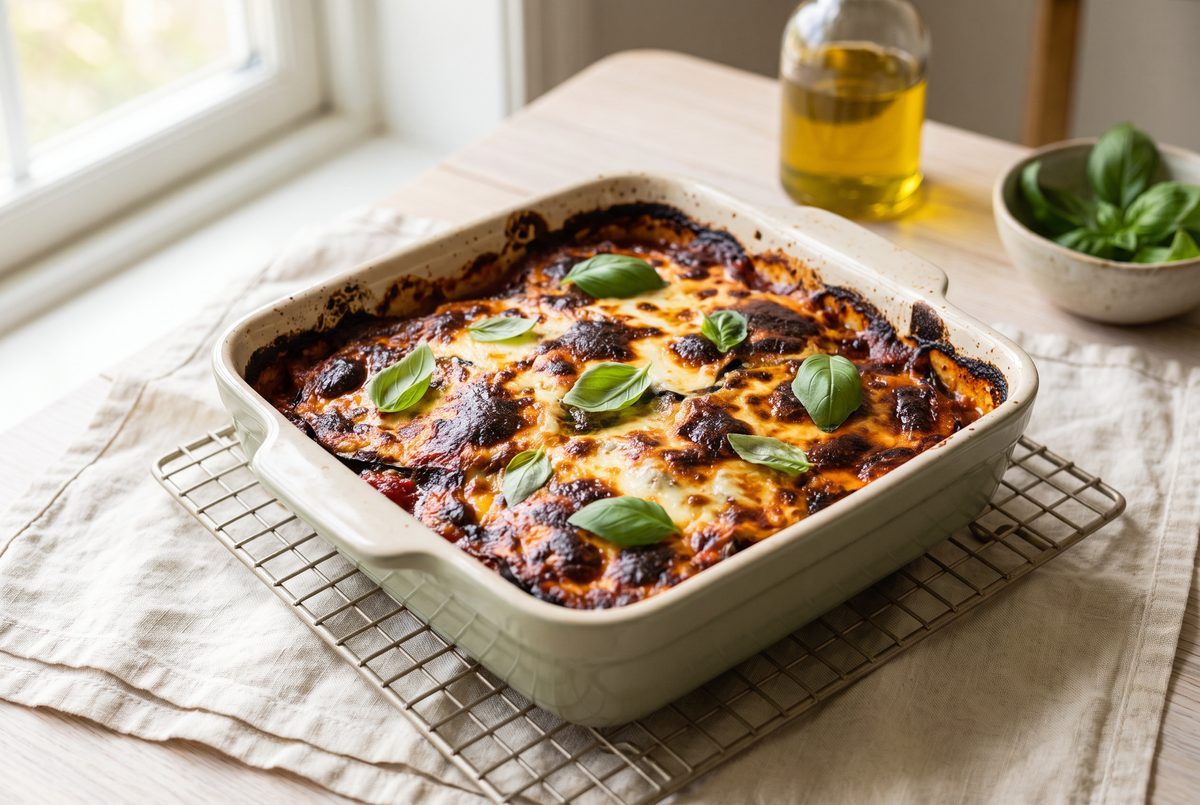
- Bake 25–30 minutes, uncovered. Bake on the middle rack until the sauce is bubbling up around the sides and the top is browned in patches rather than evenly — 25 minutes for a dish this size, 30 if yours is deeper. Leave it uncovered the whole time. Foil traps steam, and steam is exactly what you spent the first half hour getting rid of.
- Rest 15 minutes. This is not optional. Set the dish on a rack and leave it alone for 15 minutes. Hot from the oven the layers are held together by nothing but molten cheese and they slide apart on the spatula; as it cools the sauce sets and you can lift out a square with its edges intact. Scatter the reserved basil over the top and cut into four.
Tips from our kitchen
- Use a brush, not a bowl. Tossing 2½ lb of sliced eggplant in a bowl takes closer to ⅓ cup (72 g) of oil before the slices look coated, because the cut faces drink it instantly. Brushing both sides does the same job with 2 tablespoons, and the difference is 97 calories a serving.
- Two pans, one layer. Crowded slices steam each other instead of browning, and you end up with the grey sponge problem. If you only own one sheet pan, roast in two batches rather than overlapping them — the second batch costs 25 minutes you can spend on the sauce.
- Grate the mozzarella yourself. Pre-shredded cheese is dusted with potato starch or cellulose to stop it clumping, and that coating keeps it from melting into a sheet. An 8-oz block grates in a minute on the coarse side of a box grater.
- Crushed tomatoes work, with one change. If passata is hard to find, 28 oz of canned crushed tomatoes blended smooth will do, but it brings 130 mg of sodium per 100 g against 20 for most passata — about 220 mg more a serving. Leave the salt out of the sauce entirely in that case.
- If it still comes out watery, the cause is almost always under-roasted eggplant rather than too much sauce. Next time pull the slices when they are visibly shrunken and floppy, not when the timer goes off.
Variations
- Fresh mozzarella (fiordilatte), the Neapolitan way: 8 oz of fresh mozzarella instead of low-moisture gives 418 calories and 783 mg of sodium a serving — more calories but less salt, and a softer, milkier result. Tear it, do not grate it, and let the torn pieces sit in a strainer for 20 minutes first, because fresh mozzarella carries water you do not want in the dish.
- With ricotta, for a bigger dinner: fold 8 oz (227 g) of part-skim ricotta with a little black pepper and spread it over the middle layer. That takes the serving to 482 calories with 30 g of protein — out of the weight-loss band on calories for some people, squarely in the 30–50 g protein band of the muscle-gain recipes for others. Southern Italian versions do this; northern ones tend not to.
- As a side for six instead of a main for four: the same dish cut into six is 269 calories with 7.3 g of fiber, which sits under the 350-calorie ceiling we use for sides. Serve it next to something like the baked cod with chickpeas.
- Parmigiana di zucchine: swap the eggplant for 2½ lb of zucchini, sliced lengthwise and roasted the same way. It is a real Italian variant and comes to 381 calories a serving, but the fiber drops to 5.5 g — below the 6 g this collection asks for, because zucchini carries a third of the fiber eggplant does. Worth knowing before you make the swap for that reason.
- A sharper top: replace half the Parmigiano with Pecorino Romano. It browns harder and tastes saltier at the same weight, so taste before you add any salt to the sauce.
Storage & meal prep
Covered in the refrigerator it keeps 4 days and is better on day two, once the layers have set completely — leftover parmigiana is a standard Italian lunch, eaten at room temperature out of the dish it was baked in. Reheat portions uncovered for 15 minutes at 350°F (175°C) rather than in the microwave, which turns the eggplant to paste. It freezes well either baked or assembled-but-unbaked: wrap the dish tightly, freeze up to 3 months, and bake from frozen at 375°F (190°C) for 55–65 minutes, uncovered for the last 20.
Nutrition per serving
| Nutrient | Amount | % DV* |
|---|---|---|
| Calories | 403 kcal | 20% |
| Total fat | 23 g | 29% |
| Saturated fat | 8.9 g | 45% |
| Carbohydrates | 29 g | 11% |
| Fiber | 11 g | 39% |
| Sugars | 17 g | — |
| Protein | 23 g | 46% |
| Sodium | 851 mg | 37% |
*Percent Daily Values are based on a 2,000-calorie diet. Values are calculated from USDA FoodData Central and manufacturer data for the ingredients as listed; they are estimates, not lab analyses. Nutrition disclaimer.
Frequently asked questions
Is eggplant parmesan healthy?
It depends almost entirely on whether the eggplant was fried and whether it was breaded. This version is neither, and comes to 403 calories a serving with 23 g of protein and 11 g of fiber — a main course that fits a calorie deficit. A restaurant portion is typically breaded, fried and larger, which can easily double those calories. What stays high either way is sodium, at 851 mg a serving here, and saturated fat at 8.9 g, both of which are the mozzarella and Parmigiano rather than the cooking method.
How many calories are in eggplant parmesan?
This one is 403 calories for a quarter of a 9-inch square dish, calculated from the weighed ingredients. The same recipe fried instead of roasted comes to 523 calories if the slices retain ¼ cup of oil between them, which is a conservative estimate for shallow-frying 2½ lb of eggplant. Breaded and fried versions, which also carry flour, egg and breadcrumbs, run higher again. The number moves with the cooking method far more than with the cheese.
Do you have to salt eggplant before cooking it?
No, not for this recipe and not for most modern eggplant. Salting and draining was a way to deal with bitterness in older varieties and to collapse the eggplant's air pockets so it would absorb less frying oil. The bitterness has largely been bred out of American globe eggplant, and since nothing here is fried, there is no oil to keep out. Roasting at 425°F drives off the water that salting was meant to draw out, and it does it while browning the slices.
Is eggplant parmesan gluten free?
The classic Neapolitan dish is, and this version is too: eggplant, tomato, mozzarella, Parmigiano, basil, olive oil and salt, with no flour, egg wash or breadcrumbs anywhere in it. Most American recipes are not, because they bread the slices before frying. If you are cooking for someone with celiac disease, the thing to check is the Parmigiano and mozzarella packaging for shared-line warnings, not the recipe.
Can I make eggplant parmesan ahead of time?
Yes, and it is one of the dishes that improves for it. Assemble it completely, cover and refrigerate up to 2 days, then bake as written with 10 minutes added because it starts cold. Baked and refrigerated it keeps 4 days and is traditionally eaten at room temperature the next day. You can also roast the eggplant up to 3 days ahead and keep the slices in a covered container, which turns the assembly into a 10-minute job. For more dinners that hold like this, see the guide to eating Italian for weight loss.
Sources
- USDA FoodData Central — nutrient data for raw eggplant, part-skim low-moisture mozzarella, Parmigiano-Reggiano and canned tomato purée
- Rolls, B. J. (2009). The relationship between dietary energy density and energy intake. Physiology & Behavior
- Leidy, H. J. et al. (2015). The role of protein in weight loss and maintenance. American Journal of Clinical Nutrition
- Howarth, N. C., Saltzman, E., Roberts, S. B. (2001). Dietary fiber and weight regulation. Nutrition Reviews
- Estruch, R. et al. (2018). Primary prevention of cardiovascular disease with a Mediterranean diet supplemented with extra-virgin olive oil or nuts. New England Journal of Medicine
- U.S. Departments of Agriculture and Health and Human Services (2020). Dietary Guidelines for Americans, 2020–2025, 9th edition
You might also like
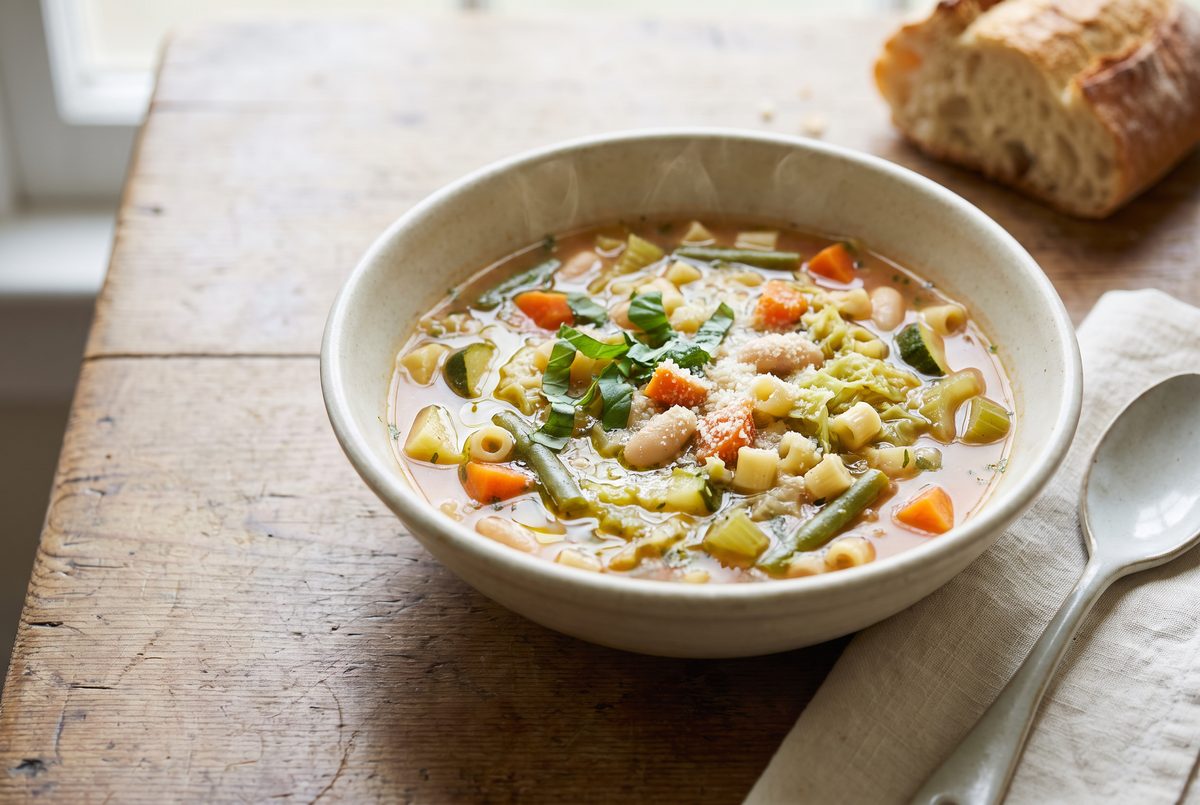
Classic Italian Minestrone Soup
Classic Italian minestrone is a thick vegetable soup with cannellini beans, seasonal vegetables and a handful of small…
- 1 hr 5 min
- 247 kcal
- 11 g protein
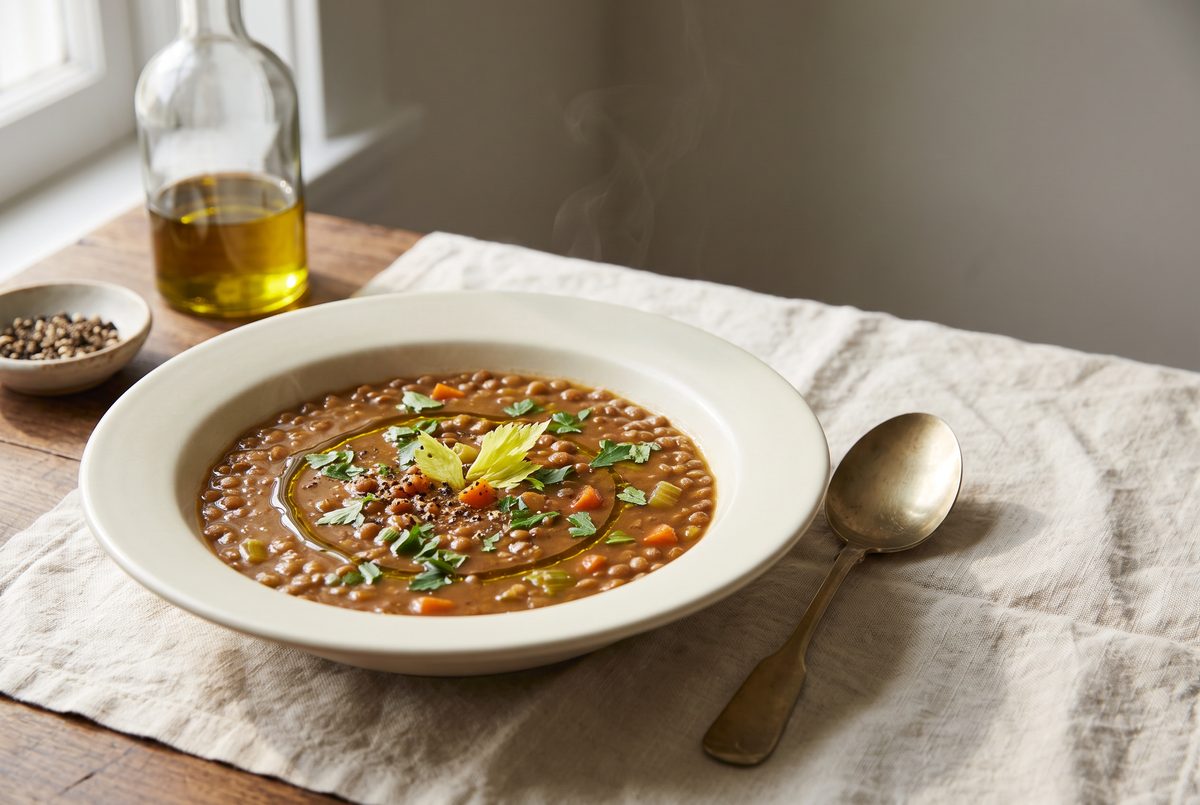
Italian Lentil Soup with Rosemary and Tomato
Italian lentil soup is a one-pot Umbrian supper: brown lentils simmered with a slow soffritto, tomato and rosemary…
- 1 hr 10 min
- 447 kcal
- 22 g protein
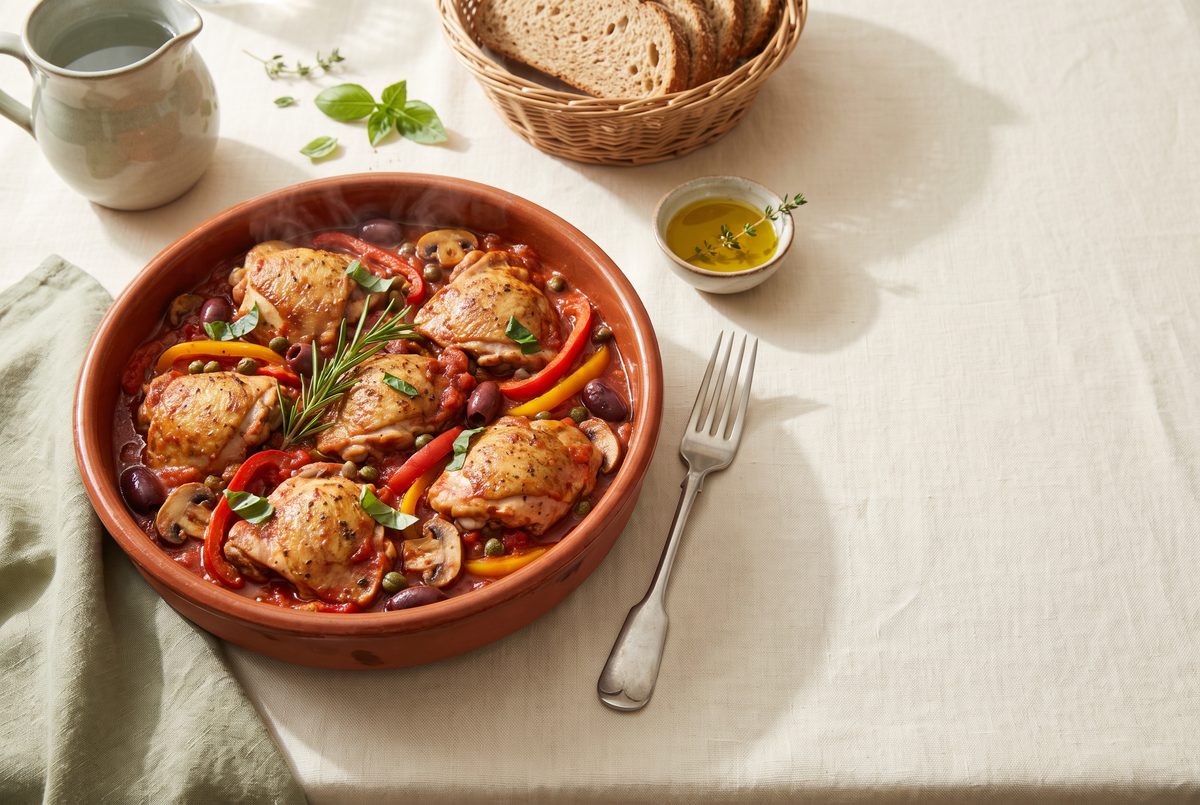
Healthy Chicken Cacciatore
Healthy chicken cacciatore is a one-pan Italian stew of skinless chicken thighs braised with bell peppers, mushrooms…
- 50 min
- 391 kcal
- 40 g protein