Rolled Turkey Breast with Spinach and Ricotta
Rollè di tacchino, the Sunday roast Italian butchers sell turkey for: a breast butterflied and pounded flat, spread with spinach, ricotta and Parmigiano, rolled with the grain, tied, seared and roasted beside a sheet of cauliflower until the slices come off the board as pinwheels.
Rollè di tacchino is what Italy does with a turkey breast instead of roasting it whole and hoping: butterflied, pounded to an even half inch, spread with squeezed spinach, part-skim ricotta and Parmigiano, rolled, tied and roasted beside a sheet pan of cauliflower. Two thick slices and a quarter of the pan are 436 calories with 54 g of protein — 12.4 g of protein per 100 calories, the best ratio of any main dish on this site — in 70 minutes, and the slices are as good cold on day four.
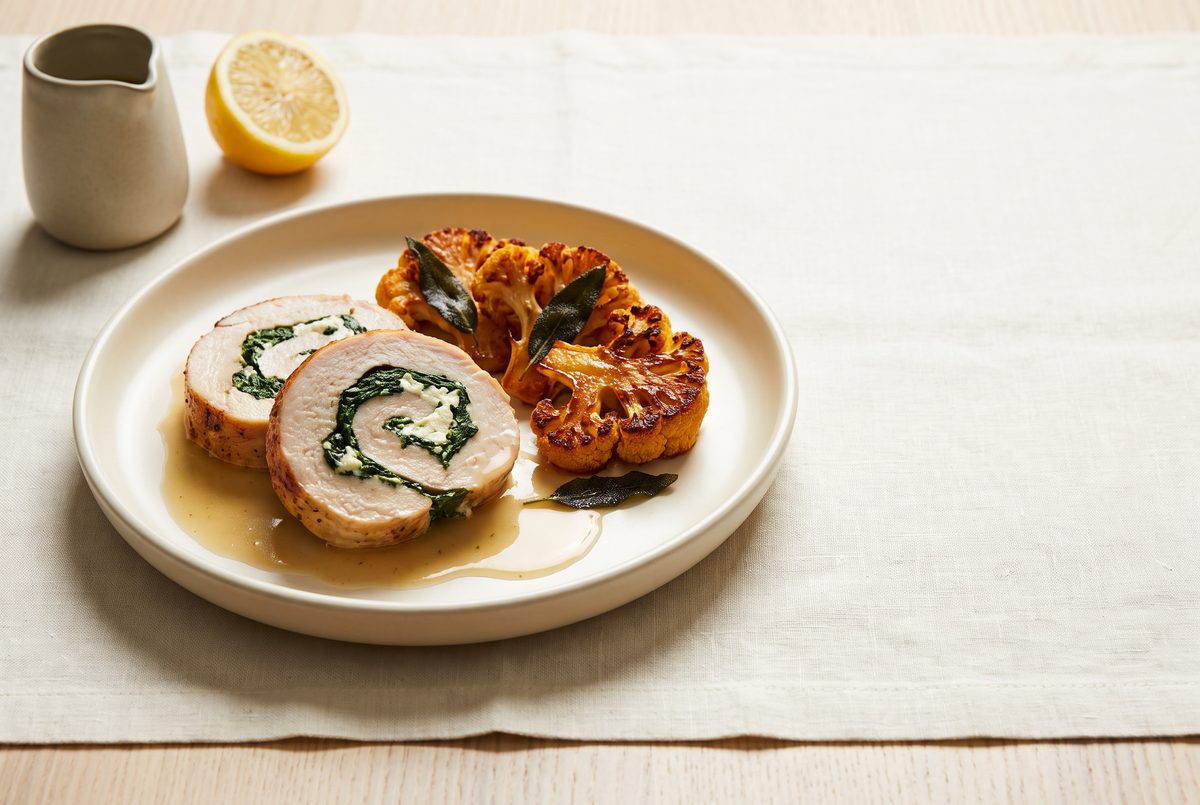
In an Italian supermarket turkey is not a bird, it is a cut. Fesa di tacchino sits in the case between the veal and the chicken, sold either in thin slices for scaloppine or in one piece for a roast, and nobody waits for a holiday to buy it — it is Tuesday food, the cheap lean thing you cook when there are four people and not much money. In America the whole animal shows up once a year with a plan attached, and for the other fifty-one weeks the boneless breast sits in the case at a few dollars a pound and gets bought by people who grill it plain, overcook it by four minutes and conclude that turkey is dry.
It is dry. That is the honest starting point: 1.5 g of fat per 100 g, nothing marbled through it, no skin in the version sold boneless. Every Italian home cook who deals with lean white meat solves this the same way, which is to stop treating the piece as a piece and open it out flat. Rollè — the word is just the French roulé worn down by Italian mouths — means you butterfly the breast, pound it to an even sheet, put something wet and fatty on the inside, roll it back up and tie it. The filling bastes the meat from the middle while the outside browns. Spinach and ricotta is the default, the same filling that goes into ravioli and cannelloni, with lemon zest and a scrape of nutmeg because that is what it has always had.
What it gets you, measured: 436 calories and 54 g of protein a plate, which is 12.4 g of protein per 100 calories — the leanest arithmetic of any main dish on this site, ahead of the sheet-pan chicken parmesan at 11.7. It is also, unlike most of what hits that number, a roast: it takes 70 minutes, half of them unattended, it slices into pinwheels that look like a restaurant did them, and it is arguably better cold on the third day than hot on the first. Novembers are long. This is a good thing to have in the fridge.
Why this recipe works for muscle gain
No meat in this kitchen carries protein with less baggage. Turkey breast is 114 calories, 23.7 g of protein, 1.5 g of fat and 0.4 g of saturated fat per 100 g raw. Expressed the way it matters when you are eating to a calorie number, that is 20.8 g of protein per 100 calories — ahead of veal top round (19.9), skinless chicken breast (18.8), pork tenderloin (17.4) and trimmed top sirloin (17.0). The 6 oz raw portion each person gets here is 40 g of protein on its own, before the dairy in the filling adds 8 g and the vegetables another 5. The finished plate is 54 g of protein for 436 calories; the closest thing on the site is the sheet-pan chicken parmesan, which gets 56 g but spends 478 calories doing it.
Fifty-four grams is one full feeding, with room to spare. The useful unit is not the daily total but the single sitting: roughly 0.4 g of protein per kg of body weight per meal, across three to five meals, is where the evidence points (Schoenfeld & Aragon, 2018), with the daily point of diminishing returns near 1.6 g per kg and a plausible ceiling around 2.2 (Morton et al., 2018). One plate covers a feeding for an adult of essentially any size. The protein is also complete and leucine-rich — the comparison of animal and plant protein sources on muscle protein synthesis is laid out in van Vliet et al. (2015) — so nothing has to be eaten alongside it to make the amino acid profile work. The day's arithmetic, including how to spread it, is in our guide on how much protein you need to build muscle, and the rest of the muscle-gain recipes are portioned to the same logic.
The ricotta is a cooking device, and it is also most of the saturated fat. Part-skim ricotta is 138 calories and 7.9 g of fat per 100 g, of which 4.9 g is saturated. The 180 g in this recipe is 45 g a serving: 62 calories, 5.1 g of protein, 3.6 g of fat and 2.2 g of the plate's 5.2 g of saturated fat. It is in there because it melts rather than tightens, which is what keeps the inside of the roll wet while the outside takes 25 minutes of dry 425°F heat — a job that butter or a fat cap would otherwise do with twice the saturated fat and none of the protein. The Parmigiano brings 2.7 g of protein and 1.2 g more saturated fat for 7.5 g a serving, and it is also the only thing seasoning the filling. Whole-milk ricotta works and tastes better; it costs about 30 calories and 1.5 g of saturated fat a serving, which is a trade worth making on a Sunday and not on a Tuesday.
Two numbers to be honest about: the sodium and the carbohydrate. Sodium is 824 mg a plate, and the breakdown matters more than the total — 436 mg is the ¾ teaspoon of salt the whole recipe uses, 120 mg is the Parmigiano, 85 mg is the turkey itself, and the rest is the ricotta, the spinach and the cauliflower carrying their own. That is inside the Dietary Guidelines' 2,300 mg day for a dinner this size, and it holds only if you buy plain turkey: pre-brined breast, labeled as containing up to 8% of a solution, can carry 300 mg of sodium per 4 oz before you salt anything. The carbohydrate is the other honest number. At 16 g a plate this is a training dinner, not fuel for a long run — the version with potatoes instead of cauliflower in the variations below reaches 37 g, and if the point of the evening is glycogen rather than protein the carb-loading guide and the endurance recipes are built for it.
Ingredients
One tied turkey roll, 8 thick slices, with a sheet pan of roasted cauliflower — 4 dinner plates, or 8 slices on an antipasto board
The turkey
The filling
The pan
The sauce
Instructions
- Wilt the spinach, then squeeze it like it owes you money. Put the 10 oz of spinach in a dry pan over medium heat with nothing added and a lid on, and give it 3 to 4 minutes, turning it over once with tongs — it collapses to about a fifth of its volume and lets go of a surprising amount of water. Tip it into a sieve, run cold water over it to stop the cooking and set the color, then gather it into the middle of a clean kitchen towel and twist. Keep twisting until no more water comes out: ten ounces of raw spinach should end up as a dense ball of about 3 oz, and it should feel almost dry. Chop it roughly. If you are using frozen chopped spinach, thaw it and do exactly the same thing with the towel — frozen is honestly easier here, and it is the same vegetable.
- Butterfly the breast and pound it to an even ½ inch. Lay the turkey breast on the board with the thick side away from you and cut it almost in half horizontally, stopping about half an inch from the far edge, then open it out like a book. Cover it with plastic wrap or slide it into a large zip-top bag and flatten it with the flat side of a mallet or the bottom of a small pan, working from the center outward in overlapping strokes. You want a rough rectangle about 10 by 8 inches and an even ½ inch (1.25 cm) thick — even matters more than thin. Thin spots tear and leak filling; thick spots are still at 140°F when the rest of the roll is done. Season the exposed face with half of the ½ teaspoon of salt and half the pepper.
- Spread the filling thin, and leave a border. Mix the chopped spinach with the ricotta, the Parmigiano, the lemon zest, the grated garlic and the nutmeg. No salt: the Parmigiano brings 480 mg of sodium to the bowl on its own. Spread it over the meat in a layer no thicker than ¼ inch, leaving a clean 1-inch border all the way around — the filling moves outward as you roll, and a border is the only thing standing between you and a pan of spinach. Resist the urge to use more: this looks like a thin layer and it is the right amount, and an overfilled roll squeezes itself empty in the oven.
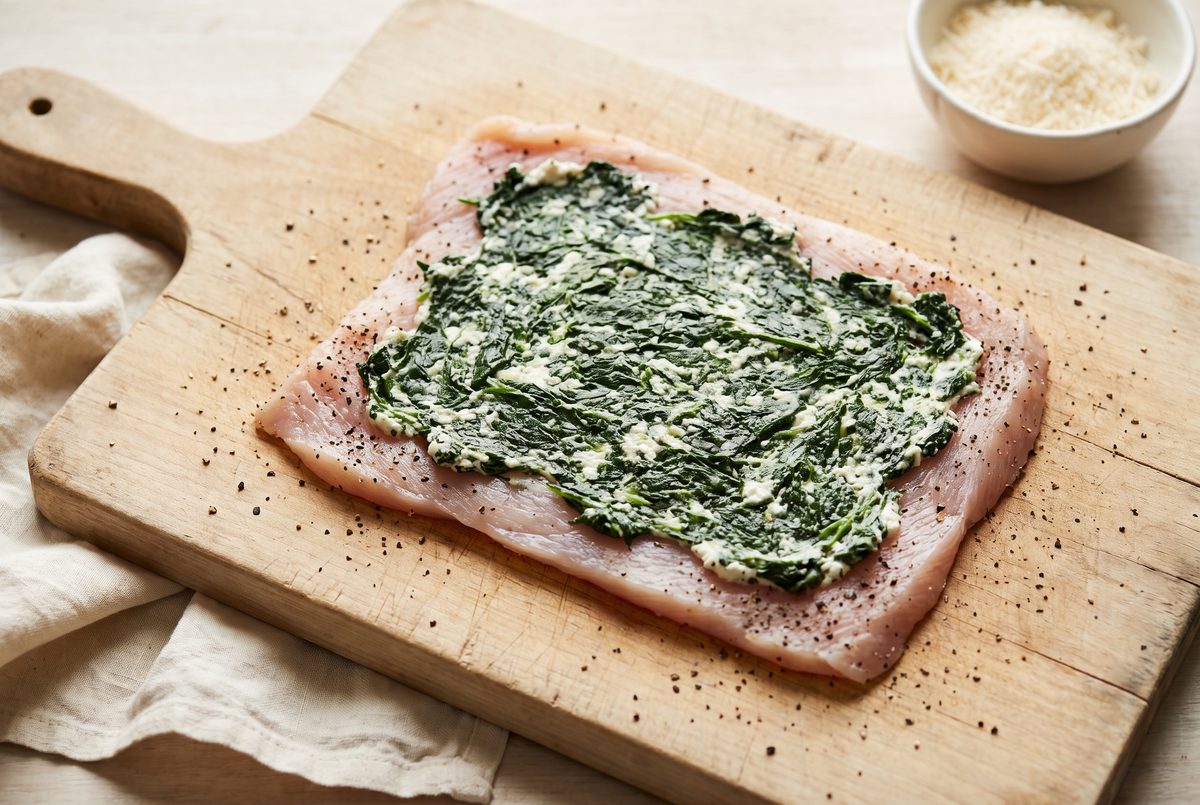
- Roll with the grain, tie at 1-inch intervals. Roll it up from the long side, firmly but without strangling it, so the grain of the meat runs the length of the roll — that way every slice is cut across the grain. Finish seam-side down. Cut six lengths of butcher's twine and tie them at 1-inch intervals, starting with the two ends and working toward the middle so the filling is pushed inward rather than out, and slide 4 sage leaves under the twine along the top. Season the outside with the remaining salt and pepper. The roll should be about 2½ inches across and feel firm, like a well-packed sleeping bag. At this point it can go in the fridge, uncovered, for up to 24 hours — a dry surface browns better.
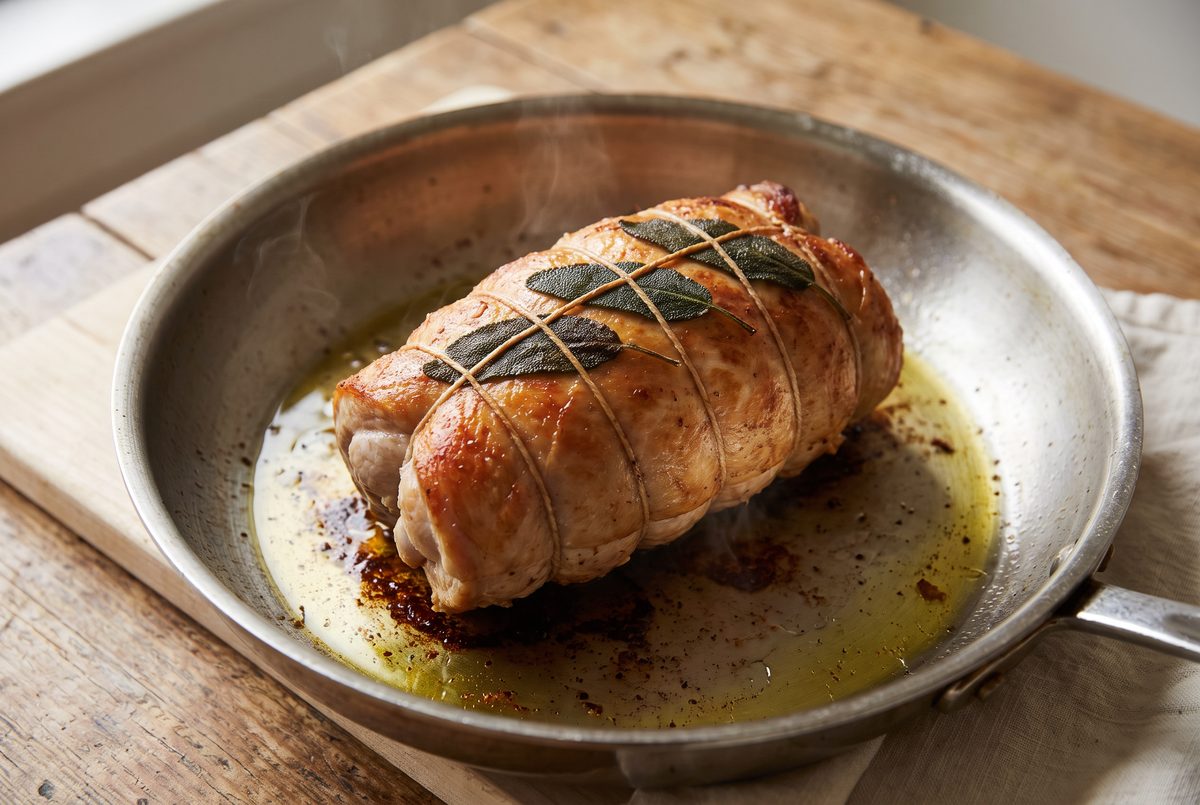
- Sear all four sides, 6 to 8 minutes total. Heat the oven to 425°F (220°C). Warm the 1 tablespoon of oil in a heavy skillet — stainless steel or dark enameled, 10 or 12 inches — over medium-high until it shimmers, and put the roll in seam-side down. Do not move it for 2 minutes. Then turn it a quarter and give each of the other three sides 90 seconds to 2 minutes, until the whole outside is deeply golden and the sage under the twine has gone dark and crisp. This is color, not cooking: the roll comes out of the skillet still raw in the middle. Move it to a plain sheet pan and keep the skillet, with everything stuck to the bottom of it, for the sauce.
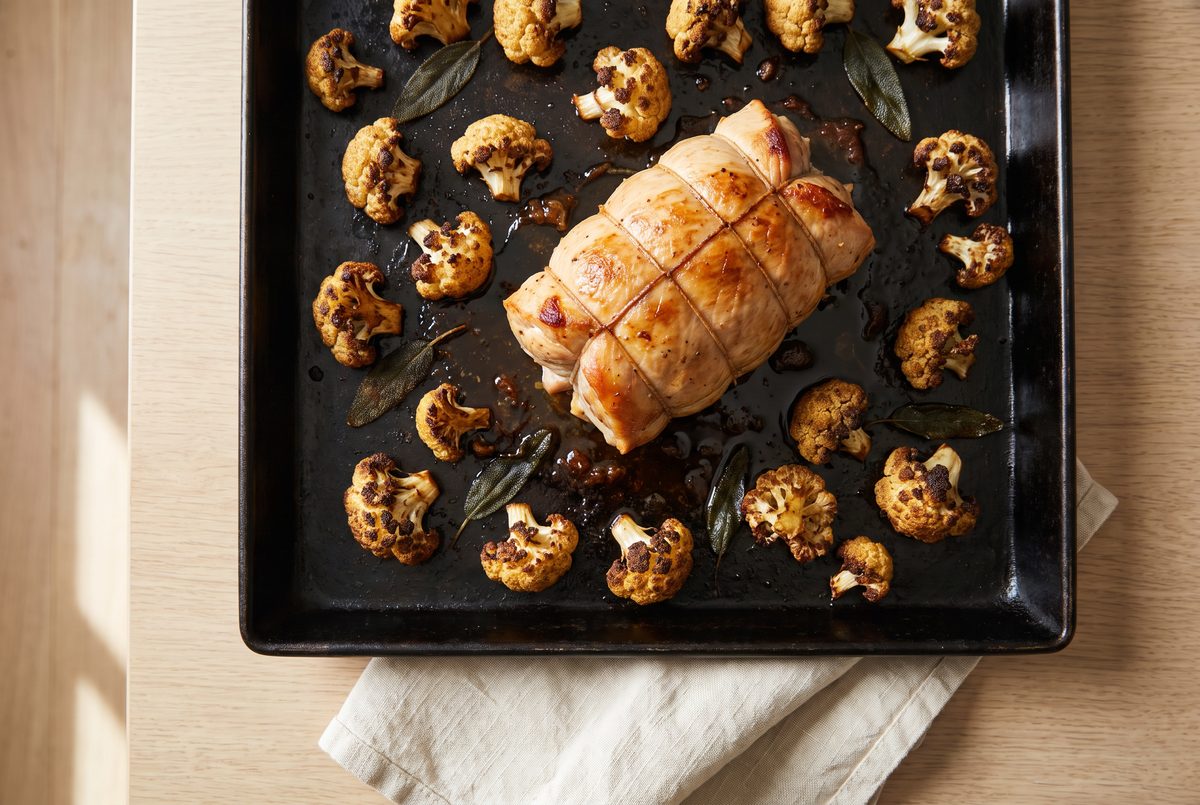
- Cauliflower around it, 25 to 32 minutes, 160°F in the middle. Toss the cauliflower with the second tablespoon of oil and the ¼ teaspoon of salt and spread it around the roll in a single layer, cut sides down, with the remaining 4 sage leaves tucked among it. Crowded florets steam and go gray; a single layer with space between them browns. Roast 25 to 32 minutes, turning the cauliflower once at the halfway mark, until the florets are deep brown at the edges and an instant-read thermometer pushed into the thickest part of the roll — through the middle, into meat and not into filling — reads 160°F (71°C). Start checking at 25 minutes. A roll this size moves about 2°F a minute at the end, so the window between right and ruined is roughly three minutes wide.
- Rest 10 minutes while the sauce reduces. Then slice, then cut the twine. Move the roll to a board and leave it alone for 10 minutes — carryover takes the center from 160°F to the USDA's 165°F (74°C) while it sits, and the juices stop running the moment you cut. Meanwhile set the skillet over medium-high, pour in the ½ cup of wine and scrape the bottom clean as it boils down by half, 2 to 3 minutes. Add the ½ cup of broth and the rosemary sprig, simmer 3 to 4 minutes until it just coats a spoon, pull out the rosemary and stir in the tablespoon of lemon juice off the heat along with any juice that has collected under the roll. Slice the roll into eight rounds about 1 inch thick — cutting through the twine at each tie, so every slice stays in one piece until it is on the plate — then snip the twine off each round. Two slices per plate, cauliflower alongside, sauce spooned over.
Tips from our kitchen
- Buy plain turkey, and read the fine print. A lot of boneless turkey breast in American supermarkets is labeled as containing up to 8% of a solution, which is water, salt and sometimes phosphates injected to stop people overcooking it — that can mean around 300 mg of sodium per 4 oz before you have touched the salt box, against the 20 mg in plain turkey. Pre-brined meat also will not take a sear properly, because it leaks. The label to look for says turkey breast, and nothing else.
- A thermometer, or don't bother. On a cut with 1.5 g of fat per 100 g there is no margin and no visual cue: the outside looks identical at 155°F and at 180°F, and the difference on the tongue is enormous. An instant-read thermometer costs less than the turkey. Push it into the thickest part through the end of the roll if you can, so you are reading meat and not the ricotta down the middle, which runs hotter.
- If the breast is too thick to butterfly cleanly, cut it in two. Some pieces sold as a half breast are a lump rather than a slab. Cut the piece into two thinner slabs through the thickest part, pound each one, and lay them side by side with a ½-inch overlap to make your rectangle — the overlap seals as it cooks and nobody will ever know. Two small rolls instead of one also work and cook in about 18 minutes; the timing above is for a single 2½-inch roll.
- The cauliflower needs the room more than the heat. A pound and a half of florets on a half-sheet pan around the roll is right at the limit; on anything smaller, roast the cauliflower on its own second pan. Crowding is the only thing that prevents browning, and unbrowned cauliflower in a dish like this just tastes wet. Cut sides down on the first side, and leave them alone until the halfway turn.
- Without wine: ½ cup of low-sodium chicken broth plus 2 teaspoons of white wine vinegar, reduced the same way, then the rest of the broth. The sauce is a little flatter — the wine is doing acid and aroma at once — but it is a better answer than skipping the deglaze, which leaves the best-tasting part of the dish glued to the skillet.
Variations
- With potatoes instead of cauliflower, for a training dinner: 525 calories, 54 g of protein and 37 g of carbohydrate. Swap the 1½ lb of cauliflower for 1½ lb (680 g) of potatoes in ¾-inch chunks, tossed with the same tablespoon of oil and salt; they need the full 32 minutes and a turn. Same protein, 21 g more carbohydrate, which is the difference between a dinner that sits next to training and one that fuels it — the logic is in the carb-loading guide.
- Wrapped in prosciutto, the way a Northern Italian butcher ties it: 474 calories, 58 g of protein, and 1,124 mg of sodium. Lay 2 oz (60 g) of prosciutto in overlapping slices over the outside of the tied roll before searing. It bastes the lean meat from the outside as well as the inside and adds 4 g of protein, but it also adds 300 mg of sodium a serving — the single biggest sodium decision available in this recipe. Worth it once; not the weekly version.
- The roll on its own, no vegetable: 363 calories, 51 g of protein, 7.4 g of carbohydrate. Skip the cauliflower and the second tablespoon of oil and roast the roll on a bare pan for the same 25 to 32 minutes. This is the version to make when it is going over pasta e ceci or next to bread, or when you want the leanest two slices on the site to take to work.
- With chicken breast, if turkey is not in the case: 447 calories, 52 g of protein. Two 12-oz boneless skinless chicken breasts, butterflied and pounded, make two smaller rolls that cook in about 20 minutes to the same 160°F. The numbers barely move — chicken breast is 120 calories and 22.5 g of protein per 100 g against turkey's 114 and 23.7 — and the dish is the same dish. Turkey is the better buy in November and the slightly leaner animal.
- A sliced-cold antipasto, which is what Italy does with the leftovers. Chill the roll whole, then slice it thin — ⅜ inch, not an inch — and lay the rounds on a platter with a spoonful of the cold sauce, a few capers and a little raw olive oil. Eight slices feed a table of six as a starter. The filling sets firm when it is cold, which is exactly when the pinwheel looks best, and it is the reason to make this on Saturday for a Sunday lunch rather than the other way round.
Storage & meal prep
Sliced and in a container, 4 days in the fridge, and this is one of the rare roasts that does not get worse. Keep the slices in their sauce if you have any left, or sprinkle them with a teaspoon of water before you cover them; store the cauliflower separately or it goes soft against the meat. Lean white meat punishes reheating more than fat meat does, so the best two answers are cold, straight from the fridge — thin slices on bread with a little mustard or olive oil, which is how half of this roll actually gets eaten in practice — or warmed gently in the sauce in a covered pan over low heat for 4 or 5 minutes, never in the microwave at full power, which drives the water out of the turkey and the whey out of the ricotta at the same time. The whole roll, cooked, freezes for 2 months: wrap it unsliced, thaw it overnight in the fridge and slice it cold, then warm the slices in sauce. Do not freeze it raw and filled — the USDA advises against freezing stuffed raw poultry, because the center thaws and cooks unevenly. For a week of lunches built on the same logic, the Mediterranean meal prep guide has the batch arithmetic.
Nutrition per serving
| Nutrient | Amount | % DV* |
|---|---|---|
| Calories | 436 kcal | 22% |
| Total fat | 16 g | 21% |
| Saturated fat | 5.2 g | 26% |
| Carbohydrates | 16 g | 6% |
| Fiber | 5.5 g | 20% |
| Sugars | 4.3 g | — |
| Protein | 54 g | 108% |
| Sodium | 824 mg | 36% |
*Percent Daily Values are based on a 2,000-calorie diet. Values are calculated from USDA FoodData Central and manufacturer data for the ingredients as listed; they are estimates, not lab analyses. Nutrition disclaimer.
Frequently asked questions
How much protein is in turkey breast?
23.7 g per 100 g raw, for 114 calories and 1.5 g of fat — which is 20.8 g of protein per 100 calories, the highest of any meat used on this site, ahead of veal top round (19.9), skinless chicken breast (18.8), pork tenderloin (17.4) and trimmed top sirloin (17.0). The 6 oz (170 g) raw portion in this recipe carries 40 g of protein on its own, and the finished plate with the ricotta filling and the vegetables reaches 54 g for 436 calories. Turkey breast loses roughly a quarter of its weight in water as it roasts, so 6 oz raw is about 4½ oz on the plate; the protein does not go anywhere.
What temperature should rolled turkey breast be cooked to?
165°F (74°C) in the center, which is the USDA's safe minimum for all poultry — but you take it out of the oven at 160°F (71°C) and let carryover heat do the last five degrees during a 10-minute rest. Measure in the thickest part of the roll, pushing the probe into meat rather than into the ricotta down the middle, which heats faster and will read high. At 425°F a 2½-inch roll gets there in 25 to 32 minutes after searing, and it climbs about 2°F a minute at the end, so start checking at 25.
Can I make rolled turkey breast ahead of time?
Yes, and it is better for it. Assemble and tie the roll up to 24 hours ahead and leave it uncovered in the fridge — the surface dries out, which makes a better sear, and the filling firms up so it stays put when you roll it onto the heat. Then sear and roast on the day; nothing in the timing changes. Cooked, the sliced roll keeps 4 days and is excellent cold, so the other way to do it is to roast it on Saturday and eat it in slices through the week. The one thing to avoid is freezing it raw and filled: the USDA advises against freezing stuffed raw poultry because it thaws unevenly.
Can I serve this instead of a whole turkey for a small Thanksgiving?
It is a reasonable answer for four to six people, and it solves the two problems a whole bird has at that scale — it cooks in half an hour instead of three, and there is no dark-meat-versus-white-meat negotiation. One roll is 4 dinner plates at 436 calories each, or 8 slices if there is enough else on the table; doubled, it is two rolls on one sheet pan with the same 25 to 32 minutes, since they cook by thickness and not by total weight. Carve it at the table like a roast, with the sauce in a jug. For the vegetable side of that meal, the Brussels sprouts with Tuscan white beans is built for the same oven.
Is turkey breast healthier than chicken breast?
Marginally, and not enough to choose between them on health grounds. Per 100 g raw, turkey breast is 114 calories with 23.7 g of protein and 1.5 g of fat; skinless chicken breast is 120 calories with 22.5 g of protein and 2.6 g of fat. Turkey is a little leaner and a little denser in protein, chicken is usually cheaper and always easier to find, and swapping one for the other in this recipe moves the plate from 436 calories and 54 g of protein to 447 and 52. The real variable is not the species but what you do to it: a pre-brined breast of either carries several hundred milligrams of added sodium, and a breaded one is a different food.
Why did my roll fall apart when I sliced it?
Four usual causes, in order of likelihood. The spinach was not squeezed dry, so steam built up inside and forced the seam open — ten ounces of raw spinach has to come down to about 3 oz of dense, barely damp ball. The filling was too thick or ran to the edges, with no 1-inch border to seal against. The roll was not rested, so it was still under pressure when the knife went in; give it 10 minutes. Or the twine came off too early: slice through the ties, one round at a time, and snip the string off each slice after it is cut, not before.
Sources
- USDA FoodData Central — turkey, whole, breast, meat only, raw; spinach, raw; cheese, ricotta, part skim milk; cheese, Parmesan, hard; cauliflower, raw; olive oil; wine, table, white, dry; chicken broth, low sodium; lemon peel and lemon juice, raw; garlic, raw; sage, fresh; rosemary, fresh; nutmeg, ground; potatoes, raw; prosciutto; and chicken breast, veal top round, pork tenderloin and beef top sirloin, raw (for the protein-density comparisons)
- USDA Food Safety and Inspection Service — Safe Minimum Internal Temperature Chart: poultry, including stuffed poultry and poultry roasts, 165°F (73.9°C); and FSIS guidance against freezing raw stuffed poultry
- Dietary Guidelines for Americans 2020–2025 — saturated fat under 10% of calories; sodium under 2,300 mg per day
- Schoenfeld, B.J. & Aragon, A.A. (2018). How much protein can the body use in a single meal for muscle-building? Implications for daily protein distribution. Journal of the International Society of Sports Nutrition 15:10
- Morton, R.W. et al. (2018). A systematic review, meta-analysis and meta-regression of the effect of protein supplementation on resistance training-induced gains in muscle mass and strength in healthy adults. British Journal of Sports Medicine 52(6)
- van Vliet, S., Burd, N.A. & van Loon, L.J.C. (2015). The Skeletal Muscle Anabolic Response to Plant- versus Animal-Based Protein Consumption. Journal of Nutrition 145(9)
You might also like
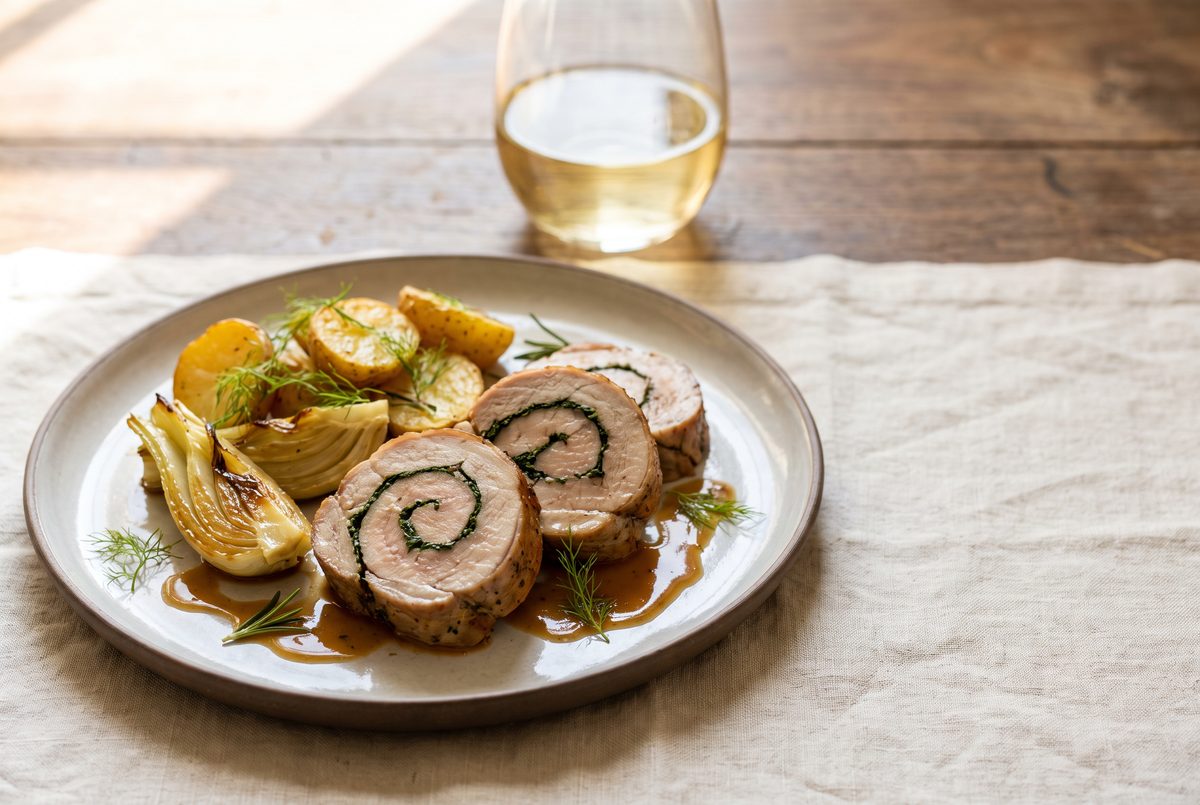
Porchetta-Style Pork Tenderloin
This is porchetta's seasoning — toasted fennel seed, garlic, rosemary, sage and lemon zest, pounded to a paste —…
- 1 hr 15 min
- 537 kcal
- 42 g protein
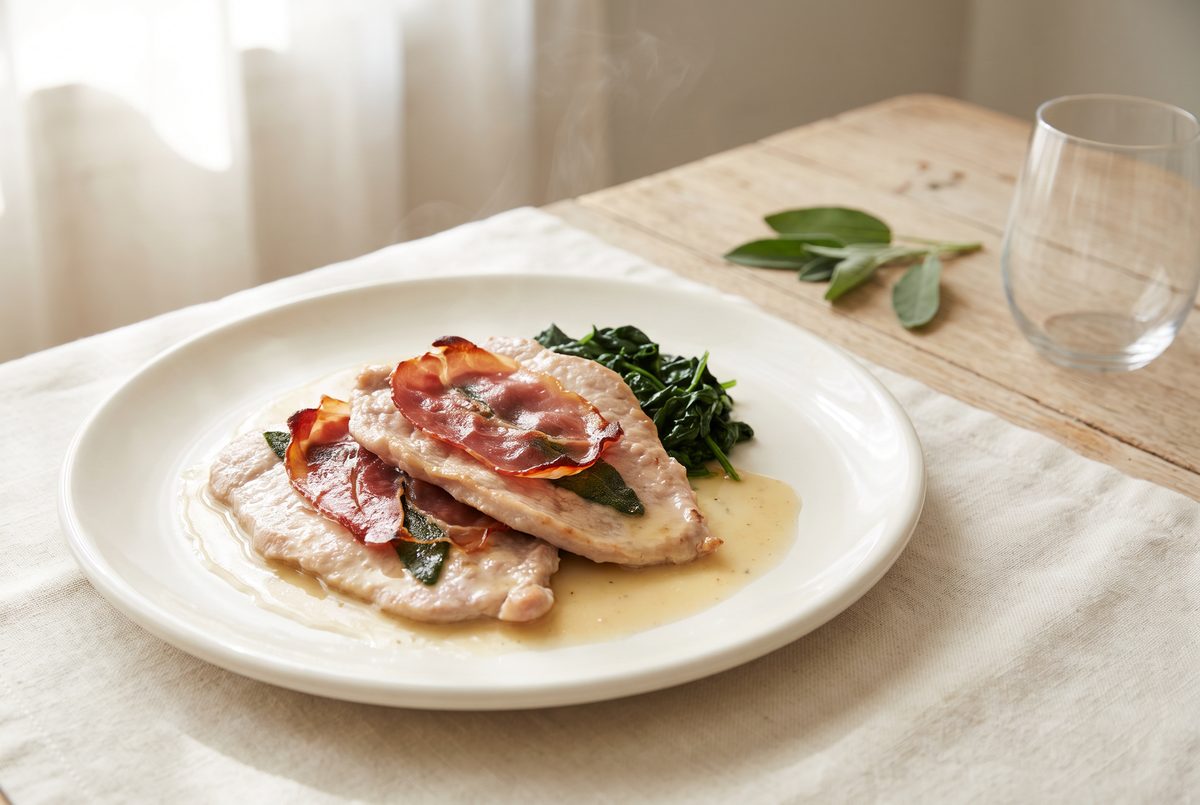
Saltimbocca alla Romana
Saltimbocca alla romana is veal pounded thin under a slice of prosciutto and a sage leaf, seared four minutes total…
- 30 min
- 463 kcal
- 47 g protein
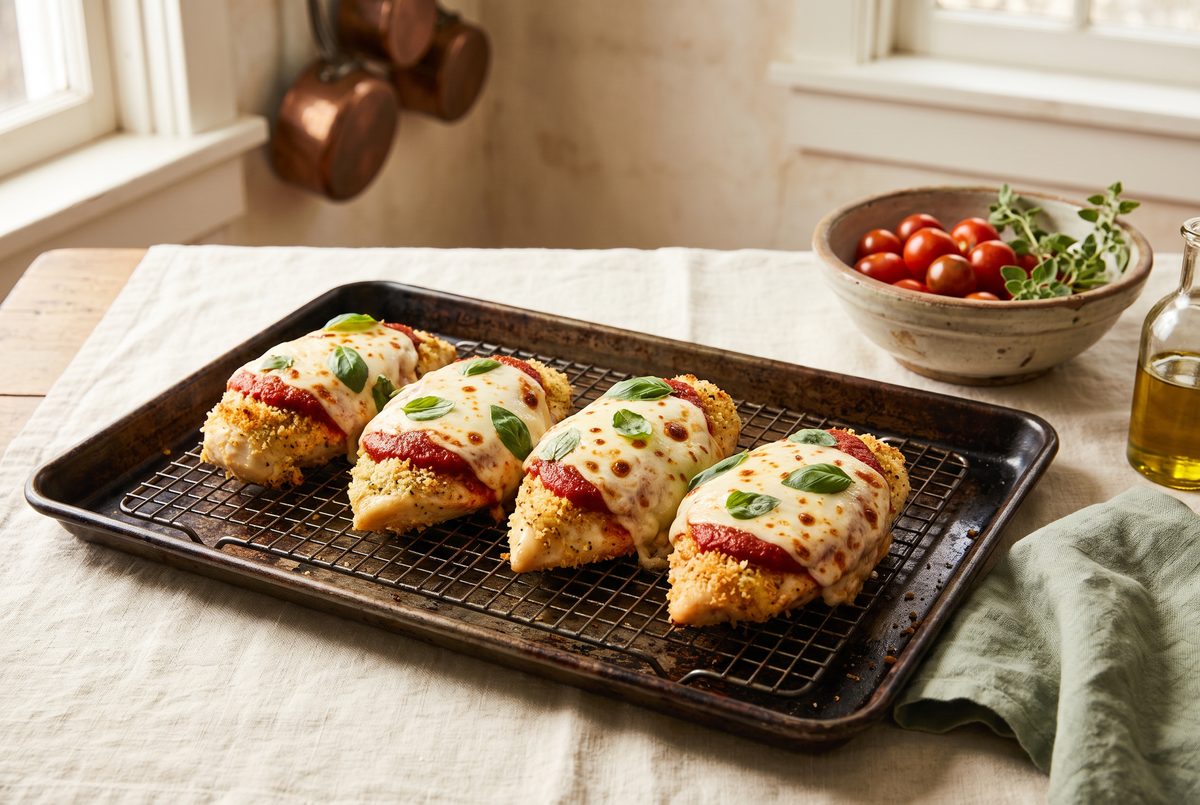
Sheet-Pan Chicken Parmesan, High-Protein
High-protein sheet-pan chicken parmesan bakes breaded chicken breasts on a wire rack so they crisp without frying…
- 40 min
- 478 kcal
- 56 g protein