Porchetta-Style Pork Tenderloin with Fennel and Potatoes
The fennel-seed, garlic and rosemary paste that makes porchetta taste like porchetta, moved onto the leanest cut in the butcher's case — rolled inside the meat instead of rubbed on it, because tenderloin has no fat to carry it.
This is porchetta's seasoning — toasted fennel seed, garlic, rosemary, sage and lemon zest, pounded to a paste — rolled inside two butterflied pork tenderloins and roasted over potatoes and fennel wedges. One plate comes to 537 calories with 42 g of protein, 50 g of carbohydrate and 9.4 g of fiber, out of the oven in an hour and a quarter, and it is naturally gluten-free and dairy-free.
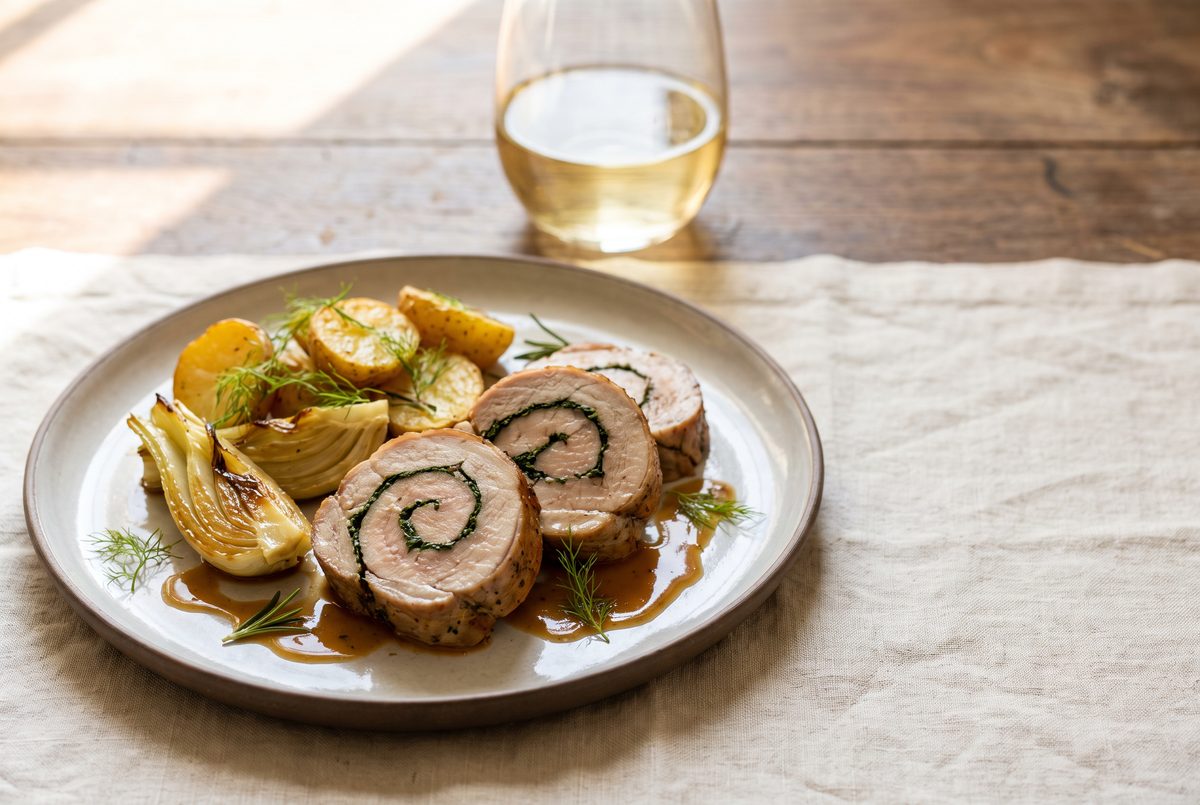
Porchetta in Italy is a roadside thing. Outside Rome, in the Castelli towns and at every village fair in Umbria and Lazio, there is a truck with the back open and a boned pig on a spit inside it, and a man carving slices onto paper with a piece of crackling on top. You eat it standing up in a bread roll with nothing else on it. What you are tasting, under the fat and the salt, is a paste: wild fennel, garlic, rosemary, pepper, sometimes the herb-and-garlic mash Romans call a battuto, worked into the inside of the animal before it was tied shut.
That paste is portable. The pig is not. Most home versions get around it by using pork belly or a fatty shoulder, which works and takes four hours, and leaves you with a dish that belongs to a holiday rather than a Tuesday. This one goes the other way: same paste, leanest possible cut, 45 minutes in the oven. Pork tenderloin is the loin's small inner muscle — the psoas — and it is the leanest major cut in the case, which is also exactly why it has a reputation for being boring. Two of them come vacuum-packed together in every American supermarket and most of them get cut into medallions and sautéed into submission.
The trick is where the seasoning sits. Rub a tenderloin on the outside and you have seasoned a surface; there is no skin, no fat cap, nothing for the paste to melt into and no time for it to travel. So the tenderloin gets butterflied — split lengthwise almost all the way through and opened flat like a book — the paste goes on the cut face, and the whole thing is rolled and tied. Now the fennel and garlic are in the middle of every slice, which is where porchetta tastes of them too. The potatoes and fennel wedges underneath catch the pork fat and the wine, and the plate is done in one tray and one pan.
Why this recipe works for muscle gain
Pork tenderloin is the lean cut people forget. At 120 calories and 20.9 g of protein per 100 g raw, with 3.5 g of fat, it sits between skinless chicken breast (120 calories, 22.5 g of protein) and chicken thigh (121 calories, 19.7 g), and well under lean beef sirloin (131 calories, 22.3 g). That is why 1½ lb of it carries four plates to 42 g of protein each while the whole meal — meat, 2 lb of potatoes, a fennel bulb and 3 tablespoons of olive oil — stays at 537 calories a serving, with 17 g of fat of which only 3.5 g is saturated.
42 g is one full feeding, and the day's total is what decides anything. The practical per-meal target for someone training is roughly 0.4 g of protein per kg of body weight, taken across three to five feedings (Schoenfeld & Aragon, 2018); the meta-analysis by Morton et al. (2018) put the daily point of diminishing returns near 1.6 g per kg, with a plausible ceiling around 2.2. One plate of this covers a feeding for an adult up to about 105 kg. The arithmetic for a whole day is in how much protein to build muscle.
The carbohydrate is part of the recipe, not a side dish. Two pounds of potatoes roasted under the meat put 50 g of carbohydrate on each plate — a quarter of what a hard training day needs, in the same tray — and they do most of the work on fiber: 9.4 g per serving between the potatoes and the fennel, against the 25 to 38 g a day most adults are told to aim for and rarely reach. Leave the potato skins on; that is where about half of it is.
The fat is olive oil and the pork's own, in small amounts. Real porchetta is built on belly and skin, and the fat is the point of it — there is no honest way to call that a lean dish. This is the opposite cut, and the only fat added is 3 tablespoons of oil across four servings: one in the paste, two on the vegetables. What browns the meat is the sear, not a coating. The rest of the muscle-gain recipes are sized the same way, protein first and carbohydrate matched to the training.
Ingredients
2 rolled tenderloins, about 12 slices, with potatoes and fennel
The pork
The paste
The tray
The pan sauce
Instructions
- Toast the fennel seeds and make the paste. Put the fennel seeds in a dry skillet over medium heat for 90 seconds to 2 minutes, moving the pan now and then, until they darken a shade and the kitchen smells of anise — this is not optional, raw fennel seed tastes dusty and toasted fennel seed tastes of porchetta. Tip them into a mortar and crush them coarsely, then add the garlic, rosemary leaves, sage, lemon zest, chili flakes, salt and pepper and work it all to a rough green paste. Stir in the tablespoon of oil. A small food processor does it in 20 seconds; a cutting board and a heavy knife do it in three minutes and give a better texture. You want it spreadable but still speckled, not a purée.
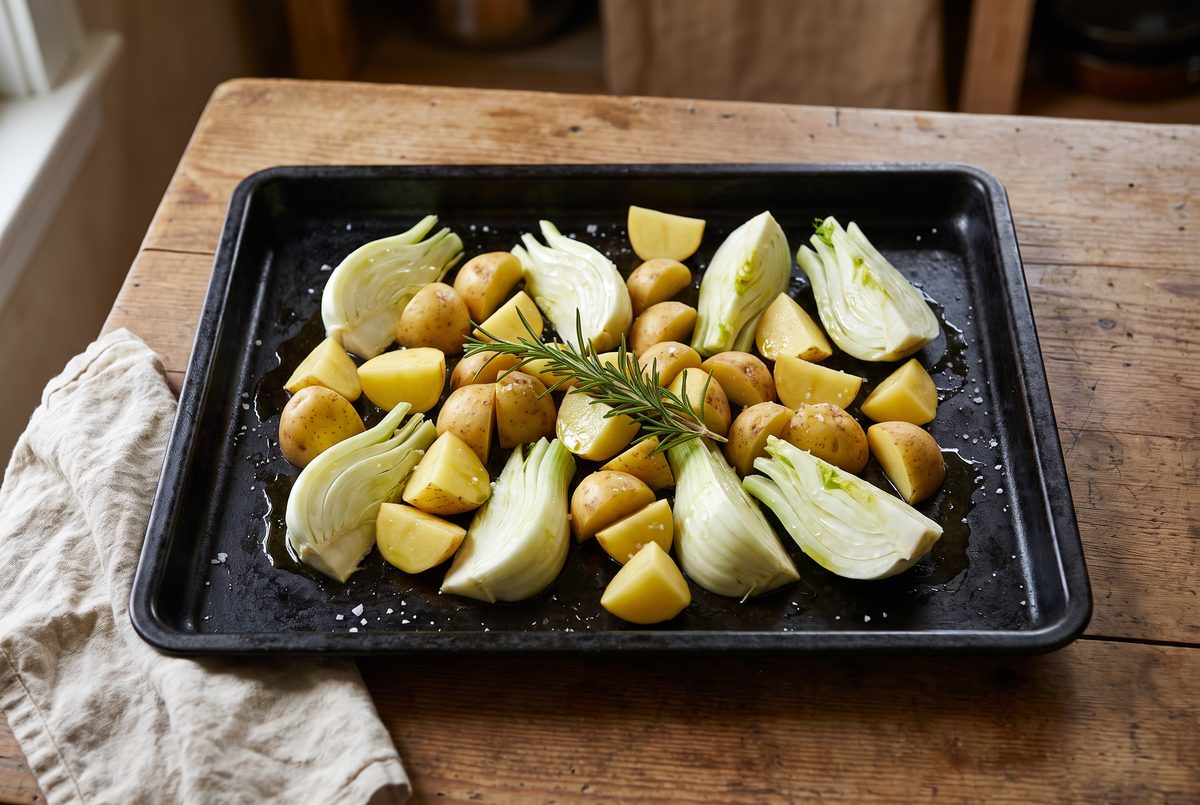
- Potatoes and fennel into the oven first. Heat the oven to 425°F (220°C). Toss the potato chunks and fennel wedges on a large sheet pan with the 2 tablespoons of oil and the ½ teaspoon of salt, spread them in one layer with the fennel cut-side down, lay the rosemary sprig on top and roast 20 minutes before the meat goes anywhere near them. Potatoes need about 40 minutes at this temperature and the pork needs 20: starting them together is the mistake that leaves you cutting into pale, waxy potatoes while the meat rests and cools.
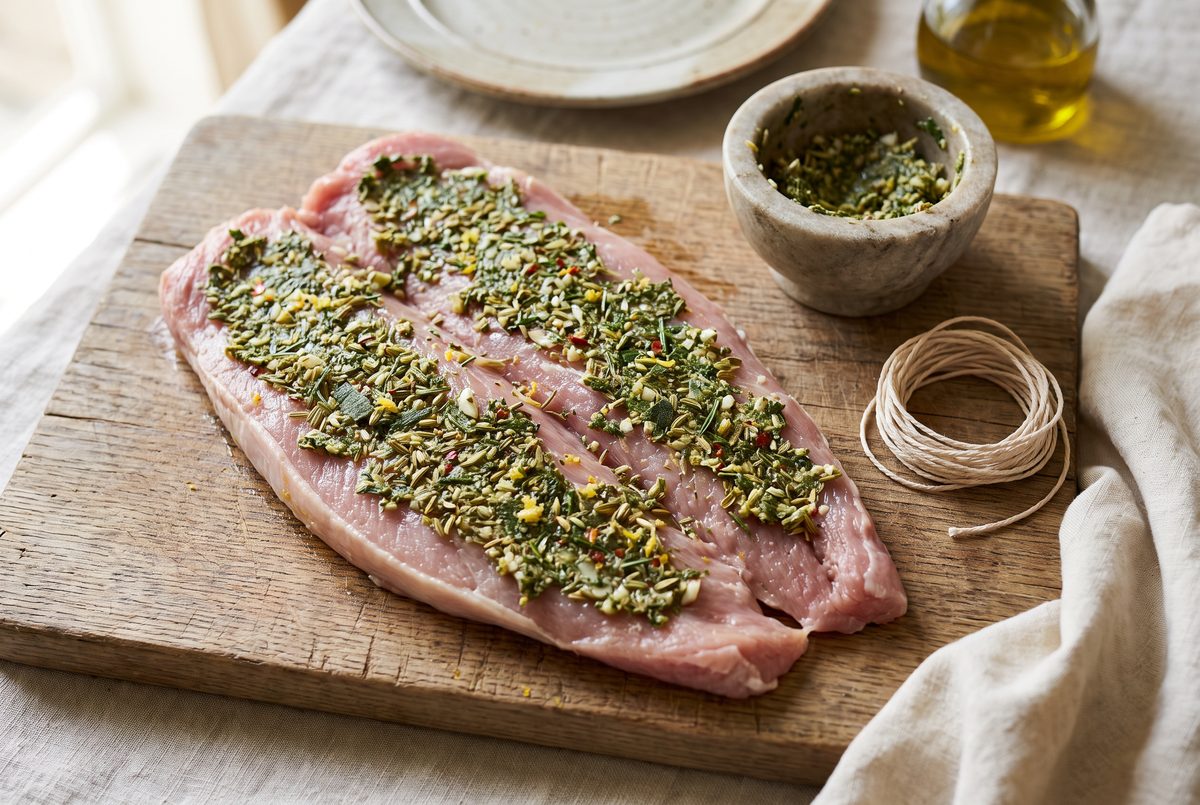
- Butterfly the tenderloins and spread the paste. Lay a tenderloin on the board and cut along its length with a long thin knife, going about three-quarters of the way through, then open it out flat like a book. Cover it with parchment and give it four or five firm taps with the flat of a mallet or the bottom of a pan, just to even out the thickness — about ½ inch. Spread half the paste over the cut face, leaving a bare half-inch along the long edge so it does not all squeeze out, and repeat with the second tenderloin. The thin tail end of the muscle is not a flaw: fold it back over itself when you roll, which evens out the cooking.
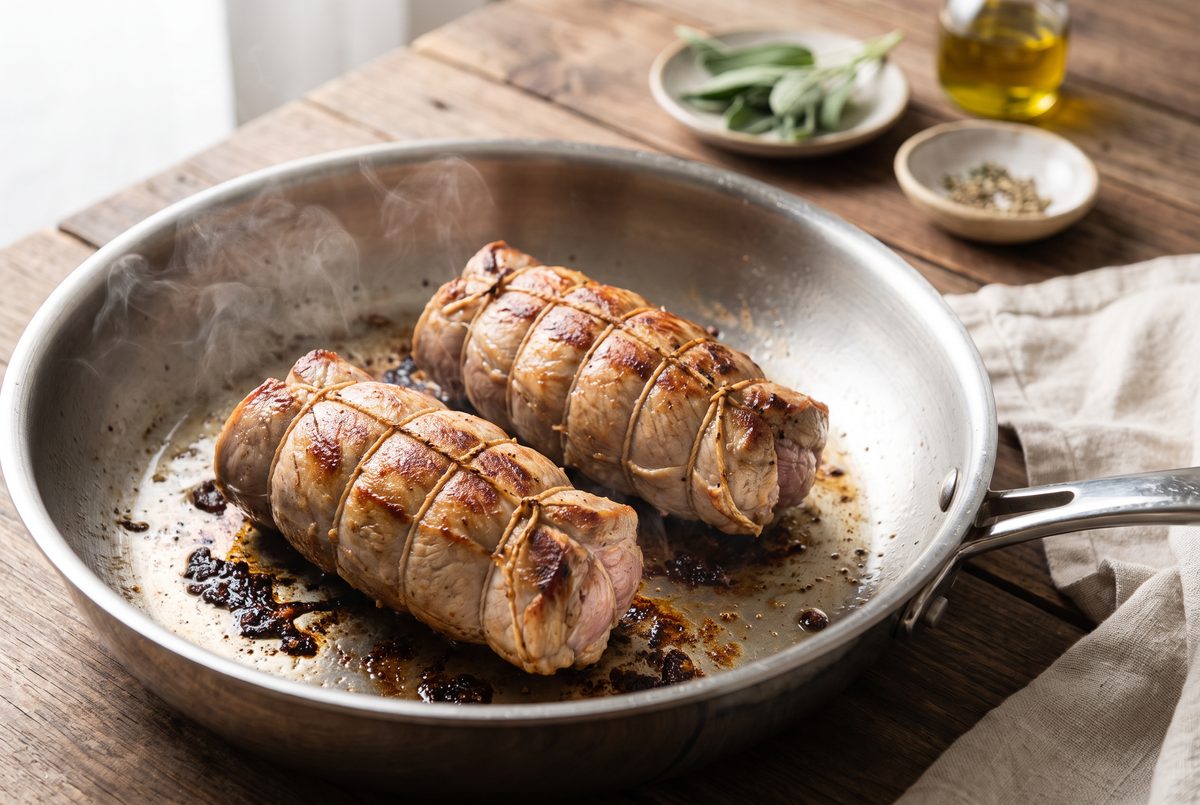
- Roll and tie at 1-inch intervals. Roll each tenderloin up along its length into a tight cylinder, paste inside, and tie it with butcher's twine at 1-inch intervals — five or six loops for a 12 oz piece. Tie snugly, not tourniquet-tight: the aim is an even cylinder that cooks at one rate, and pulling hard squeezes the paste out of the ends. No twine in the drawer? Two long strips cut from a parchment sheet, wrapped and twisted, hold a tenderloin well enough for 45 minutes. Dry the outside of the rolls with a paper towel; a wet surface steams instead of browning.
- Sear all four sides, 6 minutes total. Heat an ovenproof stainless-steel or heavy enameled pan over medium-high with no added oil — there is already a tablespoon in the paste and the pork releases its own. Lay the rolls in and leave them 90 seconds a side, turning through four sides, about 6 minutes in total, until the outside is deeply golden and the twine has scorch marks. The browned bits left on the bottom of the pan are the sauce; keep that pan.
- Roast to 145°F — about 20 minutes. Push the vegetables to the sides of the sheet pan to make room, set the seared rolls in the middle and return the tray to the oven for 18 to 22 minutes. Start checking at 18 with an instant-read thermometer pushed into the thickest part: you are looking for 145°F (63°C). This is the step to use a thermometer on rather than a clock — tenderloins vary from 10 to 16 oz and the difference between 145°F and 155°F is about four minutes. The center will be faintly pink, which is both correct and safe for whole pork cuts.
- Rest 10 minutes, and make the sauce while it does. Move the rolls to a board and leave them alone 10 minutes — carve into a tenderloin straight out of the oven and the juice runs onto the board instead of staying in the slices, and the temperature still climbs about 5°F while it stands. Meanwhile set the searing pan over medium-high, pour in the wine and scrape the bottom with a wooden spoon, letting it boil hard 2 minutes until it has reduced by half and smells round rather than sharp. Add the broth and any juice from the resting board and give it 1 minute more. It stays thin, like a jus; there is no flour and no butter in it.
- Cut the twine, slice thick, spoon over the sauce. Snip the loops and pull the twine off, then cut the rolls into slices a good ¾ inch thick — thinner and the spiral of paste falls apart on the plate. Divide the potatoes and fennel between four plates, lay three slices on each, spoon the pan sauce over the meat and scatter the chopped fennel fronds. A squeeze of lemon on the vegetables, not on the pork.
Tips from our kitchen
- Buy the two-pack and cook both. American pork tenderloin is sold two to a vacuum pack, usually 1½ lb together, which is exactly this recipe. Cooking one and freezing the other is a false economy: the second roll, sliced cold, is the best thing you can put in a lunch box all week.
- Silverskin off, fat on. There is a thin opalescent membrane along one side of a tenderloin that stays tough however long you cook it — slide a knife under one end and pull it off. The little scraps of actual fat can stay; on a cut this lean you want them.
- No mortar? Use the flat of a knife and salt. Pile the garlic, herbs and toasted fennel seed on the board, add the salt from the recipe, and drag the flat of a heavy blade across the heap over and over. The salt is the abrasive. It takes about three minutes and gives a better paste than a food processor, which tends to go wet and pasty.
- If the roll won't stay shut, you have overfilled the bare edge or tied too tight. Half a teaspoon of paste squeezing out is normal and it browns in the pan; a seam that unrolls means you need an extra loop of twine between the ones you have.
- Leftover paste keeps. Double it, press it into a small jar under a film of olive oil, and it holds 2 weeks in the fridge. On chicken thighs or over roast potatoes it does the same work.
Variations
- With pork loin instead of tenderloin, which is nearer to real porchetta: a 2 lb boneless loin, butterflied the same way, rolled and roasted at 375°F for about 55 minutes to the same 145°F. It is fattier and more forgiving, feeds six, and the fat cap scored in a diamond pattern crisps into something close to crackling.
- On polenta instead of potatoes, for a plate that stays gluten-free and lands lighter on carbohydrate: skip the tray entirely, roast only the fennel, and serve the slices over the soft polenta from our creamy mushroom polenta with the pan sauce poured over.
- With apples and a little vinegar, which is how the Trentino end of the country treats pork in October: add 2 tart apples in wedges to the tray for the last 20 minutes and finish the pan sauce with a teaspoon of red wine vinegar instead of the lemon.
- Porchetta sandwiches, the proper destination for leftovers: slice the cold roast as thin as you can, pile it into a split ciabatta roll with nothing but a spoonful of the sauce and a few arugula leaves, and press it under a plate for 10 minutes.
- For the same protein without the oven, saltimbocca alla romana gets to 47 g in half an hour in one skillet, and the Italian beef stew with potatoes does the slow version for a batch.
Storage & meal prep
The sliced meat keeps 3 days in the fridge and is genuinely good cold — better cold than reheated, which is unusual for pork and comes down to the paste, whose fennel and garlic settle overnight. If you want it warm, do not microwave slices: lay them in a pan with a tablespoon of water or leftover sauce, cover, and give them 2 minutes over low heat, just to take the chill off. The potatoes and fennel keep 4 days and come back properly in a 400°F oven for 8 minutes — spread out, not piled. Whole, untied and wrapped tight, a cooked roll freezes for 2 months; slice it frozen for sandwiches rather than thawing the whole thing. Raw, the tenderloins can be butterflied, spread, rolled and tied up to 24 hours ahead and kept covered in the fridge, which is the version to cook if you are feeding people on a weeknight.
Nutrition per serving
| Nutrient | Amount | % DV* |
|---|---|---|
| Calories | 537 kcal | 27% |
| Total fat | 17 g | 22% |
| Saturated fat | 3.5 g | 18% |
| Carbohydrates | 50 g | 18% |
| Fiber | 9.4 g | 34% |
| Sugars | 6.2 g | — |
| Protein | 42 g | 84% |
| Sodium | 652 mg | 28% |
*Percent Daily Values are based on a 2,000-calorie diet. Values are calculated from USDA FoodData Central and manufacturer data for the ingredients as listed; they are estimates, not lab analyses. Nutrition disclaimer.
Frequently asked questions
What does porchetta-style mean?
It means the seasoning, not the cut. Porchetta is a whole boned pig or a pork belly wrapped around loin, rubbed inside with a paste of fennel, garlic, rosemary and pepper and roasted for hours in Lazio and Umbria. Porchetta-style means that paste, used on something you can cook at home in an hour — here, two butterflied pork tenderloins rolled around it. It is not porchetta and there is no crackling; what carries over is the fennel-and-garlic heart of the dish.
Is pork tenderloin healthy?
It is one of the leanest cuts of meat sold: 120 calories and 20.9 g of protein per 100 g raw, with 3.5 g of fat and 1.2 g of saturated fat — essentially the same numbers as skinless chicken breast, and leaner than chicken thigh. This whole plate, including 2 lb of potatoes and 3 tablespoons of olive oil across four servings, comes to 537 calories with 42 g of protein, 17 g of fat and 652 mg of sodium. The caveat worth knowing is that lean cuts are unforgiving: the health argument disappears if you cook the dryness out of it and then cover it in cream.
How much protein is in pork tenderloin?
About 35.5 g in a 6 oz raw portion, which is what each person gets here; the plate reaches 42 g with the potatoes and fennel added in. That covers a full feeding for most people training, where the practical per-meal target is around 0.4 g of protein per kg of body weight (Schoenfeld & Aragon, 2018). Per 100 g raw it is 20.9 g of protein for 120 calories, which is a better ratio than any cut of beef in common use.
What temperature should pork tenderloin be cooked to?
145°F (63°C) measured in the thickest part, then rested 3 minutes at minimum and 10 for a rolled roast like this one. The USDA lowered its recommendation for whole pork cuts from 160°F to 145°F in 2011, and the difference is the whole dish: at 145°F a tenderloin is juicy with a faintly pink center, at 160°F it is grey and tight. Ground pork is a separate case and still needs 160°F.
Can I make porchetta-style pork tenderloin ahead of time?
Yes, up to the point of cooking. Butterfly, spread, roll and tie the tenderloins a day ahead and keep them covered in the fridge — a night with the paste on them improves the flavor, and the sear and roast then take 26 minutes of hands-on work. Cooked, it is a meal-prep roast rather than a reheated dinner: the slices keep 3 days and are best eaten cold, in a sandwich or on top of a salad, rather than warmed up twice.
Do I need butcher's twine to tie it?
It helps, and it costs almost nothing, but two strips cut from a parchment sheet and twisted around the roll hold it closed for the 45 minutes this takes. What you must not do is roast it unrolled with the paste exposed: the garlic burns on the open face and the meat cooks unevenly because a butterflied tenderloin is half as thick as a rolled one.
Sources
- USDA FoodData Central — pork, fresh, loin, tenderloin, separable lean only, raw; potatoes, flesh and skin, raw; fennel, bulb, raw; fennel seed; olive oil; chicken breast and thigh, raw (for the comparison)
- USDA Food Safety and Inspection Service — safe minimum internal temperature for whole pork cuts, 145°F with a 3-minute rest (revised from 160°F in 2011); ground pork, 160°F
- Morton, R.W. et al. (2018). A systematic review, meta-analysis and meta-regression of the effect of protein supplementation on resistance training-induced gains in muscle mass and strength in healthy adults. British Journal of Sports Medicine
- Schoenfeld, B.J. & Aragon, A.A. (2018). How much protein can the body use in a single meal for muscle-building? Implications for daily protein distribution. Journal of the International Society of Sports Nutrition
- Dietary Guidelines for Americans 2020–2025 — dietary fiber recommendation of 25 to 34 g per day for adults
You might also like
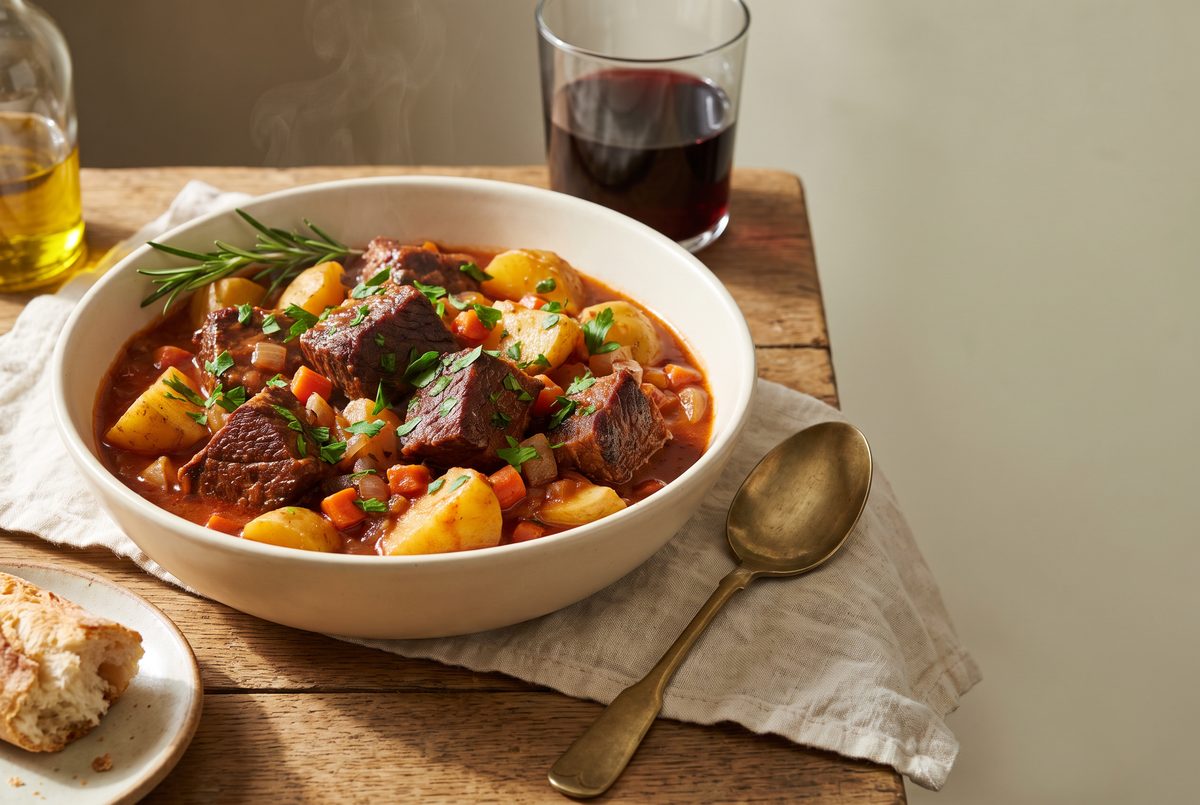
Italian Beef Stew with Potatoes
Spezzatino is the beef stew every Italian region cooks a version of: chuck browned hard, simmered in red wine and…
- 2 hr 50 min
- 537 kcal
- 42 g protein
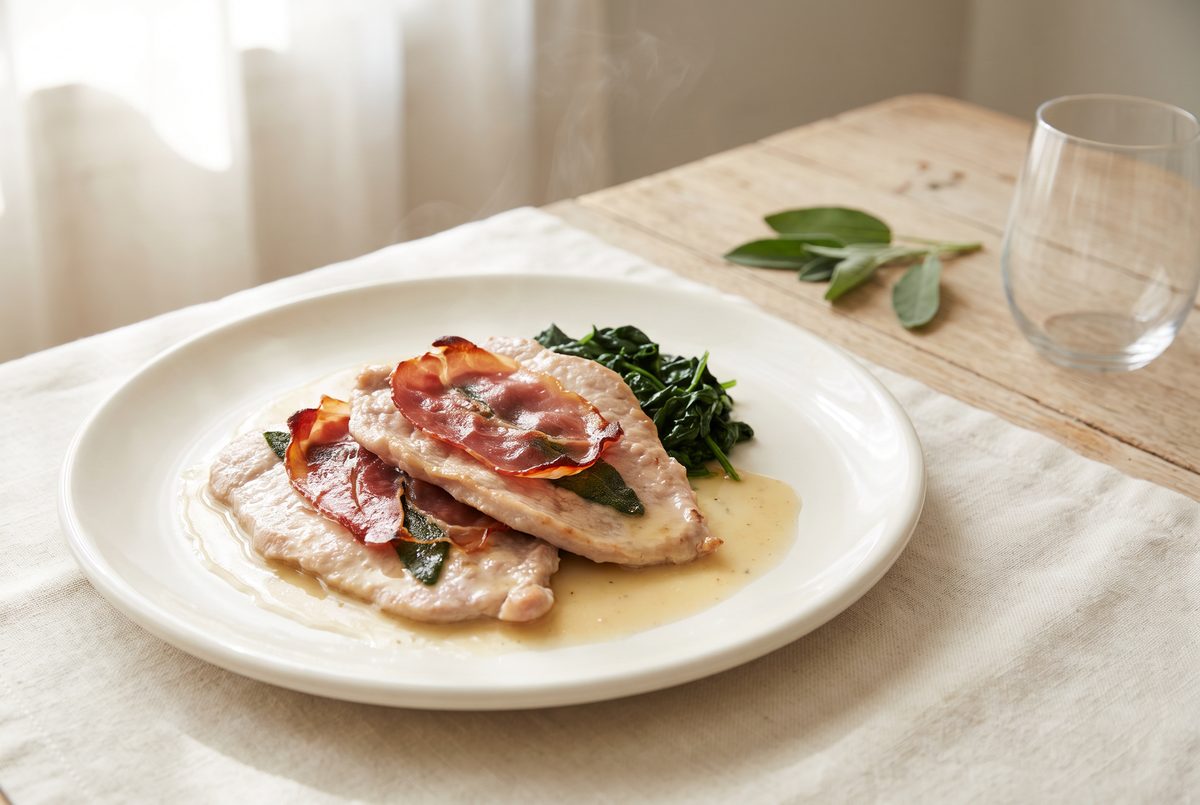
Saltimbocca alla Romana (Veal, Prosciutto, Sage)
Saltimbocca alla romana is veal pounded thin under a slice of prosciutto and a sage leaf, seared four minutes total…
- 30 min
- 463 kcal
- 47 g protein
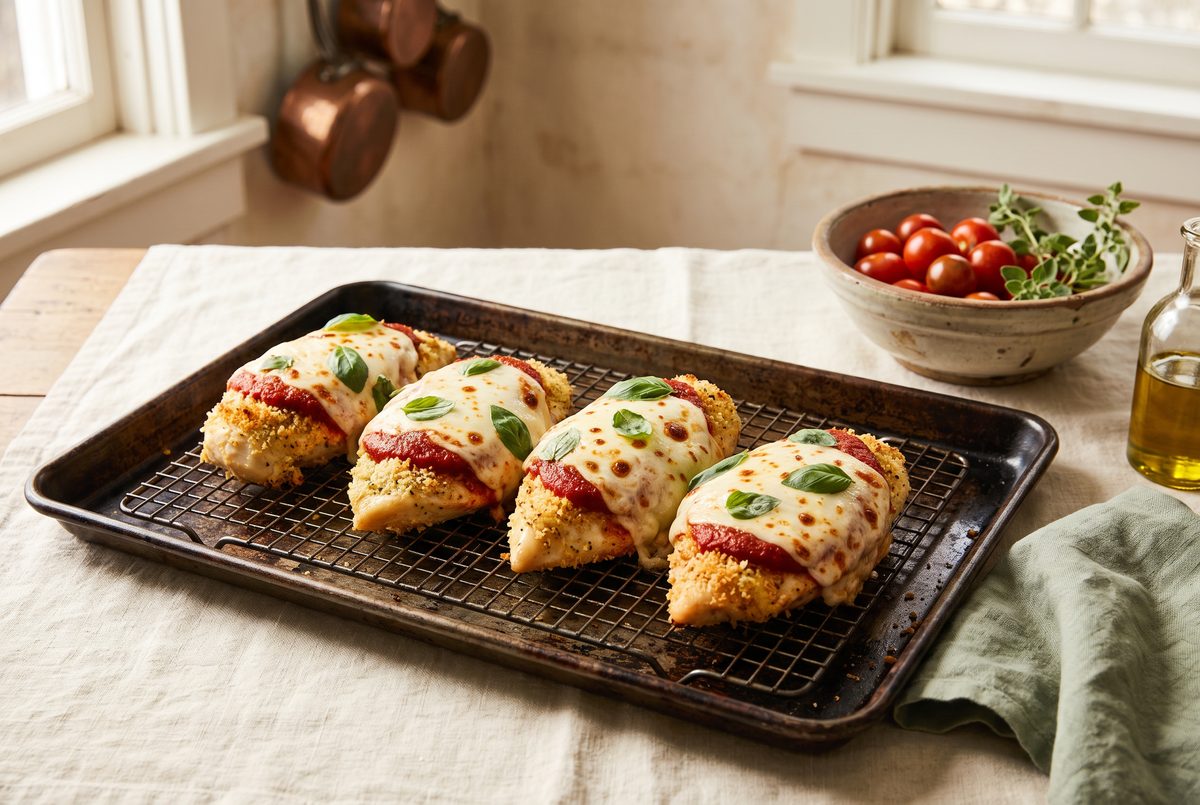
Sheet-Pan Chicken Parmesan, High-Protein
High-protein sheet-pan chicken parmesan bakes breaded chicken breasts on a wire rack so they crisp without frying…
- 40 min
- 478 kcal
- 56 g protein