Shrimp alla Busara in Tomato and Wine
The Adriatic fisherman's one-pan dish, named after the pot it was cooked in: shrimp seared hard and taken out, a sauce of garlic, white wine and tomato built in the same pan, a handful of dry breadcrumbs stirred in to make it cling, and the shrimp back for ninety seconds at the end.
Shrimp alla busara is the Adriatic original behind every garlic-and-wine shrimp dish: 1½ lb of shrimp seared in one pan, a sauce of garlic, dry white wine and tomato built in the same pan, and dry breadcrumbs stirred in at the end to thicken it instead of butter or cream. One plate with a slice of grilled ciabatta is 442 calories with 40 g of protein and 16 g of fat, in 30 minutes, and 34 g of that protein is the shrimp.
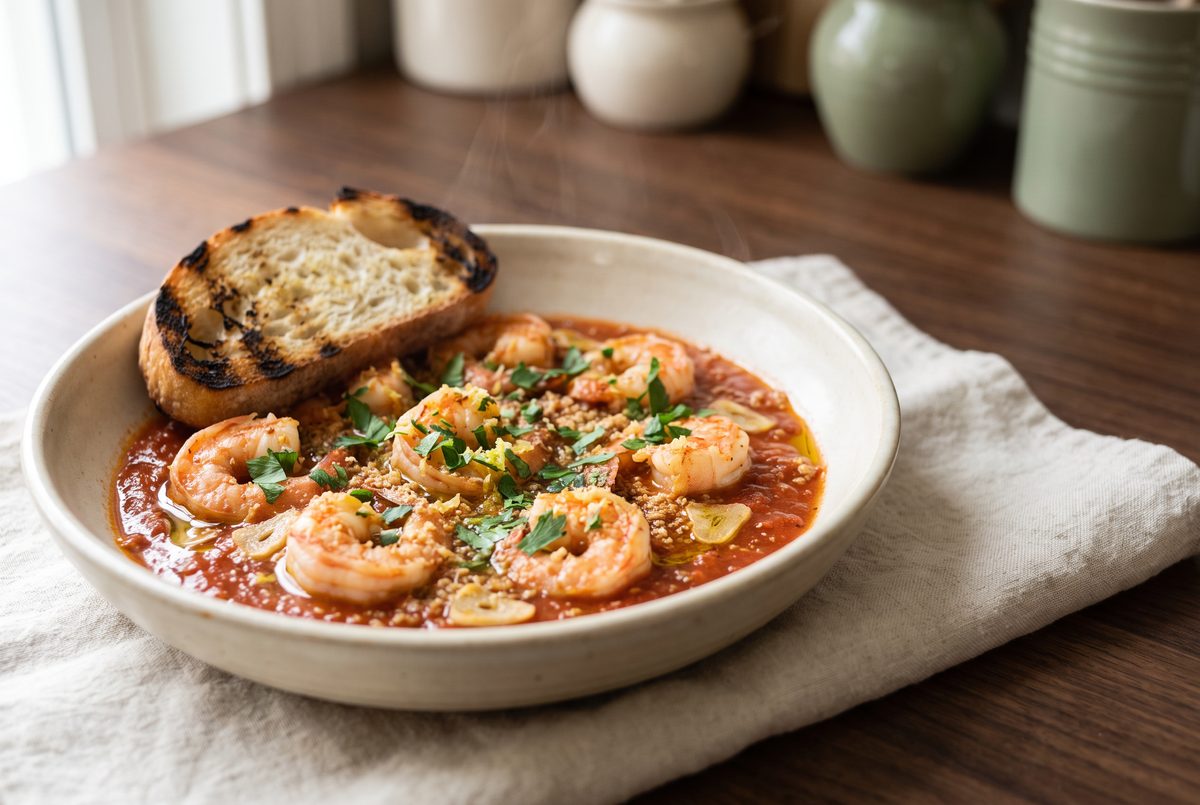
Busara is the pot, not the sauce. Along the Adriatic between Trieste and the Istrian coast a buzara was the deep two-handled pan that lived on a fishing boat, and the dish named after it is simply what went into that pan at the end of a night's work: the part of the catch too small, too broken or too ugly to sell, cooked in the only things a boat carried — oil, garlic, a bottle of white, and dry bread crumbled in to turn the juice into something you could mop up. Every element of the recipe started as a constraint. That is usually why a dish survives.
The original is made with scampi, langoustines, shells on and split down the back so the sauce gets inside. In an American fish case those are either absent or forty dollars a pound, and Italian home cooks reached for gamberi long before we did — shrimp alla busara is an ordinary Friulian weeknight dinner, not a downgrade. What does not substitute is the bread. The crumbs are the whole mechanism of the sauce, and they are the reason this reads as a rich dish while containing no butter at all: 30 g of dry crumbs, stirred in at the end, bind the wine and the liquor the shrimp let go. It is the same trick as the pasta water in a carbonara, done with the other half of the bread basket.
The arithmetic that put it in the muscle-gain file is not something the fishermen were thinking about. Shrimp is the most protein-dense food in this kitchen by a clear margin: 20.1 g of protein for 85 calories per 100 g raw, with half a gram of fat. A pound and a half of it, four ways, with a slice of grilled ciabatta to get the sauce off the plate, is 40 g of protein for 442 calories — and it is on the table in half an hour, in one pan, which is more than can be said for most of the ways to eat that much protein.
Why this recipe works for muscle gain
Nothing in this kitchen carries protein as cheaply as shrimp. Per 100 g raw it is 85 calories, 20.1 g of protein, 0.5 g of fat and 0.1 g of that saturated. Expressed the way it actually matters when you are eating to a calorie number, that is 23.6 g of protein per 100 calories — ahead of skinless chicken breast (18.8), trimmed top sirloin (17.0), canned tuna in water (22.0) and far ahead of salmon (9.8), which earns its place on other grounds. The 6 oz raw portion each person gets here is 34 g of protein on its own; the slice of ciabatta adds about 3 g and the breadcrumbs and sauce the last 3, which is how the plate reaches 40 g while total fat stays at 16 g — and 13 of those 16 grams are the olive oil, added on purpose.
Forty grams is one full feeding, which is the unit that matters. The practical per-meal target for someone training is roughly 0.4 g of protein per kg of body weight spread over three to five feedings (Schoenfeld & Aragon, 2018), with the daily point of diminishing returns near 1.6 g per kg and a plausible ceiling around 2.2 (Morton et al., 2018). One plate covers a feeding for an adult up to about 100 kg. Shrimp protein is complete and the plate needs nothing behind it; the day's arithmetic is in our guide on how much protein you need to build muscle, and the rest of the muscle-gain recipes are portioned to the same logic.
The cholesterol question, answered straight. Shrimp is the one genuinely lean food that is also genuinely high in dietary cholesterol, and that fact kept it off a lot of plates for thirty years. The science moved: the American Heart Association's 2019 advisory concluded that the evidence does not support a specific numeric limit on dietary cholesterol, and recommends judging foods on their whole pattern instead (Carson et al., 2020), while the Dietary Guidelines for Americans 2020–2025 carry no numeric cholesterol cap either. The number that does move LDL is saturated fat, and shrimp has 0.1 g per 100 g — this entire plate has 2.3 g, against a guideline ceiling of under 10% of calories. Shrimp is also in the lowest-mercury group of the FDA and EPA's Advice About Eating Fish, the "Best Choices" list that can be eaten two to three times a week, and it is a strong source of selenium, vitamin B12 and iodine. If you have been told to watch dietary cholesterol specifically by a doctor, that instruction is between you and your doctor; what the general guidance no longer says is that shrimp is off the table.
Two honest numbers: the sodium, and what the bread is doing. Sodium is 751 mg a plate, and the breakdown is the useful part — 291 mg is the ½ teaspoon of salt, 202 mg is the shrimp itself (shellfish is naturally salty, 119 mg per 100 g, which is more than twice beef), and 196 mg is the ciabatta. Nothing in the sauce is seasoned at all, and it still does not need to be. The bread is the other number worth naming: it is 18 of the plate's 30 g of carbohydrate. Thirty grams is a training dinner, not a carb-load — if the point of the evening is to fill glycogen before a long run, the carb-loading guide and the endurance recipes are built for that, and the spaghetti version in the variations below gets this dish there at 662 calories and 75 g of carbohydrate.
Ingredients
One wide pan of shrimp in sauce with grilled bread, 4 plates
The shrimp
The sauce
To finish
Instructions
- Dry the shrimp properly and salt them. Nothing else gets salt. If the shrimp are frozen — almost all shrimp sold in America is, including most of what sits on ice at the counter — put them in a colander under cold running water for 5 minutes, or overnight in the fridge if you planned ahead. Never in warm water. Then pat them dry on both sides with paper towel and keep patting until the towel comes away almost clean: a wet shrimp steams in the pan instead of browning, and a shrimp that has steamed will not taste of the sear afterwards. Toss them with the whole ½ teaspoon of salt and leave them on the board while you slice the garlic and chop the parsley. The sauce gets no salt at all — between the shrimp, the breadcrumbs and the bread there is already 751 mg a plate.
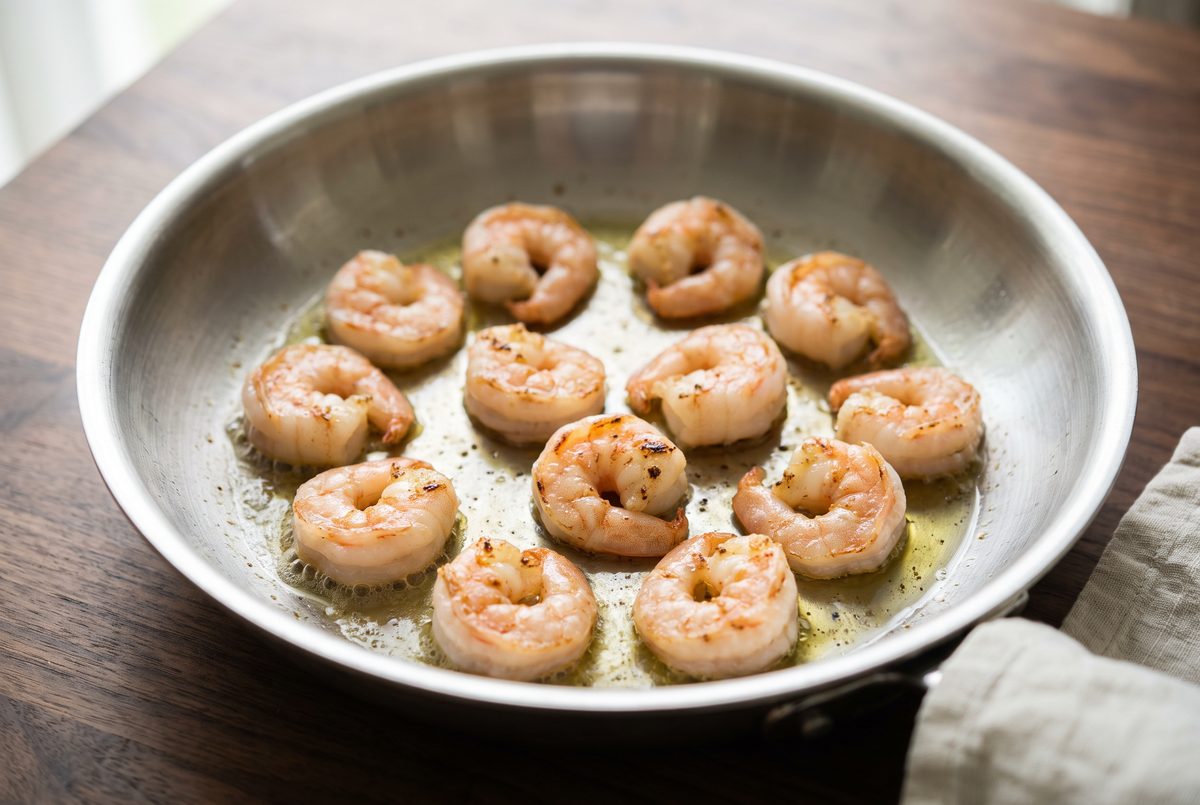
- Sear them 60 to 90 seconds a side, then take them out. Heat the 1 tablespoon of oil in your widest pan — 12 inches, stainless steel or dark enameled — over medium-high until it shimmers and moves like water. Lay the shrimp down in a single layer, in two batches if they do not all fit with space between them: shrimp crowded into a pan release their water, the temperature drops, and they poach. Give them 60 to 90 seconds, turn each one, then 30 to 60 seconds more. They should be pink and lightly browned outside and still faintly translucent at the thickest part — they are going back into the pan later and will finish there. Move them to a plate, every drop of juice included.
- Garlic and chili in the shrimp oil — 60 seconds, blond. Add the 2 tablespoons of oil to the same pan, drop the heat to medium, and add the sliced garlic and chili flakes. Give it about 60 seconds, until the kitchen smells sweet and the slices are just turning pale gold at their edges. Garlic is the clock in this dish: twenty seconds past gold it turns bitter, and there is no rescuing a pan built on burnt garlic — throw it out and start the sauce again, which costs you two minutes and a clove. This is why the garlic is sliced rather than minced; minced garlic is scorched before sliced garlic has released anything.
- Fry the tomato paste 1 minute, then boil the wine down by half. Stir in the tablespoon of tomato paste and let it fry in the oil for a full minute, until it darkens from bright red to brick and stops smelling of the tin. Skipping this is the single biggest difference between a busara with depth and one that tastes like shrimp in pasta sauce. Pour in the ⅔ cup of wine, scrape the bottom of the pan to lift everything the shrimp left behind, and let it boil hard 2 to 3 minutes until it has reduced by about half and no longer smells sharp.
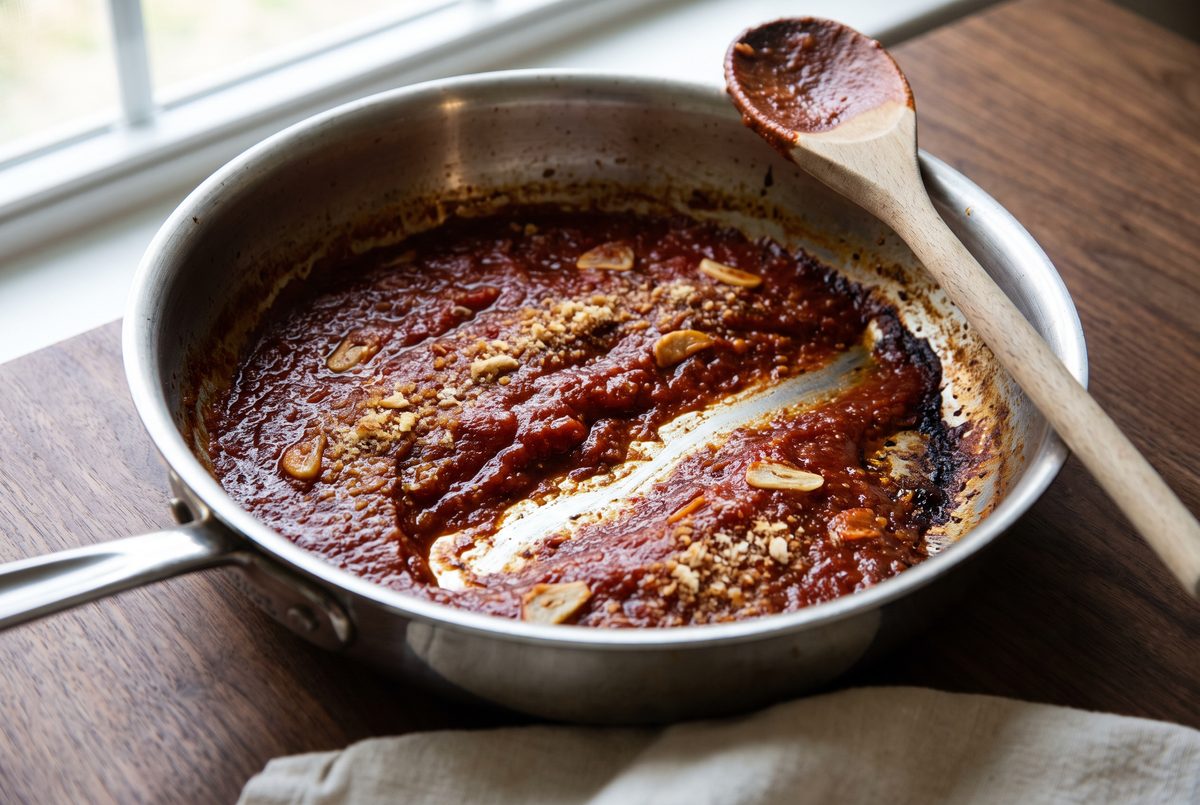
- Passata, 8 minutes, then the breadcrumbs go in. Add the ¾ cup of passata and 2 tablespoons of water, bring it to a steady simmer, and give it 8 minutes — it is ready when a spoon dragged across the bottom leaves a channel that fills in slowly. Now scatter in the 30 g of breadcrumbs and cook 3 to 4 minutes more, stirring. It will look wrong for about a minute: grainy, oddly thick, like you have ruined it. Then the crumbs finish drinking and the sauce comes together glossy and clinging. If it goes past thick into paste, bring it back with a tablespoon of water at a time — it should fall off the spoon in a ribbon, not a lump.
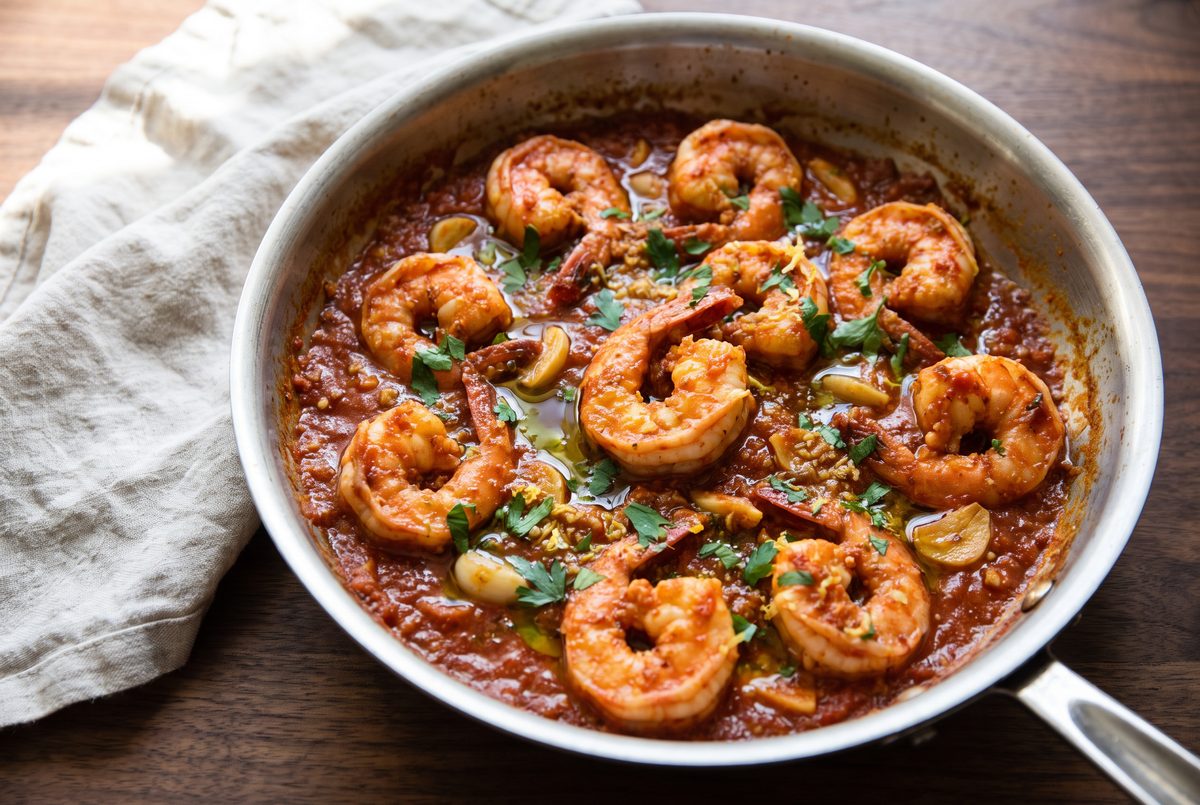
- Shrimp back in for 90 seconds, then off the heat. Return the shrimp and all the juice from the plate, turn them through the sauce to coat, and give them 90 seconds — no more. Take the pan off the heat the moment the thickest part of a shrimp has gone from translucent to opaque white. The shape is the better test: a cooked shrimp is a loose C, an overcooked one has closed into a tight O, and it will be rubber no matter how good the sauce is. Off the heat, stir in the parsley, the lemon zest, the cracked pepper and the last tablespoon of raw oil, which stays green and peppery only if the pan is no longer on the flame.
- Char the bread, and put no cheese on it. Four thick slices of ciabatta, dry, on a ridged grill pan or under the broiler until the edges are properly blackened in places — soft toast dissolves into this sauce and you lose the one thing the bread is for. Rub the hot slices with a cut clove of raw garlic if you like. Then put the pan in the middle of the table with the bread and let people serve themselves; the sauce left behind is the point of the dish and nobody has ever needed telling what to do with it. No Parmigiano. This is not a rule kept for the sake of authenticity: cheese flattens the sweetness of shellfish, which is also why no Italian cook grates it over clams.
Tips from our kitchen
- Buy frozen on purpose, not reluctantly. Shrimp is flash-frozen on the boat within hours of coming out of the water; the "fresh" tray at the fish counter is almost always that same shrimp, thawed by someone else on a day you do not know. Buying it frozen means you choose the hour it thaws. Look for raw, shell-on or peeled, 16/20 or 21/25 count per pound — small shrimp hit the inside of done before the outside browns. Avoid anything already pink and curled: cooked shrimp cannot be seared, and in this sauce they turn to erasers.
- The crumbs have to be the right kind. You want coarse, dry, unseasoned crumbs — stale bread torn and pulsed in a food processor is ideal, plain dried breadcrumbs are fine. Panko is the wrong tool: it is engineered to stay separate and crisp, so it sits in the sauce instead of dissolving into it. Fine seasoned Italian crumbs are mostly dust and dried oregano and will make the sauce taste of a jar. The nutrition table here is calculated on whole-wheat crumbs, which contribute half a gram of the plate's 2.6 g of fiber.
- If you can get shell-on shrimp, the shells are a free upgrade. About 2½ lb of shell-on shrimp yields the 1½ lb peeled this recipe needs. Simmer the shells in the ⅔ cup of wine plus ½ cup of water for 15 minutes, press them with a spoon, strain, and use that liquid in step 4 instead of plain wine. It is the difference between a good busara and the one you remember from a trattoria in Trieste, and because the shells are discarded it does not change a single number in the table.
- Width beats weight in the pan. A 12-inch pan matters more here than a heavy one, because the entire sear depends on 1½ lb of shrimp having room. If your largest pan is 10 inches, do the shrimp in two batches without apology — the extra ninety seconds costs you nothing, and one crowded batch costs you the browning on all of it.
- Without wine: ⅓ cup of low-sodium vegetable or chicken broth plus 1 tablespoon of white wine vinegar, reduced in step 4 the same way. It is a slightly flatter sauce — the wine is doing acid and aromatics at once — but it works, and it is a better answer than leaving the liquid out and letting the tomato go straight in.
Variations
- Over spaghetti, which is how Trieste actually serves it. Cook 12 oz (340 g) of spaghetti two minutes short of the box, drain it, and finish it in the sauce for those two minutes before the shrimp go back in, loosening with pasta water. Skip the bread. That plate is 662 calories, 48 g of protein and 75 g of carbohydrate — a different recipe for a different day: see the carb-loading guide and the endurance recipes.
- The pan on its own, no bread: 347 calories and 36 g of protein. With a plain green salad instead of the ciabatta it becomes the leanest high-protein dinner on the site, with 12 g of carbohydrate. You will want a spoon, and the sauce needs two extra minutes of reduction to be worth eating that way.
- With clams or mussels in it, which is the fisherman's version. Add 1 lb of scrubbed clams or mussels at the start of step 5, cover, and let them open in the sauce for 5 to 7 minutes before the breadcrumbs go in — discard any that stay shut. The liquor they release is the best thing that can happen to this pan, though it also pushes the sodium up. For the same shellfish logic applied to pasta, the spaghetti alle vongole is built on it.
- Scampi alla busara, the original. If you find langoustines, or head-on Mediterranean red shrimp: leave the shells on, split them down the back with scissors so the sauce gets into the body, and sear them 2 minutes a side. They come back into the sauce for 2 minutes rather than 90 seconds. Eat them with your fingers and put a bowl on the table for the shells.
- Over soft polenta instead of bread. Spoon the sauce and shrimp over polenta cooked loose — the method is in the creamy mushroom polenta. If you need the dish gluten-free you also have to drop the breadcrumbs, which means losing the thickener: simmer the passata 13 minutes instead of 8 so it reduces far enough to coat on its own.
Storage & meal prep
The sauce and the shrimp have opposite answers, and the recipe is better if you respect that. The sauce keeps 4 days in the fridge and is genuinely better on day two, once the garlic has settled and the crumbs have finished swelling; it freezes for 3 months. Cooked shrimp do not keep as a hot dish. Reheated, they go from a loose C to a tight O and the texture is gone — there is no container, temperature or trick that prevents it. So if you are cooking for one or two, make the whole sauce and sear only the shrimp you are eating: the rest of the shrimp keep raw in the fridge for a day, or frozen until you want them, and the second dinner is then 4 minutes of work instead of 20. What leftovers are genuinely good for is cold, the next day, at room temperature on grilled bread as an antipasto — the sauce sets to a spreadable consistency and the shrimp, never reheated, are fine. Reheat sauce over low heat with a splash of water; the microwave on full power splits the oil out of it.
Nutrition per serving
| Nutrient | Amount | % DV* |
|---|---|---|
| Calories | 442 kcal | 22% |
| Total fat | 16 g | 21% |
| Saturated fat | 2.3 g | 12% |
| Carbohydrates | 30 g | 11% |
| Fiber | 2.6 g | 9% |
| Sugars | 3.7 g | — |
| Protein | 40 g | 80% |
| Sodium | 751 mg | 33% |
*Percent Daily Values are based on a 2,000-calorie diet. Values are calculated from USDA FoodData Central and manufacturer data for the ingredients as listed; they are estimates, not lab analyses. Nutrition disclaimer.
Frequently asked questions
Is shrimp alla busara the same as shrimp scampi?
No, and the names are a good illustration of how a dish changes crossing an ocean. American shrimp scampi is butter, garlic, white wine, lemon and parsley, usually over linguine and with no tomato in it at all — an Italian-American invention, and the name is a misunderstanding: in Italy scampi are langoustines, a different animal entirely, so "shrimp scampi" reads in Italian roughly as "shrimp langoustines". Busara is the Adriatic original it descends from: tomato, no butter, and breadcrumbs instead of cream to thicken. The difference shows up in the numbers, because restaurant scampi starts with 4 to 6 tablespoons of butter for four people, which is 400 to 600 calories of butter before a shrimp enters the pan. This plate is 442 calories in total.
Can I make this with prawns, and what size should they be?
On the plate they are the same animal: prawns is the everyday word in Britain, Ireland, Australia and India for what an American fish counter labels shrimp, and Italian menus translated into English almost always render gamberi as prawns — so prawns alla busara and shrimp alla busara are one dish, and nothing in this recipe changes. Zoologically the two words do split real groups — carideans on one side, penaeids on the other — but it is no help at the counter, because the farmed species behind most American shrimp, whiteleg shrimp (Penaeus vannamei), is a penaeid, which puts it on the prawn side of a line no kitchen observes. What actually matters is the count per pound: 16/20 or 21/25 is the range this method is built for, because each one has to survive 60 to 90 seconds a side and then 90 seconds back in the sauce, and anything at 31/40 or smaller is cooked through before it has browned. If what you can buy is a big tiger prawn at 8/12 count, treat it like the langoustine version in the variations — 2 minutes a side, 2 minutes back in the sauce. The nutrition table is calculated on weight rather than count, so 1½ lb (680 g) of peeled raw shrimp is 40 g of protein a plate whichever word is on the label.
How much protein is in shrimp?
20.1 g per 100 g raw, for 85 calories and half a gram of fat — the best protein-to-calorie ratio of any food used on this site, at 23.6 g of protein per 100 calories against 18.8 for skinless chicken breast and 17.0 for trimmed top sirloin. The 6 oz raw portion in this recipe (170 g) carries 34 g of protein on its own, and the finished plate with bread and sauce reaches 40 g. Shrimp loses roughly a fifth of its weight in water as it cooks, so 6 oz raw is about 4¾ oz on the plate; the protein does not go anywhere.
Is shrimp healthy, or is it too high in cholesterol?
Shrimp is high in dietary cholesterol and very low in saturated fat — 0.1 g per 100 g — and current guidance treats the second number as the one that matters for blood lipids. The American Heart Association's 2019 science advisory concluded the evidence does not support a specific numeric limit on dietary cholesterol (Carson et al., 2020), and the Dietary Guidelines for Americans 2020–2025 set no cap either. Shrimp is also on the FDA and EPA's "Best Choices" list, the lowest-mercury group, safe to eat two to three times a week including in pregnancy, and it is a strong source of selenium, iodine and vitamin B12. If a doctor has told you specifically to limit dietary cholesterol, follow that; the general advice no longer singles shrimp out.
Can I use frozen shrimp for shrimp alla busara?
Yes — and you probably should. Shrimp is frozen on the boat within hours of being caught, and the "fresh" shrimp at the counter is usually the same product thawed a day or two earlier. Thaw it yourself in a colander under cold running water for about 5 minutes, or overnight in the fridge, never in warm water or in the microwave. The only part that is not optional is drying it: frozen shrimp carries a lot of surface water, and water has to boil off before anything can brown, so a shrimp that goes into the pan damp will steam rather than sear.
Why are there breadcrumbs in the sauce?
Because that is what the dish is. On a fishing boat the thickener available was the bread already on board, and crumbling it into the pan does what a roux or a splash of cream would do elsewhere: the starch absorbs the wine and the liquid the shrimp release and binds the oil into the tomato so the sauce coats instead of pooling. A scant ¼ cup (30 g) for four people is the right amount — enough to thicken, not enough to taste of bread. Add them in the last 3 to 4 minutes; stirred in too early they turn pasty, and added at the very end they stay gritty.
Can I make shrimp alla busara ahead of time?
The sauce yes, the shrimp no. Make the sauce through the breadcrumb stage up to 2 days ahead — it improves — and keep the shrimp raw in the fridge; on the night, reheat the sauce with a splash of water while you sear the shrimp, and dinner is 6 minutes from cold. Cooking the shrimp in advance and reheating them is the one thing that cannot be salvaged: they tighten into rubber. If you want a high-protein dinner that genuinely does cook ahead and keeps four days, the Italian meatballs in tomato sauce are built for it.
Sources
- USDA FoodData Central — crustaceans, shrimp, raw; bread, Italian (ciabatta); bread crumbs, dry, grated, whole wheat; tomato purée; tomato paste, canned; wine, table, white, dry; garlic, raw; parsley, fresh; lemon peel, raw; olive oil; butter; and chicken breast, beef top sirloin, canned light tuna in water and Atlantic salmon, raw (for the protein-density comparisons)
- FDA and EPA — Advice About Eating Fish (2021): shrimp listed in the "Best Choices" category, the lowest-mercury group, 2 to 3 servings per week
- Carson, J.A.S. et al. (2020). Dietary Cholesterol and Cardiovascular Risk: A Science Advisory From the American Heart Association. Circulation 141(3)
- Dietary Guidelines for Americans 2020–2025 — at least 8 oz of seafood per week for adults; saturated fat under 10% of calories; sodium under 2,300 mg per day
- Schoenfeld, B.J. & Aragon, A.A. (2018). How much protein can the body use in a single meal for muscle-building? Implications for daily protein distribution. Journal of the International Society of Sports Nutrition
- Morton, R.W. et al. (2018). A systematic review, meta-analysis and meta-regression of the effect of protein supplementation on resistance training-induced gains in muscle mass and strength in healthy adults. British Journal of Sports Medicine
You might also like
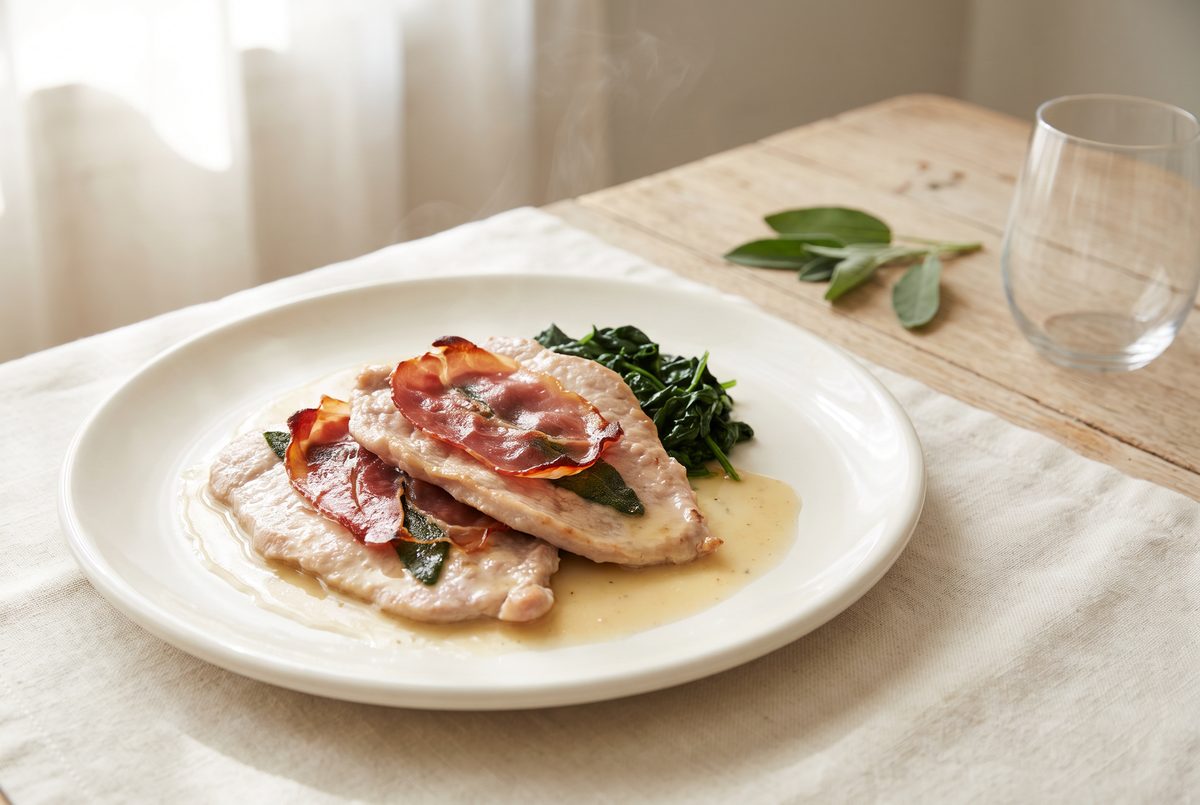
Saltimbocca alla Romana
Saltimbocca alla romana is veal pounded thin under a slice of prosciutto and a sage leaf, seared four minutes total…
- 30 min
- 463 kcal
- 47 g protein
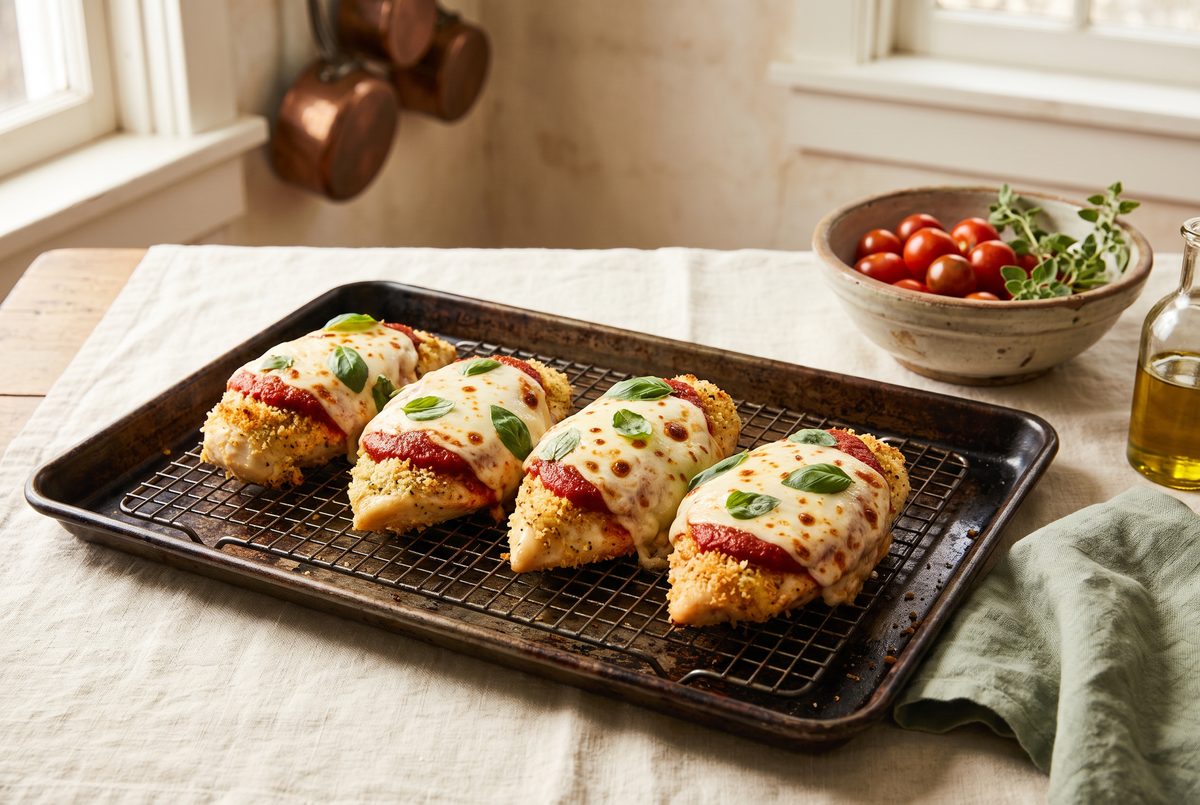
Sheet-Pan Chicken Parmesan, High-Protein
High-protein sheet-pan chicken parmesan bakes breaded chicken breasts on a wire rack so they crisp without frying…
- 40 min
- 478 kcal
- 56 g protein
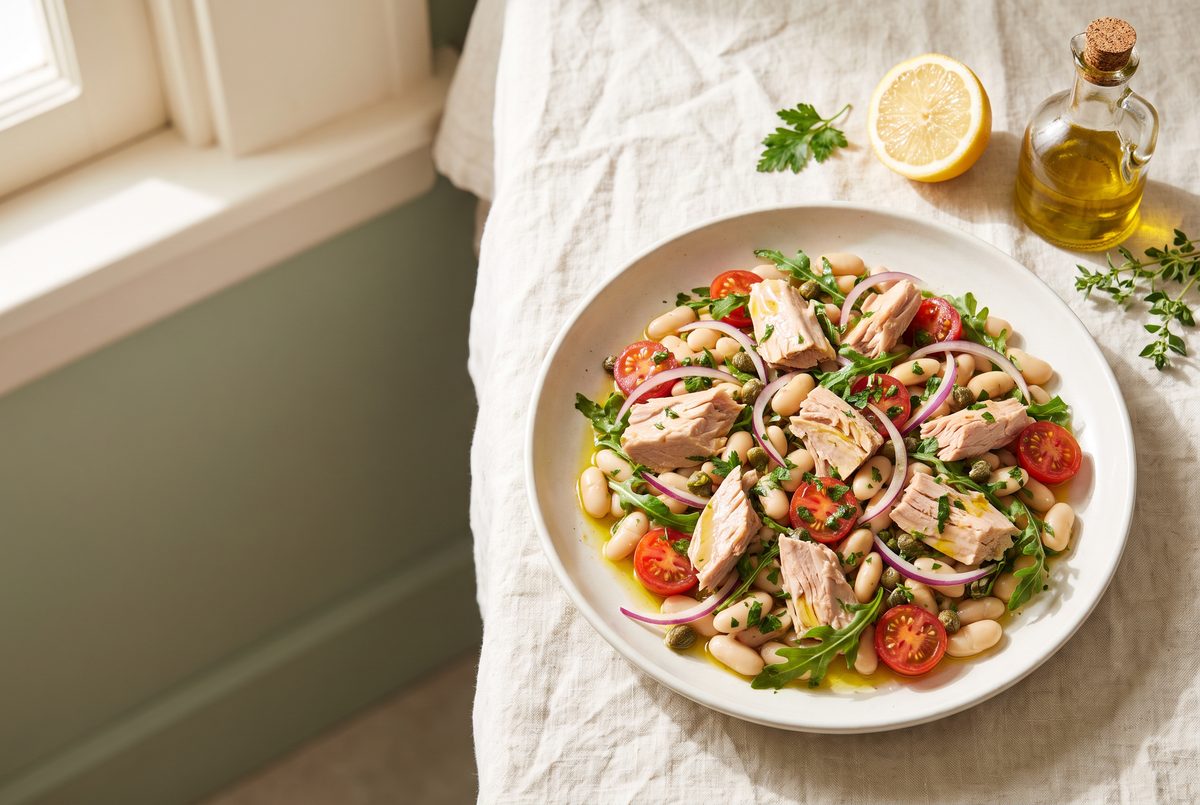
Tuscan Tuna and White Bean Salad
Tuscan tuna and white bean salad (fagioli e tonno) combines canned tuna, cannellini beans, red onion, cherry tomatoes…
- 10 min
- 426 kcal
- 40 g protein